

BBC Master ET
 | |
 | |
| A Master ET showing its Econet start-up messages (photo: Chris Whytehead, CC BY-SA 3.0) | |
| Specifications | |
|---|---|
| Manufacturer | Acorn Computers Ltd |
| Type | Econet network terminal |
| Intro price | £399 including VAT[1] |
| CPU | 65C12 at 2 MHz |
| Memory | 128 KB |
| Storage | None: files on the Econet file server |
| Display | RGB and composite video |
| Sound | — |
| ROM | 64 KB (MOS 4.00, BASIC and the network filing system) |
| Connectivity | Econet module fitted as standard |
| OS / Firmware | MOS 4.00 |
| Predecessor | BBC Master 128 |
| Model no. | ADB12 |
The BBC Master ET (Econet Terminal) is a BBC Master 128 built for use on an Econet network. It uses the same main board, 0243,000, with the Econet module fitted as standard and the parts for most of the other interfaces left off, so that the only connectors are Econet, RGB and composite video.[1][2] Its ROM holds MOS 4.00, BASIC and the network filing system, without the Master 128's View, ViewSheet, Edit, Terminal or disc filing systems; Acorn sold it at £399 including VAT, £100 less than the Master 128.[1][3]
Because the board, supply, keyboard and case are the Master 128's, the Master 128 guides apply: BBC Master 128 Maintenance Guide, BBC Master 128 Troubleshooting Guide and BBC Master 128 Capacitor Replacement Guide. Acorn's final assembly drawing is titled "Master Series 128 & E.T. final assembly".[4]
Differences from the Master 128
[edit | edit source]
| Feature | Master ET | Master 128 |
|---|---|---|
| Rear connectors | Econet, RGB, composite video | Econet, audio, cassette, RS423, analogue, RGB, composite, UHF |
| Underside connectors | None | Tube, 1 MHz bus, user port, printer, disc |
| ROM | 64 KB: MOS 4.00, BASIC, network filing system | 128 KB: MOS 3.20, BASIC, View, ViewSheet, Edit, Terminal, ADFS, DFS |
| Disc controller | Not fitted | WD1770 (or 1772) |
| Econet | Module fitted | Optional module |
| Price | £399 | £499 |
Sources: Chris's Acorns and the service manual.[1][5][2]
Chris Whytehead's ET has a single ROM in the sideways ROM sockets, and Wikipedia notes that the missing interface parts could be added later by someone able to solder them.[1][3] The parts list and circuit diagram for the Master 128 board show what goes in each empty position.[6]
Faults particular to the ET
[edit | edit source]| Symptom | Cause | Action |
|---|---|---|
| "No clock" at the top of the screen | No Econet clock: the network is not connected or its clock is off | Connect the 180° five-pin DIN lead from the network to the Econet socket and reset; if it persists, the network's clock needs attention[7] |
| Buzz from the speaker that changes with screen mode and with the program running | Crosstalk from the data and address lines into the 1 MHz bus audio line | Sprow's fix: a 10 kΩ resistor from the audio line to ground, soldered into the empty 1 MHz bus connector position. Acorn's pinout puts the audio line on pin 16 of that connector (PL5)[7][6] |
| "This is not a language" and a * prompt | Start-up language not configured | *CONFIGURE LANG 13 and *INSERT 13, then reset; if it recurs at the next switch-on, replace the battery pack[7]
|
| Disc commands do nothing | The ET has no disc hardware or software | None needed; files are on the network[7] |
For Econet faults, Acorn's service manual says only a few things can be checked without Econet test equipment: both connectors of the module correctly inserted (the longer one has two spare pins to its left, and a displaced module will not work), the module properly fitted, and NMI at the CPU (IC14 pin 6, TP3) not held low.[8] The station number is held in byte 0 of the CMOS RAM and has to be set again after the configuration is lost.[9][10][11]
Battery
[edit | edit source]The ET has the Master 128's CMOS battery and the same leakage risk. Wikipedia records that Acorn issued a safety warning in 1986 for the Master 128 and ET because the circuit charged the battery against the battery maker's recommendations, and replaced the arrangement with alkaline cells.[3] Acorn's later battery units and the procedure for changing them are in the Master 128 maintenance guide.
Gallery
[edit | edit source]-
 Underside: no connector openings
-
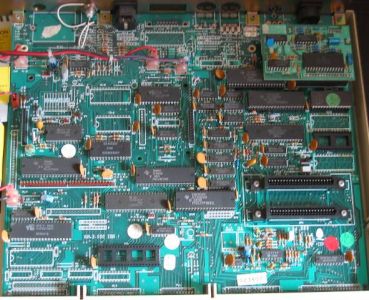 Main board with the Econet module

Photographs: Chris Whytehead, Chris's Acorns (CC BY-SA 3.0).
Related pages
[edit | edit source]- BBC Master 128
- BBC Master 128 Maintenance Guide
- BBC Master 128 Troubleshooting Guide
- BBC Master Series Documentation
References
[edit | edit source]- ↑ 1.0 1.1 1.2 1.3 1.4 Whytehead, Chris. "Master ET", Chris's Acorns (retrieved 2026-10-02). An Econet terminal with only Econet, RGB and composite video connectors at the back and none underneath; no applications in ROM; £399 including VAT; photographs of the case, underside and board; his machine: serial 01-ADB12-0102936, main board 0243,000 issue 1, GTE G65SC12P-2 at 2 MHz, 128 KB RAM, 64 KB ROM, no disc controller or disc filing system, MOS 4.00, Econet module 0243,020 issue 2.
- ↑ 2.0 2.1 Acorn Computers, British Broadcasting Corporation Master Series Microcomputer Service Manual, part no. 0443,004, issue 1, April 1986, 5.1 "Introduction", p. 13: the Econet daughter board "may as such be fitted as an optional extra (standard on the ET machine)".
- ↑ 3.0 3.1 3.2 "BBC Master", Wikipedia (retrieved 2026-10-02). Section "Master ET": same main board as the Master 128 with the components for the missing interfaces not fitted; Econet interface and ANFS fitted as standard; less software in ROM; introduced at £399. Section "Battery charging hazard": Acorn's 1986 safety warning for the Master 128 and ET.
- ↑ Acorn Computers, Master Series 128 & E.T. Final Assembly, in File:Acorn BBC Master Series Technical Drawings.pdf, PDF page 4, described on BBC Master Series Documentation.
- ↑ Whytehead, Chris. "BBC Master 128", Chris's Acorns (retrieved 2026-10-02). Rear and underside connectors of the Master 128; price £499.
- ↑ 6.0 6.1 Acorn Computers, Master Series Microcomputer Service Manual, 0443,004, parts list, pp. 57–61, and connector pinouts in the appendix (PL5, 1 MHz bus: pin 16 audio in/out, set by LK1).
- ↑ 7.0 7.1 7.2 7.3 Sprow, "The most common beeb power on problems", Sprow's webpages, updated 9 November 2010 (retrieved 2026-10-02). Community source: "No clock" on the Master ET and Econet-equipped machines; the buzz from the speaker on early BBC Bs and the Master ET, caused by crosstalk from the data and address lines into the audio line along the 1 MHz bus connector, cured by a 10 kΩ resistor to ground, fitted on the ET where the 1 MHz bus connector would be; *CONFIGURE LANG 13 for BASIC on the ET; the ET has no disc hardware or software.
- ↑ Acorn Computers, Master Series Microcomputer Service Manual, 0443,004, 7.17 "Econet", p. 49.
- ↑ Acorn Computers, Master Series Reference Manual Part 1, part no. 0443,001, issue 1, March 1986, p. F.3-3, CMOS RAM allocation (byte 0, Econet station number; bytes 1–4, file and printer server; bytes 17–19, ANFS). Remastered edition at the Internet Archive, master-reference-manual-part-1 (retrieved 2026-10-02).
- ↑ Acorn Computers, Master Series Hardware Specification, hosted as File:Acorn BBC Master Series Hardware Specification.pdf, Fitting an ECONET module, PDF pp. 46–49: the station number must be set before a machine joins a network; SK5 and SK6; the ANFS ROM.
- ↑ RetroClinic, "BBC Master 128 – Replacement CMOS battery packs" (retrieved 2026-10-02). Vendor source: replacement packs come with instructions for resetting the CMOS memory and the Econet station number.