

DECpc 433
 | |
| DECpc 433 Workstation with the SCSI expansion box on top (bitsavers.org) | |
| Specifications | |
|---|---|
| Manufacturer | Digital Equipment Corporation; co-designed and manufactured by Intel |
| Type | Desktop personal computer (graphics workstation) |
| Intro price | US$5,999 (diskless configuration, 1991)[1] |
| CPU | Intel 486 at 33 MHz[2] |
| Memory | 8 MB standard; 4 to 48 MB in 80 ns 9-bit SIMMs[3] |
| Storage | Two 3.5-inch bays (1.44 MB diskette or IDE disk) and a 2.5-inch IDE bay; SCSI connector for the expansion box[4] |
| Display | Intelligent graphics controller (TMS34020), 1280 × 1024 on DEC fixed-frequency monitors[1][5] |
| Sound | — |
| Power | 105 W power supply[4] |
| Dimensions | 2.75 × 14.5 × 16.5 in[1] |
| OS / Firmware | MS-DOS, OS/2 (DEC supplemental kits)[6] |
| Model no. | PCW10 (Ethernet or Token Ring system board) |
The DECpc 433 Workstation is an Intel 486 personal computer sold by Digital Equipment Corporation in 1991 as a PC-compatible graphics workstation. PC Magazine reported that Intel co-designed and manufactured it, and its graphics card, built by Appian Technologies around the Texas Instruments TMS34020 graphics processor, drives DEC's fixed-frequency workstation monitors at 1280 × 1024.[1] DEC's service guide for it is dated June 1991.[7]
History
[edit | edit source]PC Magazine reviewed the DECpc 433 in its issue of 15 October 1991, listing it at US$5,999 as a diskless network node, with DEC's 20-inch 1280 × 1024 monitor at US$1,995 and the expansion box at US$450.[1] DEC offered it with Pathworks networking; the system board came in Ethernet and Token Ring versions.[1][2] The rear label of a surviving unit reads Model PCW10-A2, Made in U.S.A.[8]
Hardware
[edit | edit source]The system board carries the 33 MHz Intel 486, the 82340DX ISA chip set, three banks of four SIMM sockets, a socket for an optional 64 KB or 128 KB external cache module, two 9-pin serial ports, a parallel port, an SCSI connector, floppy and IDE interfaces, the LAN interface and its connectors, keyboard and mouse connectors and four status LEDs.[2][4] The base system shipped with 8 MB in eight 1 MB × 9 SIMMs; 1 MB × 9 and 4 MB × 9 modules can be mixed between banks but not within one, and must be 80 ns or faster.[4] DEC's technical reference lists 114 bytes of battery-backed RAM and a six-layer, 10.5 × 12 inch board.[3]
The intelligent graphics controller occupies the one 16-bit ISA slot. It has four SIMM sockets of its own for 1 MB or 4 MB SIMMs of application memory.[4][2] PC Magazine gives it 2 MB of video RAM and either 4 MB or 16 MB of application memory.[1]
The 105 W power supply feeds the board and the 3.5-inch drives; the 2.5-inch IDE disk takes its power from the board.[4] The optional SCSI expansion box holds up to three SCSI devices on its own 63 W supply.[4]
| Output | Continuous current | Peak for 15 s | Maximum power |
|---|---|---|---|
| +5 V ±5% | 3.5 to 18.0 A | – | 90 W |
| +12 V ±5% | 0 to 1.0 A | 2.0 A | 12 W |
| −12 V ±10% | 0 to 0.2 A | – | 2.4 W |
| −5 V ±10% | 0 to 0.2 A | – | 1 W |
The supply senses the mains and runs from 90–132 V or 180–264 V, 47–63 Hz.[9][10]
Known faults
[edit | edit source]- Clock battery leakage. The clock battery is a 4.5 V alkaline pack (DEC part 29-28951-01) held on a Velcro pad against the inside of the front panel and plugged into header J8.[11][12] On a surviving machine photographed for bitsavers the pack is a Duracell MN1500CCB "Alkaline Computer Clock Battery", and the chassis metal above it is rusted.[8] See DECpc 433 General Maintenance.
- No picture. DEC's fault tables put a wrong setting of the video select switch first among the causes of a blank or garbled screen.[13] On the rear panel it is a rotary switch numbered 1 to 14 beside the video connector.[8]
See DECpc 433 Troubleshooting Guide for POST messages and beep codes.
Documentation
[edit | edit source]- DECpc 433 Workstation Service Guide, ER-PCW10-SV-001, June 1991: File:DECpc 433 Workstation Service Guide (ER-PCW10-SV-001).pdf
- DECpc 433 Workstation Technical Reference Manual, ER-PCW1A-TR, December 1991: File:DECpc 433 Workstation Technical Reference Manual (ER-PCW1A-TR).pdf
Details are on DECpc 433 Documentation.
Gallery
[edit | edit source]-
 Inside a DECpc 433, with the clock battery against the front panel at upper left (bitsavers.org)
-
 The alkaline clock battery and rusted chassis above it (bitsavers.org)
-
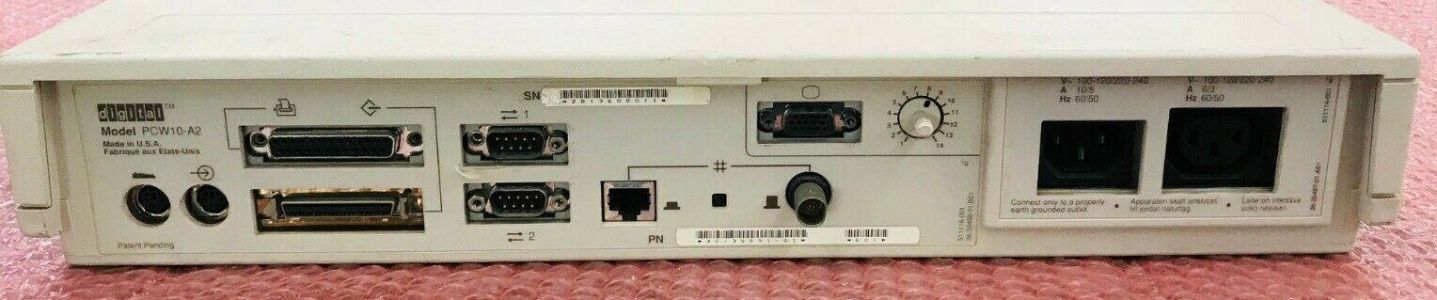 Rear panel with the video select switch beside the video connector (bitsavers.org)


Related pages
[edit | edit source]- DECpc 433 General Maintenance
- DECpc 433 Troubleshooting Guide
- DECpc 433 Capacitor Replacement Guide
- DECpc 433 Documentation
- DECpc 325
- DECpc LP
References
[edit | edit source]- ↑ 1.0 1.1 1.2 1.3 1.4 1.5 1.6 Nate Zelnick, "DECpc 433: Fast Video Blurs the Distinction Between PC and Workstation", PC Magazine, 15 October 1991, pp. 48–49, scan at bitsavers.org (ann_1_199110.jpg and ann_2_199110.jpg). Price, Intel and Appian roles, graphics memory, monitor prices, case size.
- ↑ 2.0 2.1 2.2 2.3 Digital Equipment Corporation, DECpc 433 Workstation Technical Reference Manual, ER-PCW1A-TR, December 1991, pp. 1-3 to 1-4 (File:DECpc 433 Workstation Technical Reference Manual (ER-PCW1A-TR).pdf). System board features, Ethernet and Token Ring boards, 33 MHz i486.
- ↑ 3.0 3.1 DEC, ER-PCW1A-TR, p. A-2, Table A-1. Memory sizes and speed, battery, non-volatile RAM, board size and layers.
- ↑ 4.0 4.1 4.2 4.3 4.4 4.5 4.6 DEC, ER-PCW10-SV-001, pp. 1-3 to 1-5. System box FRUs, SIMMs, external cache, power supply, drives, graphics controller, battery, SCSI expansion box.
- ↑ DEC, ER-PCW1A-TR, chapter 10. Intelligent graphics controller and the TMS34020 graphics system processor.
- ↑ DEC, ER-PCW10-SV-001, pp. 2-1 to 2-2, Table 2-1. MS-DOS and MS OS/2 supplemental kits.
- ↑ Digital Equipment Corporation, DECpc 433 Workstation Service Guide, ER-PCW10-SV-001, June 1991 (File:DECpc 433 Workstation Service Guide (ER-PCW10-SV-001).pdf).
- ↑ 8.0 8.1 8.2 Photographs of DECpc 433 Workstation serial number 2B21100274 and of the rear label PCW10-A2, bitsavers.org/pdf/dec/decpc/DECpc_433/.
- ↑ 9.0 9.1 DEC, ER-PCW1A-TR, p. 11-1, Table 11-1. 105 W power supply specification and automatic input range.
- ↑ DEC, ER-PCW10-SV-001, p. A-1, Table A-1. Input voltage ranges and current.
- ↑ DEC, ER-PCW10-SV-001, pp. 3-1 to 3-2, Table 3-1. FRU part numbers including the 4.5 V battery 29-28951-01.
- ↑ DEC, ER-PCW10-SV-001, pp. 3-23 to 3-24. Removing and replacing the system battery.
- ↑ DEC, ER-PCW10-SV-001, pp. 2-16 and 2-19, Tables 2-6 and 2-8.