

Panasonic FZ-10 R.E.A.L. 3DO
 | |
| Panasonic FZ-10 R.E.A.L. 3DO Interactive Multiplayer | |
| Specifications | |
|---|---|
| Manufacturer | Matsushita Electric Industrial (Panasonic) |
| Type | Game console |
| Released | 11 November 1994[1] |
| CPU | 32-bit RISC ARM60, 12.5 MHz[2] |
| Memory | 3 MB (2 MB main RAM, 1 MB VRAM); 1 MB ROM |
| Storage | 32 KB battery-backed SRAM |
| Display | 768 × 576 (PAL model); up to 16.7 million colours |
| Sound | 16-bit stereo PCM, 44.1 kHz sampling |
| Media | Double-speed CD-ROM drive, top loading, 32 KB read buffer |
| Ports / interface | Control port (9-pin D-sub), 30-pin expansion port, 68-pin AV expansion port, S-Video, composite and RF video, stereo audio |
| Power | 230–240 V AC 50 Hz, 30 W (U.K.); 120 V AC, 30 W (U.S.) |
| Dimensions | 310 × 236 × 68 mm |
| Weight | 1.7 kg |
| OS / Firmware | — |
| Predecessor | Panasonic FZ-1 |
| Model no. | FZ-10 |
The Panasonic FZ-10 R.E.A.L. 3DO Interactive Multiplayer is Matsushita's second 3DO console, released on 11 November 1994 to replace the FZ-1. It is slimmer and lighter, loads discs from the top and has a memory manager built in, so saved games can be managed without a separate disc.[1] Panasonic's service manual describes it as having the same functions as the FZ-1, with a top-loading drive and the CD-ROM drive circuit moved onto the main board.[2]
Specifications
[edit | edit source]| Item | Panasonic's figure |
|---|---|
| CPU | 32-bit RISC processor ARM60, 12.5 MHz |
| Memory | 3 MB in total: 2 MB main RAM, 1 MB VRAM |
| SRAM | 32 KB, battery backed |
| ROM | 1 MB |
| Video outputs | Composite (PAL), S-Video, RF on channel 21 |
| Resolution | 768 × 576 (384 × 288 internally) |
| Colours | Up to 16.7 million |
| Audio | 16-bit stereo PCM, 44.1 kHz |
| CD-ROM drive | Double speed, 32 KB read buffer; 12 cm and 8 cm discs |
| Ports | Control port (9-pin D-sub, daisy chain), 30-pin expansion port, 68-pin AV expansion port for the Video CD adaptor |
| Size and weight | 310 × 236 × 68 mm, 1.7 kg |
| Power | 230–240 V AC, 50 Hz, 30 W |
[2] North American 3DO consoles are rated 120 V, 60 Hz, 30 W, and the FZ-10 takes a detachable figure-8 (IEC 60320 C7) mains lead.[1]
Hardware
[edit | edit source]Main boards
[edit | edit source]The FZ-10 was built with two main board designs. On the later one, the separate MADAM and CLIO chips of the FZ-1 and the colour encoder are combined in one chip, ANVIL (IC120), which Panasonic's U.K. service manual describes as handling CPU control, memory management, the cel engine, the DSP and video output.[2][3] ConsoleMods dates the change to 1995 and notes that the earlier, "pre-Anvil" boards are easier to fit with an RGB modification.[3] Console5 lists two FZ-10 main boards, DFUP0678ZA M4 and DFUP0714ZA M2; Panasonic's parts list in the U.K. manual has the same electrolytic positions as the DFUP0714ZA list.[4][2]
Drive
[edit | edit source]The drive is a top-loading traverse unit wired to the main board, which carries the servo and signal electronics. Its laser is the Sanyo SF-92.5, the same as the FZ-1's, in a short-wire version.[2][4][5] Panasonic's service note is to tape down switch SW720 in order to play a disc with the lid open.[2]
Power supply
[edit | edit source]Unlike the FZ-1, the FZ-10 has a separate switch-mode power board with its own fuse (2 A, 250 V). It supplies +9 V and +5 V to the main board through the 18-way connector CN101. On the 120 V and 230–240 V boards the power switch works through the primary-side control circuit, not in the mains feed, so the primary circuit is live whenever the mains lead is plugged in; the community drawing of the Japanese board shows the switch in the mains feed instead.[6][2][7] The board differs by region: ETXMM002A2B for 120 V, ETXMM002J2B for Japan and ETXMM002E2B for 230–240 V. The 120 V and Japanese boards use a 150 µF, 200 V primary reservoir; the 230–240 V board uses 47 µF, 400 V.[7][6][8][2] A replacement supply built around a PicoPSU is sold for the FZ-10 by Will's Console Modifications.[9]
Controls and connections
[edit | edit source]The FZ-10 has a top-loading lid, a single controller port on the front and, at the rear, the S-Video, composite video and audio outputs, the expansion port and a mains inlet. The AV expansion slot is on the right side under a cover.[2] The controller supplied with the FZ-10 is smaller than the FZ-1's and has no headphone socket.[1]
-
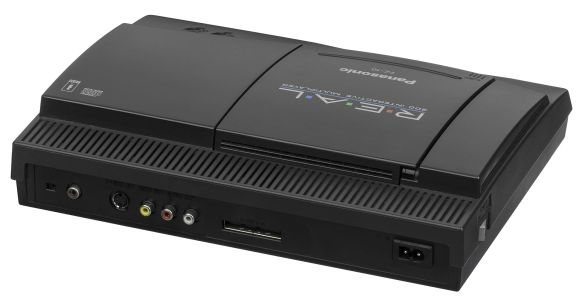 Rear of an FZ-10
-
 Community drawing of the 120 V power board ETXMM002A2B


Known faults
[edit | edit source]The 3DO Development Repo's list of common failures gives none specific to the FZ-10.[10] The faults it gives for all 3DO models apply: failed capacitors, a weak laser, cracked joints on the video sockets and dirty connectors.[10] Panasonic's own troubleshooting table for the ANVIL board points most picture, sound and program faults at ANVIL, the DRAM and VRAM, the mute circuit or the traverse unit.[2] See the Panasonic FZ-10 Troubleshooting Guide.
Documentation
[edit | edit source]- Panasonic FZ-10 Documentation: Panasonic's U.K. service manual, the U.S. operating instructions and community drawings of the three power boards.
Related pages
[edit | edit source]- Panasonic FZ-10 General Maintenance
- Panasonic FZ-10 Troubleshooting Guide
- Panasonic FZ-10 Capacitor Replacement Guide
- Panasonic FZ-1 R.E.A.L. 3DO
- Goldstar GDO-101M 3DO
References
[edit | edit source]- ↑ 1.0 1.1 1.2 1.3 3DO, Wikipedia—link(accessed 2026-10-01) Section "Variants" and section on power supplies. Used for the release date and model history only.
- ↑ 2.00 2.01 2.02 2.03 2.04 2.05 2.06 2.07 2.08 2.09 2.10 Matsushita Electric Industrial Co., Service Manual: 3DO Interactive Multiplayer FZ-10, order no. IMD9504003C2, area [E] (U.K.): general description and specifications pp. 1-1 to 1-2, block explanation, handling precautions 2-1, disassembly 2-2, troubleshooting table 2-3, service notes 3-4, service tools 3-5, replacement parts list 3-7. Hosted here as File:Panasonic FZ-10 Service Manual IMD9504003C2.pdf; see Panasonic FZ-10 Documentation.
- ↑ 3.0 3.1 3DO Model Differences, ConsoleMods Wiki, 8 May 2026—link(accessed 2026-10-01) Section "Panasonic FZ-10": "Pre-Anvil" (1994–1995) and "Anvil" (1995–1996) revisions, detachable mains lead, memory management on the console.
- ↑ 4.0 4.1 Panasonic 3DO FZ-10, Console5 TechWiki—link(accessed 2026-10-01) Capacitor lists for power board ETXMM002A2B and main boards DFUP0678ZA M4 and DFUP0714ZA M2; laser type and drive test points. Secondary source.
- ↑ Laser assemblies, 3DO Development Repo—link(accessed 2026-10-01) Table of the laser fitted to each 3DO model and the drives that share it.
- ↑ 6.0 6.1 Panasonic 3DO FZ-10 power supply schematic diagram, ETXMM002J2B, NPX002J2-1B, one sheet. Community redrawing from the 3DO Development Repo. Hosted here as File:Panasonic FZ-10 Power Supply ETXMM002J2B Schematic.pdf.
- ↑ 7.0 7.1 Panasonic 3DO FZ-10 POWER SUPPLY (120V, 30W) schematic diagram, ETXMM002A2B, NPX002A2-1B, one sheet. Community redrawing (credited to "Tristrams" by Console5), from the 3DO Development Repo. Hosted here as File:Panasonic FZ-10 Power Supply ETXMM002A2B Schematic.pdf.
- ↑ Panasonic 3DO FZ-10 POWER SUPPLY (230-240V, 30W) schematic diagram, ETXMM002E2B, NPX002E2-1A, one sheet. Community redrawing from the 3DO Development Repo. Hosted here as File:Panasonic FZ-10 Power Supply ETXMM002E2B Schematic.pdf.
- ↑ PSUs (Power Supply Units), 3DO Development Repo—link(accessed 2026-10-01)
- ↑ 10.0 10.1 General Hardware Repair and Maintenance, 3DO Development Repo, 7 November 2022—link(accessed 2026-10-01) Section "Common Failures": the FZ-10 entry reads "TBC"; general 3DO symptoms.