

Magnavox Odyssey 3000
 | |
| An Odyssey 3000, with its two player controls in their recesses | |
| Specifications | |
|---|---|
| Manufacturer | Magnavox Consumer Electronics Company |
| Type | Dedicated home video game console |
| Released | 1977[1][2] |
| CPU | None; one game chip, U1, General Instrument AY-3-8500-1 (Magnavox 612114-1)[3][4] |
| Memory | None |
| Storage | — |
| Display | Black and white, RF output on VHF channel 3 or 4[5][6] |
| Sound | Built-in 8 Ω speaker[3][4] |
| Power | Six C cells or an AC to DC adaptor[6] |
| OS / Firmware | — |
| Predecessor | Magnavox Odyssey 2000 |
| Successor | Magnavox Odyssey 4000 |
| Model no. | BH7514[6] |
The Magnavox Odyssey 3000 (model BH7514) is a dedicated home video game console made by Magnavox from 1977. It plays Tennis, Hockey, Smash and a one-player Practice game in black and white on the AY-3-8500 game chip, with on-screen scores. Ball speed, ball angle and player size each have their own Amateur/Professional switch, the serve can be automatic or manual, and the two player controls unplug from the console.[6][5][7]
History
[edit | edit source]The Odyssey 3000 was one of three consoles Magnavox released in 1977 with General Instrument chips, alongside the Magnavox Odyssey 2000 and Magnavox Odyssey 4000. Pong-Story describes it as a new case design with detachable controllers and all four difficulty settings, and notes that the console mentions a British patent although no British example has turned up.[1] Among Magnavox's AY-3-8500 consoles, the Magnavox Odyssey 300 played three games and the Odyssey 2000 added Practice; the 3000 was the only one that let the player set each of the chip's difficulty options separately.[7]
Magnavox's service manual, No. 6509, covers the BH7514 and was first issued in November 1977. Wikipedia gives the model number as 7508.[6][2]
Hardware
[edit | edit source]Circuit
[edit | edit source]The schematic marks the game chip U1 as an AY-3-8500-1, the NTSC version of General Instrument's chip, and the parts list gives it the Magnavox number 612114-1, the same number as on the Odyssey 300 and 2000.[3][4][7][8][9] Around it are three transistors on the main board: Q1, the voltage regulator; Q3 (1502A), the 2 MHz oscillator, tuned by the coil L1; and Q2, the sound amplifier for the 8 Ω speaker. The RF modulator is a separate board with its own oscillator transistor Q4 (1502B).[3][4]
The main board is marked XM-050-C and the modulator board XJ-012-B.[10][3] The parts list uses a different numbering scheme from Magnavox's other Odyssey manuals, with numbers such as 14Q001-1 for the top cabinet and 16Q001-2 for the slide switches, where the Odyssey 2000 manual uses six-digit Magnavox numbers.[4][9]
| Ref | Function (schematic) | Part |
|---|---|---|
| U1 | Game chip, AY-3-8500-1 | 612114-1 |
| Q1 | Voltage regulator | ED1702-0 |
| Q2 | Sound amplifier | ED1702-0 |
| Q3 | 2 MHz oscillator | 1502A |
| Q4 | RF oscillator, on the modulator board | 1502B |
| D1 | 7.5 V zener diode for the regulator | 53Q001-1 |
Power
[edit | edit source]The console runs from six C cells or an optional AC to DC adaptor. The cells sit in a compartment with its own door, which also holds the channel switch.[6][4] The adaptor socket J1 and the game cord are mounted on a terminal plate (14Q001-6) on the top rear of the console.[4][11] Q1 drops the supply to 7.1 V for U1, with its base held by the 7.5 V zener D1; Magnavox measured 9.8 V at the collector with the adaptor connected.[3]
Controls
[edit | edit source]| Ref | Control | Positions | U1 pin |
|---|---|---|---|
| S8 | POWER | On, off | Supply |
| S3 | Game selector (round knob) | Practice, Smash, Hockey, Tennis | 23, 22, 21, 20 |
| S4 | ANGLE | Amateur, Professional | 5 |
| S5 | SPEED | Amateur, Professional | 7 |
| S6 | PLAYER SIZE | Amateur, Professional | 13 |
| S7 | SERVE | Auto, manual | 8 |
| S2-A | RESET button | Momentary | 25 |
| S2-B | SERVE button | Momentary | 8 |
| S1 | Channel select, in the battery compartment | 3, 4 | Modulator |
Each player control is a 500 kΩ control in its own case on a cord, 5 ft for the right player and 6 ft for the left, and sits in a recess in the console marked VISITING TEAM or HOME TEAM.[4][11]
Scoring and serve
[edit | edit source]The score is shown on screen. With the serve switch at AUTO the ball is returned to play from the side that won the point; at MANUAL the player presses SERVE. When one side reaches 15 the ball keeps bouncing around the screen with no hits or scores until RESET is pressed, which sets the score to 0-0 and serves from a random side. Three tones mark a hit on the top or bottom wall, a hit on a player and a point.[6]
Troubleshooting
[edit | edit source]Magnavox's service manual has no symptom chart. It gives the U1 voltage chart, the regulator voltages on the schematic and two adjustments: the 2 MHz oscillator, set with the coil L1, and the channel 3 RF oscillator, set with the trimmer CT1; channel 4 is not adjustable. Symptoms and checks are on Magnavox Odyssey 3000 Troubleshooting Guide, the adjustments and routine care on Magnavox Odyssey 3000 General Maintenance, and the four electrolytic capacitors on Magnavox Odyssey 3000 Capacitor Replacement Guide.[6][3]
Documentation
[edit | edit source]Magnavox Service Manual No. 6509 is hosted on the wiki and described on Magnavox Odyssey 3000 Documentation. The parts list gives the instruction booklet as IB3280-1.[6][4]
Gallery
[edit | edit source]-
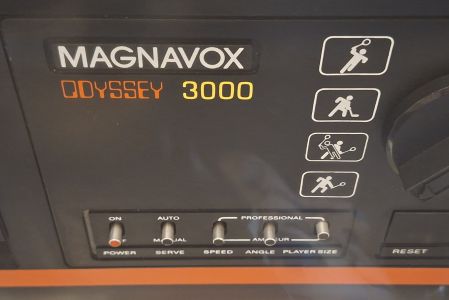 The control panel: POWER, SERVE, SPEED, ANGLE and PLAYER SIZE switches
-
 The HOME TEAM player control in its recess
-
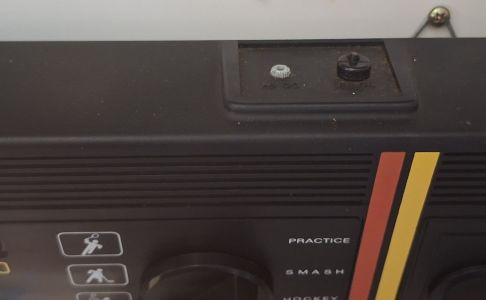 The terminal plate on the top rear, for the game cord and adaptor socket
-
 Magnavox's drawing of the main board, XM-050-C (p. 6509-2)
-
 Magnavox's drawing of the modulator board, XJ-012-B (p. 6509-4)


Related pages
[edit | edit source]- Magnavox Odyssey 3000 General Maintenance
- Magnavox Odyssey 3000 Troubleshooting Guide
- Magnavox Odyssey 3000 Capacitor Replacement Guide
- Magnavox Odyssey 3000 Documentation
- Magnavox Odyssey 2000, the AY-3-8500 console it followed
- Magnavox Odyssey 4000
References
[edit | edit source]- ↑ 1.0 1.1 David Winter, Pong-Story, "Other Magnavox Odyssey systems" (retrieved 2026-10-19): the Odyssey 2000, 3000 and 4000 released in 1977 with General Instrument chips; the Odyssey 3000 as a new case design with detachable controllers and all four difficulty settings, and its mention of a British patent.
- ↑ 2.0 2.1 Wikipedia, "Magnavox Odyssey series" (retrieved 2026-10-19), section on the Odyssey 3000: model number given as 7508, released in 1977, the four games, the serve, speed and angle controls, the new angular case with flat Reset and Serve buttons and a round game selector, detachable controllers without fire buttons, and power from six C cells or an optional AC adapter.
- ↑ 3.0 3.1 3.2 3.3 3.4 3.5 3.6 3.7 3.8 Magnavox, Service Manual No. 6509, November 1977, pp. 6509-3 and 6509-4: BH7514 schematic diagram with the regulator voltages, U1 marked AY-3-8500-1, the U1 voltage chart, the notes (including the triangle marking parts not on the P.C. board and voltages taken with a VTVM on the AC to DC adaptor), the modulator schematic and the modulator P.C. board (XJ-012-B). Hosted as File:Magnavox Odyssey 3000 Service Manual 6509.pdf.
- ↑ 4.00 4.01 4.02 4.03 4.04 4.05 4.06 4.07 4.08 4.09 4.10 Magnavox, Service Manual No. 6509, November 1977, p. 6509-5: BH7514 replacement parts list (coils, capacitors with type, value, rating and part number, controls and switches, semiconductors, cords, speaker and instruction booklet IB3280-1) and the cabinet replacement parts list. Hosted as File:Magnavox Odyssey 3000 Service Manual 6509.pdf.
- ↑ 5.0 5.1 Nerdly Pleasures, "Sears (Atari) Tele-games Pong vs Magavox Odyssey 100 - Battle of the First Pong Consoles", 7 August 2022 (retrieved 2026-10-19): the later Odyssey models, with the 300, 400, 2000 and 3000 in black and white and only the 500 and 4000 in colour. Owner's hands-on report.
- ↑ 6.00 6.01 6.02 6.03 6.04 6.05 6.06 6.07 6.08 6.09 Magnavox Consumer Electronics Company, Service Manual No. 6509: BH7514 Odyssey, first issue, November 1977, p. 6509-1: general information (6 C cells or an optional AC to DC voltage adaptor; Tennis, Hockey, Smash and Practice; Amateur and Professional settings for ball speed, ball angle and player size; manual or automatic serve; on-screen scoring; play to 15; reset to 0-0 with a random serve; three tones), the service adjustments (2 MHz oscillator with L1; channel 3 RF oscillator with CT1; channel 4 not adjustable) and typical operation (channel switch in the battery compartment; detachable player controls). Hosted as File:Magnavox Odyssey 3000 Service Manual 6509.pdf.
- ↑ 7.0 7.1 7.2 David Winter, Pong-Story, "PONG in a Chip" (retrieved 2026-10-19): the AY-3-8500 and its games, the Odyssey 300, 2000 and 3000 as Magnavox's line of AY-3-8500 consoles, the Odyssey 3000 as the only one that let the four difficulty settings be set individually, and the -1 suffix marking the NTSC version of a General Instrument chip.
- ↑ Magnavox, Service Manual No. 6504: BG7500 Odyssey (Odyssey 300), October 1976, p. 6504-2: BG7500 replacement parts list, with IC1 612114-1 and the switch part numbers. Hosted as File:Magnavox Odyssey 300 Service Manual 6504.pdf.
- ↑ 9.0 9.1 Magnavox, Service Manual No. 6507: BH7510 Odyssey (Odyssey 2000), October 1977, p. 6507-2: BH7510 replacement parts list, with IC1 612114-1, the 6-38 pF oscillator trimmer C4 and Magnavox's six-digit part numbers. Hosted as File:Magnavox Odyssey 2000 Service Manual 6507.pdf.
- ↑ Magnavox, Service Manual No. 6509, November 1977, p. 6509-2: main P.C. board, component view (board XM-050-C), with the off-board jack, battery, power switch, slide switches, game selector, push buttons and player controls. Hosted as File:Magnavox Odyssey 3000 Service Manual 6509.pdf.
- ↑ 11.0 11.1 11.2 Sintegrity, photographs of a Magnavox Odyssey 3000 on display, 12 July 2025, on Wikimedia Commons as File:Magnavox Odyssey 3000 (1).jpg, (2), (4) and (6) (CC BY-SA 4.0; retrieved 2026-10-19): the console's panel and switch legends, the player controls in their recesses and the terminal plate on the top rear. Hosted as File:Magnavox Odyssey 3000 console.jpg and the files in the gallery.


