

TRS-80 Pocket Computer
 | |
| The original TRS-80 Pocket Computer (26-3501) with its 26-3505 printer and cassette interface, CTR-80A recorder, boxes and manuals (photograph CalebGJ, CC0) | |
| Specifications | |
|---|---|
| Manufacturer | Sharp, for Radio Shack (Tandy Corporation) |
| Type | Pocket computer |
| Released | 1980 |
| Discontinued | 1983 |
| Intro price | US$249.95 at launch, later US$149.95 |
| CPU | Two Sharp 4-bit processors, SC43177 and SC43178, at 256 kHz |
| Memory | 1,920 bytes, 1,424 free for programs |
| Storage | Cassette, through the 26-3503 or 26-3505 interface |
| Display | 24-character LCD |
| Sound | — |
| Power | Four MR44 button cells |
| Dimensions | 175 × 70 × 15 mm |
| Weight | 170 g with cells |
| OS / Firmware | BASIC |
| Successor | TRS-80 PC-3 |
| Model no. | 26-3501 |
The TRS-80 Pocket Computer was Radio Shack's first pocket computer, a rebadged Sharp PC-1211 introduced in 1980 at US$249.95 under catalogue number 26-3501.[1] When Tandy added further models numbered PC-2 to PC-8, the original became known as the PC-1.[2] All eight models in the line were made for Tandy by Sharp or Casio: the PC-1, PC-2, PC-3 and PC-8 are Sharp designs and the PC-4, PC-5, PC-6 and PC-7 are Casio designs.[2][3]
The line
[edit | edit source]| Model | Catalogue no. | Introduced | Original model | Free memory (bytes) | Display | Cells |
|---|---|---|---|---|---|---|
| PC-1 | 26-3501 | 1980 | Sharp PC-1211 | 1,424 of 1,920 | 24 characters | Four MR44 |
| PC-2 | 26-3601 | 1982 | Sharp PC-1500 | 1,850 of 3,584 | 156 × 7 dots | Four AA, or a 6 V adaptor |
| PC-3 | 26-3590 | 1983 | Sharp PC-1250 | 1,438 of 2,048 | 24 characters | Two CR2032 |
| PC-3, 4 KB ("PC-3A") | 26-3589 | 1984 | Sharp PC-1251 | 3,486 of 4,096 | 24 characters | Two CR2032 |
| PC-4 | 26-3650, 26-3650A | 1983 | Casio PB-100 | 544 of 1,024 | 12 characters | Two CR2032 |
| PC-4 | 26-3650B | 1985 | Casio PB-100F, modified | 544 of 1,024 | 12 characters | Two CR2032 |
| PC-5 | 26-3670 | 1985 | Casio FX-780P | 3,552 of 4,096 | 24 characters | Two CR2032, one CR1220 for memory backup |
| PC-6 | 26-3672 | 1986 | Casio FX-790P | 7,520 of 8,192 | 24 characters | Two CR2032, one CR1220 for memory backup |
| PC-7 | 26-3673 | 1986 | Casio FX-5200P, modified | 1,568 of 2,048 | 12 characters | Two CR2032 |
| PC-8 | 26-3655 | 1987 | Sharp PC-1246 | 1,278 of 2,048 | 16 characters | Two CR2032 |
Sources for the table: Kaiser's three model pages give the catalogue numbers, years, original models, memory and displays;[4][5][6] the Pocket Museum gives the PC-2's catalogue number and the cells for every model.[3][7] The PC-6's cells are from its service manual.[8] The 4 KB PC-3 was the PC-3A in some catalogues. Kaiser and Goldklang give its original as the Sharp PC-1251; the Pocket Museum gives the PC-1250A.[4][2][3]
History
[edit | edit source]Tandy promoted its first pocket computer through its Radio Shack stores, imported Sharp's printer and tape interfaces for it and released its own software on cassette. Its price later fell to US$149.95.[1][4] In 1982 Tandy added the much larger PC-2, a rebadged Sharp PC-1500 with an 8-bit processor and a graphic display, at US$279.95, later cut to US$199.95.[1][5]
In 1983 Tandy turned to Casio for a cheaper model and released the PC-4, a Casio PB-100. Later the same year came the PC-3, Sharp's PC-1250, which runs the PC-1's BASIC and reads PC-1 tapes, followed in 1984 by a 4 KB version based on the PC-1251.[1][4] From 1984 Tandy dropped the Radio Shack and TRS-80 names from the pocket computers and badged them Tandy, starting with the 4 KB PC-3 and the 1985 PC-4.[1]
The later models came from both suppliers. Casio supplied the PC-5 (1985), PC-6 (1986) and PC-7 (1986), sold as Pocket Scientific Computers; Sharp supplied the PC-8 (1987), a PC-1246 from Sharp's 1983 range.[1] The PC-7 stayed on sale until 1990, and the PC-6 was the last of the line, still in Radio Shack catalogues in 1991.[6][1]
Compatibility
[edit | edit source]The Sharp and Casio models do not share programs or peripherals, and the PC-2 stands apart from the other Sharp models.[1][2]
The PC-3 reads PC-1 tapes and runs PC-1 programs, and the PC-8 runs PC-3 programs that fit its 16-character screen. The PC-3 and PC-8 share the 11-pin interface and the PC-3's peripherals; the PC-3 does not have the PC-1's peripheral port, so the PC-1's interfaces (26-3503 and 26-3505) do not fit it.[4][2]
The PC-2 has its own architecture, BASIC and peripherals and is not compatible with the PC-1.[1][5]
Among the Casio models, programs for the 1985 PC-4 (26-3650B) run on the PC-5, PC-6 and PC-7; programs for the original 26-3650 need their unique keywords converted first.[2][6] The PC-5 and PC-6 use the PC-4's printer and cassette interface through the 26-3671 link cable, and the PC-7 has no expansion port at all.[1][6]
Peripherals
[edit | edit source]| Catalogue no. | Item | For | Original |
|---|---|---|---|
| 26-3503 | Cassette interface | PC-1 | Sharp CE-121 |
| 26-3505 | Printer and cassette interface (NiCd pack) | PC-1 | Sharp CE-122 |
| 26-3605 | Four-colour printer/plotter and cassette interface (NiCd pack) | PC-2 | Sharp CE-150 |
| 26-3612 | RS-232C interface | PC-2 | Sharp CE-158, modified |
| 26-3615 | 4 KB memory module | PC-2 | Sharp CE-151 |
| 26-3616 | 8 KB memory module | PC-2 | Sharp CE-155 |
| 26-3591 | Thermal printer and cassette interface | PC-3, PC-8 | – |
| 26-3651 | Cassette interface | PC-4; PC-5 and PC-6 through 26-3671 | Casio FA-3 |
| 26-3652 | Thermal printer (rechargeable supply) | PC-4; PC-5 and PC-6 through 26-3671 | Casio FP-12 |
| 26-3653 | 1 KB memory module | PC-4 | – |
| 26-3671 | Link cable to the PC-4's printer and cassette interface | PC-5, PC-6 | – |
| 26-3674 | 8 KB memory module | PC-6 | Casio RP-8 |
Catalogue numbers and Sharp or Casio equivalents are Kaiser's.[4][5][6] Kaiser could find no Sharp equivalent for the 26-3591 and notes that it appears to be Sharp-made.[4]
The PC-1
[edit | edit source]Hardware
[edit | edit source]The PC-1 uses two Sharp 4-bit processors, the SC43177 and SC43178, at 256 kHz. Kaiser explains that they share the work of the BASIC interpreter and system software, with execution switching between them, because one chip could not hold all of it.[4] Of the 1,920 bytes of RAM, 1,424 are free for programs; Kaiser counts 1,536 bytes of main RAM and 384 bytes inside the display chips.[4][1] The display shows one line of 24 characters. The computer measures 175 × 70 × 15 mm, weighs 170 g and runs from four MR44 button cells.[4][3]
BASIC
[edit | edit source]The PC-1's BASIC, which Tandy called Pocket BASIC, set the pattern for the later Sharp-built models: a RUN mode for calculations and running programs, a PRO mode for entering and editing them, 26 fixed variables A to Z, and reserve keys that hold up to 48 bytes of text for quick entry. Strings are limited to eight characters.[4]
Options
[edit | edit source]Tandy launched the PC-1 with the 26-3503 cassette interface, a Sharp CE-121 that runs from AA cells, at US$49, and later added the 26-3505 printer and cassette interface, a Sharp CE-122 with a 16-column dot-matrix printer, at US$149.95.[4]
Faults
[edit | edit source]Kaiser reports that many PC-1 displays gradually darken around the traces, some almost completely, which he attributes to poor sealing of the LCD assembly. Not every unit is affected, and he advises buyers to choose the clearest display they can find.[4]
The 26-3505 printer and cassette interface runs from a NiCd pack. Once such a pack fails, an external supply does not usually bring the printer back, because the printer runs from the pack; Kaiser's fixes are to rewire the interface or fit equivalent NiCd cells, and NiMH cells do not work without conversion.[4][1]
Common faults across the line
[edit | edit source]Cells
[edit | edit source]Every model except the PC-2 runs from lithium or button cells. Radio Shack told PC-4 owners to change both cells every two years, because worn cells may leak, and never to leave flat cells inside.[9] On the PC-5 and PC-6 a separate CR1220 keeps the memory while the main cells are changed.[6] Each model's General Maintenance page gives the cell procedure, and Battery Explosion, Capacitor or Corrosion Damage covers cleaning up after a leak.
Printer packs
[edit | edit source]Most of the printer interfaces, including the PC-1's 26-3505 and the PC-2's 26-3605, run from rechargeable NiCd packs, and many second-hand printers no longer work because the pack has failed.[1][5] Kaiser also reports that the 26-3605's plotter gears tend to strip and break even under light load.[5]
Hinges and latches
[edit | edit source]Most PC-5 and PC-6 clamshells on the second-hand market have broken hinges or latches.[6] TRS-80 PC-6 General Maintenance covers protecting the hinges and a printed replacement latch.
Capacitors
[edit | edit source]The boards carry few electrolytic capacitors. The PC-4 service manual's parts list has two,[10] the PC-6 manual three (C11 to C13)[8] and the Sharp PC-1246 manual, for the PC-8, one (C4).[11] The capacitor guide for each model gives the values and positions.
Model pages
[edit | edit source]Gallery
[edit | edit source]-
 PC-4 in its 26-3651 cassette interface (Joe Haupt, CC BY-SA 2.0)
-
 PC-5 (Pocket Museum)
-
 PC-6 (Jrincayc, public domain)
-
 PC-7 (Pocket Museum)
-
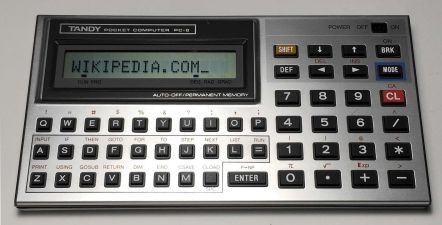 PC-8 (Jcassara86, CC BY-SA 4.0)


Documentation
[edit | edit source]- TRS-80 PC-1 Documentation: Radio Shack's service manual for the PC-1 and the 26-3503 cassette interface.
- TRS-80 PC-2 Documentation: Radio Shack's service manual for the PC-2 and the 26-3605 printer and cassette interface.
- TRS-80 PC-3 Documentation: Radio Shack's PC-3 owner's manual.
- TRS-80 PC-4 Documentation: the PC-4 service manual, owner's manual and cassette interface manual.
- TRS-80 PC-6 Documentation: the PC-6 service manual.
- TRS-80 PC-8 Documentation: Sharp's PC-1246 and PC-1247 service manual.
- Kaiser's Gopher archive holds Tandy manuals for the PC-1 (user, printer and service manuals), the PC-2 (user, printer/cassette and RS-232C manuals, memory map and an assembly language tutorial) and the PC-3 (user manual).[4][5]
References
[edit | edit source]- ↑ 1.00 1.01 1.02 1.03 1.04 1.05 1.06 1.07 1.08 1.09 1.10 1.11 1.12 Cameron Kaiser, Tandy! Pocket! Mania!, Floodgap Retrobits, main page (last modified 10 February 2024). Retrieved 2026-10-21. History of the line: the Sharp PC-1211 rebadged as the PC-1 at US$249.95 in 1980, later reduced to US$149.95; the PC-2 (Sharp PC-1500) in 1982; the PC-4 (Casio PB-100) in 1983 with 544 of 1,024 bytes free, and its 1985 reissue partly based on the PB-100F; the PC-3 (Sharp PC-1250) later in 1983 and the 4 KB PC-3 (PC-1251) in 1984; neither the PC-2 nor the PC-4 compatible with the PC-1; the change from Radio Shack and TRS-80 badging to Tandy from 1984; the PC-5 and PC-6 (Casio FX-780P and FX-790P) in 1985 and 1986, using the PC-4's peripherals through a link cable; the PC-7 (Casio FX-5200P) alongside the PC-6, with no expansion options; the PC-8 (Sharp PC-1246) in 1987, able to use the PC-3's peripherals; the PC-6 the last on sale, until around 1991; rechargeable NiCd packs in most of the printer interfaces, which go flat and stop the printer working even on external power.
- ↑ 2.0 2.1 2.2 2.3 2.4 2.5 Wikipedia, "Tandy Pocket Computer". Retrieved 2026-10-21. The original TRS-80 Pocket Computer later known as the PC-1; the PC-1, PC-2, PC-3 and PC-8 designed by Sharp and the PC-4 to PC-7 by Casio; Ira Goldklang's list of the original models, which gives the Sharp PC-1251 for the PC-3 and PC-3A; PC-1 programs running unchanged on the PC-3, and on the PC-8 with changes for its screen size; PC-4 (26-3650B) programs running on the PC-5, PC-6 and PC-7.
- ↑ 3.0 3.1 3.2 3.3 Pocket Museum, "Tandy's computers", with the model pages PC-1, PC-2, PC-3 and PC-3A. Retrieved 2026-10-21. Catalogue numbers of the eight models and the original Sharp or Casio model of each (PC-3A given as the Sharp PC-1250A); catalogue numbers of the printers, tape interfaces, memory modules and RS-232 interface. Model pages: PC-1 four MR44 button cells, 175 × 70 × 15 mm, 170 g; PC-2 four AA cells or a 6 V adaptor; PC-3 and PC-3A two CR2032 cells.
- ↑ 4.00 4.01 4.02 4.03 4.04 4.05 4.06 4.07 4.08 4.09 4.10 4.11 4.12 4.13 4.14 Cameron Kaiser, "Tandy Radio Shack Pocket Computer PC-1, PC-3, PC-8", Floodgap Retrobits, Tandy! Pocket! Mania!. Retrieved 2026-10-21. PC-1: 26-3501, introduced 1980 as the Sharp PC-1211, SC43177/SC43178 dual 4-bit processors at 256 kHz, 24-character LCD, 1,424 of 1,920 bytes free, 175 × 70 × 15 mm, 170 g; the RUN and PRO modes, fixed variables A to Z and reserve keys of S'-BASIC; options 26-3503 cassette interface (Sharp CE-121) and 26-3505 cassette and printer interface (Sharp CE-122), the latter on NiCd cells; the darkening of PC-1 LCDs; discontinued 1983. PC-3: 26-3590 (Sharp PC-1250, 1983) and 26-3589 (Sharp PC-1251, 1984), SC61860 at 576 kHz, 1,438 of 2,048 and 3,486 of 4,096 bytes free; PC-1 tapes readable on a PC-3; the 4 KB model the first to drop the Radio Shack name and on sale until 1986; 26-3591 printer and cassette interface; the 11-pin I/O connector pinout. PC-8: 26-3655, Sharp PC-1246, 1987; compatible with all PC-3 peripherals.
- ↑ 5.0 5.1 5.2 5.3 5.4 5.5 5.6 Cameron Kaiser, "Tandy Radio Shack Pocket Computer PC-2", Floodgap Retrobits, Tandy! Pocket! Mania!. Retrieved 2026-10-21. Introduced 1982 as the Sharp PC-1500; LH5801 8-bit CMOS processor at 1.3 MHz; 156 × 7 dot LCD; 1,850 of 3,584 bytes free; 195 × 86 × 25.5 mm, 375 g; US$279.95, later US$199.95; options 26-3605 printer/plotter/cassette interface (Sharp CE-150), on NiCd cells and with gears that strip, 26-3612 RS-232C interface (modified Sharp CE-158), 26-3615 4 KB (Sharp CE-151) and 26-3616 8 KB (Sharp CE-155) memory; discontinued 1984.
- ↑ 6.0 6.1 6.2 6.3 6.4 6.5 6.6 Cameron Kaiser, "Tandy Radio Shack Pocket Computer PC-4 and Tandy Pocket Scientific Computer PC-5, PC-6, PC-7", Floodgap Retrobits, Tandy! Pocket! Mania!. Retrieved 2026-10-21. PC-4: 26-3650/26-3650A from 1983 (Casio PB-100) and 26-3650B from 1985 (Casio PB-100F, modified), 544 of 1,024 bytes free, 12-character LCD; options 26-3651 cassette interface (Casio FA-3), 26-3652 thermal printer (Casio FP-12) on a rechargeable supply, 26-3653 1 KB memory. PC-5: 26-3670, 1985, Casio FX-780P, 3,552 of 4,096 bytes free. PC-6: 26-3672, 1986, Casio FX-790P, 7,520 of 8,192 bytes free, 26-3674 8 KB memory (Casio RP-8), still in Radio Shack catalogues in 1991. PC-5 and PC-6: 24-character LCD, a backup cell that keeps the memory while the main cells are changed, hinges and latches that break, the 26-3671 link cable to the PC-4's printer and cassette interface. PC-7: 26-3673, 1986, modified Casio FX-5200P, 12-character LCD, 1,568 of 2,048 bytes free, no expansion of any kind, on sale until 1990. The PC-5, PC-6 and PC-7 use the 26-3650B's BASIC, so programs for the original 26-3650 and 26-3650A need their unique keywords converted.
- ↑ Pocket Museum, "The Tandy PC-4 computer (26-3650)", "The Tandy PC-5 computer (26-3670)", "The Tandy PC-7 computer (26-3673)" and "The Tandy PC-8 computer (26-3655)". Retrieved 2026-10-21. Cells: two CR2032 for the PC-4, PC-7 and PC-8; two CR2032 and one CR1220 for the PC-5.
- ↑ 8.0 8.1 Tandy, Service Manual: Pocket Scientific Computer PC-6, catalogue number 26-3672. Hosted as File:Tandy PC-6 Pocket Scientific Computer Service Manual (26-3672).pdf. Specifications p. 3: two CR2032 main cells and one CR1220 memory backup cell. Parts list p. 20: electrolytic capacitors C11 and C12, 22 µF 10 V, and C13, 100 µF 10 V.
- ↑ Radio Shack, TRS-80 PC-4 Owner's Manual, catalogue number 26-3650A. Hosted as File:Radio Shack TRS-80 PC-4 Owner's Manual (26-3650A).pdf. Use precautions p. 3: replace the batteries every two years, worn batteries may leak, do not leave dead batteries in the computer.
- ↑ Radio Shack, Service Manual: TRS-80 PC-4 Pocket Computer and Cassette Interface, catalogue numbers 26-3650, 26-3651, 26-3653. Hosted as File:Radio Shack TRS-80 PC-4 Pocket Computer and Cassette Interface Service Manual (26-3650).pdf. Parts list: two electrolytic capacitors, 10 µF 16 V and 4.7 µF 35 V.
- ↑ Sharp Corporation, Service Manual: PC-1246, PC-1247, code 00ZPC1247SM/E, December 1984. Hosted as File:Sharp PC-1246 PC-1247 Service Manual.pdf. Parts list p. 12: C4, 22 µF 6.3 V, the only electrolytic capacitor.