

Mattel Aquarius
 | |
| Mattel Aquarius (Evan-Amos, public domain) | |
| Specifications | |
|---|---|
| Manufacturer | Radofin Electronics (Far East) Ltd, Hong Kong, for Mattel Electronics[1][2] |
| Type | Home computer |
| Released | June 1983 (USA)[2] |
| Discontinued | October 1983 (Mattel)[2] |
| Intro price | US$160[2] |
| CPU | Zilog Z80A or a compatible part (NEC D780C on many boards), about 3.5 MHz[3][2][4] |
| Memory | 4 KB RAM; 8 KB BASIC ROM and 2 KB character ROM[3][4] |
| Storage | Cassette (600 baud) through a 5-pin DIN socket; ROM cartridges[3] |
| Display | RF output to a television; 40 × 24 text, 80 × 72 block graphics, 16 colours[3] |
| Sound | One tone channel through the television[3] |
| Power | External transformer on a captive cord: +8.8 V, +16 V and −19 V DC[3] |
| OS / Firmware | Microsoft BASIC in ROM[3] |
| Successor | Mattel Aquarius II |
| Model no. | 5931[3] |
The Mattel Aquarius is a Z80-based home computer designed and built by Radofin Electronics of Hong Kong and sold by Mattel Electronics from June 1983, at US$160.[2][1] It has 4 KB of RAM, Microsoft BASIC in 8 KB of ROM, a 48-key rubber keyboard with a separate reset key, a cartridge port, a cassette interface and a serial printer port, and connects only to a television through its RF modulator.[3] Mattel stopped selling it in October 1983.[2]
History
[edit | edit source]Radofin had designed a line of home computers before Mattel came to it. Mattel took the two smaller designs: "Checkers", sold as the Aquarius (model 5931), and "Chess", which became the Mattel Aquarius II (model 4000).[3] Mattel announced the Aquarius in 1982 and first showed it to the public at the Winter Consumer Electronics Show in Las Vegas in January 1983.[2] It went on sale in June 1983 and was withdrawn four months later.[2] Mattel paid Radofin to take back the marketing rights; the remaining Mattel stock went to CEZAR Industries of Hawthorne, California, and then to CRIMAC Incorporated of Redwood City, formed around November 1984, which also produced some new Aquarius products.[3]
Radofin also sold the machine outside the USA. Its own edition of the manual lists versions for the UK (PAL I, 240 V, UHF channel 36), Germany, Scandinavia, the Benelux countries, Australia (VHF 0 or 1) and other markets, each with the television system and mains voltage of that country.[1] Dick Smith Electronics sold it in Australia as catalogue number X-6000.[4]
There are two versions of the BASIC ROM. Both show "Copyright (c) 1982 by Microsoft Inc." at start-up; the later one, called the "new ROM" in the Aquarius FAQ and S2 in MAME, adds "S2" to that line, leaves 1724 bytes free instead of 1731, and fixes some bugs, among them the misprinted "Bad" message after a failed CLOAD? verify.[3][4]
Hardware
[edit | edit source]The main board carries the processor, two 2 KB static RAMs, two mask ROMs, two custom chips, a TEA1002 colour encoder, a handful of 74LS and CMOS logic chips, the power regulators and a Radofin RF modulator. Most of it sits under a metal RF shield that is soldered to the board as well as held by twisted tabs.[3][5][6][7]

| Function | As marked on boards examined | Notes |
|---|---|---|
| Processor | NEC D780C-1; Zilog Z80A on some boards | The FAQ also lists a Hitachi HD64180 on some boards.[3][7] |
| Static RAM | Synertek SY2128-2 and Hitachi HM6116P-2 on one board; HM6116P-2 and NEC D4016C-2 in the FAQ | Two 2 KB parts give the 4 KB; on Leaded Solder's board the HM6116 was the only socketed chip.[3][7][5] |
| Mask ROMs | NEC D2364C-1; General Instrument 9316C marked REL-C16-C | MAME holds an 8 KB BASIC ROM at U2 and a 2 KB character ROM at U5.[7][4] |
| Custom logic | Ferranti REL-PLA2 (XZ-2007-1); Hitachi HD61K202P | Leaded Solder reports that the PLA scrambles data on the external bus with a key chosen at start-up.[5][7][3] |
| Colour encoder | Mullard TEA1002 | 18-pin; 7.15909 MHz crystal on NTSC boards, 8.867238 MHz on PAL.[5][4] |
| Regulation | 7805 for +5 V; transistor regulator for +12 V | The only TO-220 transistor on the photographed board is a 2SC1061 beside the power switch.[8][7] |
MAME runs the processor at half the 7.15909 MHz crystal frequency, about 3.58 MHz. Published figures for the clock are 3.5 MHz and 4 MHz.[4][2][9] One photographed board reads HD61Z202P on the Hitachi chip; the FAQ, Leaded Solder and Harrington's recreation all give HD61K202P.[7][3][5][6]
Sean Harrington and Mack Wharton have redrawn the NTSC board (Radofin part number 5931-4229 A) as an open-source like-for-like replacement, the Aquarius Motherboard v1-1-0. Their schematic and parts list cover the whole board. They renumbered many resistors and capacitors, so their designators do not always match an original board.[6][8]
Power
[edit | edit source]The power supply is a plug-in transformer on a cord that cannot be unplugged from the computer.[10][5] It delivers three DC outputs:[3]
| Output | Current | Wires |
|---|---|---|
| +8.8 V DC | 1.2 A | red and black |
| +16 V DC | 0.15 A | yellow and black |
| −19 V DC | 0.01 A | blue and black |
Inside, the cord ends in a four-pin in-line connector that pushes onto pins on the main board and locks against a curved plastic tab.[3] On the board, the 8.8 V line is smoothed by a 10,000 µF capacitor and regulated to +5 V by a 7805; the 16 V line is smoothed by a 1,000 µF capacitor and feeds a transistor regulator for +12 V; the −19 V line passes through a 1.8 kΩ resistor to become the −12 V line. A three-pole slide switch on the board switches all three.[8] The printer port's RS-232 signals swing between +12 V and −12 V.[3] The power light is fed from the switched 8.8 V line, so it fades slowly after switch-off while the 10,000 µF capacitor discharges.[8][5]
Ports and keyboard
[edit | edit source]
Seen from the back, left to right, are the cartridge port, the printer jack, the data recorder socket, the channel selector, the TV cable jack and the power cord.[10]
| Port | Connector | Details |
|---|---|---|
| Cartridge and expansion | 44-way edge connector | Game, program and memory cartridges, and the Mattel Aquarius Mini-Expander[6][3] |
| Printer | 3.5 mm stereo jack | Tip data out, ring printer busy/ready, sleeve ground; BASIC sends at 1200 baud, 8 data bits, 2 stop bits, no parity[3] |
| Cassette | 5-pin DIN socket | Pin 1 MIC, pin 2 ground, pin 3 EAR, pins 4 and 5 unused; 600 baud, 900 Hz and 1800 Hz tones[3] |
| TV | RF socket | Recessed channel 3/4 switch on NTSC machines; no video monitor output[10][3] |
The cassette socket is the same connector as the TRS-80's but the pinout is different, so a TRS-80 cassette cable fits and does not work.[3]
The keyboard has 48 keys on an 8 × 6 matrix plus a reset key (RST). It is joined to the main board by a short flat plastic cable with 16 printed conductors, held in a slot on the board by friction.[3]
Peripherals
[edit | edit source]Mattel and Radofin model numbers from the FAQ:[3]
| Item | Model | Notes |
|---|---|---|
| Mini Expander | 4063 | Two cartridge ports, two hand controllers, extra sound channels |
| Data Recorder | 4394 | Cassette recorder with its own transformer and mains cord |
| Aquarius Printer | 4210 | 40-column thermal printer |
| Aquarius 4-Color Printer | 4615 | Pen printer and plotter |
| Modem | 4399 | 300 baud; CRIMAC sold a later model, 4820C |
| 4K, 16K and 32K RAM cartridges | 4214, 4215, 4217 | |
| Single Disk Drive | 4801C | CRIMAC; 2.8-inch Quick Disks, 64 KB a side |
Repair
[edit | edit source]The Aquarius has its own repair guides:
- Mattel Aquarius General Maintenance: opening the case, the keyboard cable, cleaning, the power cord and transformer, storage.
- Mattel Aquarius Troubleshooting Guide: the power rails, symptoms, video and keyboard faults, cassette problems.
- Mattel Aquarius Capacitor Replacement Guide: the eight electrolytic capacitors on the main board.
Harrington describes the hardware as hardy, with few parts going bad.[6] Owners' restoration work has centred on the power section. Harrington sells a kit of the eight electrolytic capacitors on the board, and both he and Leaded Solder replaced the 7805, which is fixed to the RF shield and runs hot, with a switching regulator.[11][12][5] The two PLAs cannot be bought new, so a failed PLA means a donor board.[6]
Documentation
[edit | edit source]- Mattel Aquarius Documentation: the hosted instruction cards, the Mini Expander instructions and the recreated board schematic.
- Aquarius Simplified Instruction Cards (Mattel, 5931-0250-G3): set-up, back panel and troubleshooting tips.
- Aquarius Motherboard v1-1-0 Rev D schematic (Harrington and Wharton, 2022, GPL).
- Aquarius Guide to Home Computing (Mattel, 5931-0240-G1): the owner's manual, with a retyped transcription of Radofin's international edition (5931-0038R-1).
Harrington's schematic was drawn from an NTSC board to correct the 1986 "MEKO" schematic, which was drawn from a PAL board and gives some values that differ from production boards.[6]
Gallery
[edit | edit source]-
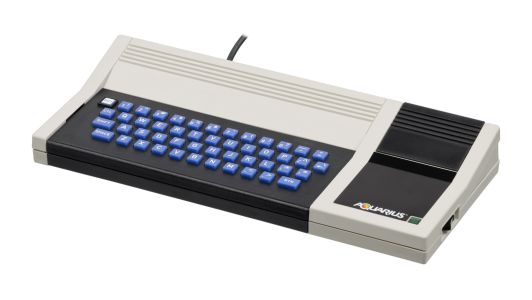 Mattel Aquarius (Evan-Amos, public domain)
-
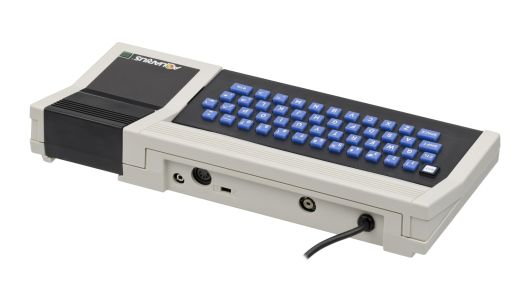 Rear panel (Evan-Amos, public domain)
-
 Top case removed, RF shield in place (Evan-Amos, public domain)
-
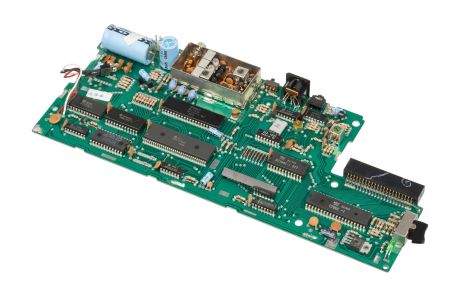 Main board, component side (Evan-Amos, public domain)
-
 Main board, solder side (Evan-Amos, public domain)
-
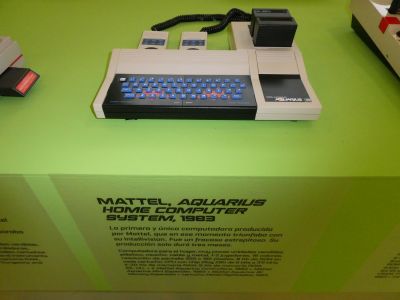 With Mini Expander and hand controllers (Jzh2074, CC BY-SA 4.0)


Related pages
[edit | edit source]- Mattel Aquarius General Maintenance
- Mattel Aquarius Troubleshooting Guide
- Mattel Aquarius Capacitor Replacement Guide
- Mattel Aquarius II
- Mattel Aquarius Mini-Expander
- Mattel Aquarius Documentation
References
[edit | edit source]- ↑ 1.0 1.1 1.2 Radofin Electronics (Far East) Ltd, Aquarius Guide to Home Computing, publication 5931-0038R-1 (© 1983, printed in Hong Kong). Retyped transcription hosted here as File:Aquarius Guide to Home Computing (Radofin edition, retyped).pdf, from the Internet Archive item AquariusGuideToHomeComputing (retrieved 2026-10-19): inside cover (TV systems, mains voltages and channels by country), "Key points for trouble free use", "Hook-up without hang-ups" (power cord with attached transformer; channel selector), "Turning your Aquarius computer off", "The reset key".
- ↑ 2.00 2.01 2.02 2.03 2.04 2.05 2.06 2.07 2.08 2.09 Steve's Old Computer Museum, "Mattel Aquarius" (retrieved 2026-10-19): model 5931; announced 1982; shown at the Las Vegas Winter CES in January 1983; released June 1983; discontinued October 1983; US$160; Z80A at 3.5 MHz; Radofin Electronics Far East as designer and manufacturer.
- ↑ 3.00 3.01 3.02 3.03 3.04 3.05 3.06 3.07 3.08 3.09 3.10 3.11 3.12 3.13 3.14 3.15 3.16 3.17 3.18 3.19 3.20 3.21 3.22 3.23 3.24 3.25 3.26 Fred Horvat and Gil Parrish, "Mattel Aquarius FAQ", last updated 6 May 2001 (retrieved 2026-10-19). Sections "What is the Aquarius?" (Radofin's three-machine line, Checkers as model 5931 and Chess as the Aquarius II, model 4000; Z-80A or a compatible NEC D780C or Hitachi HD64180; 4 KB RAM, 8 KB ROM; 48 keys on an 8-line by 6-line matrix plus reset; one-voice tone generator; TV only; printer interface; cassette at 600 baud; old and new ROM start-up messages, 1731 and 1724 bytes free), "What Hardware was Released?" (model numbers, CEZAR and CRIMAC), "What's the Power Supply?" (+8.8 V 1.2 A red-black, +16 V 0.15 A yellow-black, −19 V 0.01 A blue-black; four-pin connector inside, wires yellow, black, red, blue from the back), "What's Inside the Aquarius?" (six screws; 16-conductor keyboard cable held by friction; soldered metal shield; chips listed), "How do I Save and Load Back BASIC Programs?" (cassette DIN pinout; TRS-80 cable incompatible), "What's the Tape Recording Format?" (900 Hz and 1800 Hz), "What About Connecting Printers?" (mini-stereo pinout; 1200 baud, 8 data bits, 2 stop bits, no parity; RS-232C ±12 V).
- ↑ 4.0 4.1 4.2 4.3 4.4 4.5 4.6 MAME source, src/mame/mattel/aquarius.cpp at commit eee415b (retrieved 2026-10-19): Z80 clocked at 7.15909 MHz ÷ 2; TEA1002 at 7.15909 MHz (NTSC) or 8.867238 MHz (PAL); BASIC ROM 8 KB at U2 in versions S1 and S2; character ROM 2 KB at U5; Dick Smith catalogue numbers (X-6000 Aquarius).
- ↑ 5.0 5.1 5.2 5.3 5.4 5.5 5.6 5.7 Leaded Solder, "Mattel's Little Friend", 1 August 2023 (retrieved 2026-10-19). Hard-wired AC adapter; RF shield soldered to the board in places as well as twist-locked; the 10,000 µF capacitor held enough charge for the power light to stay lit about ten seconds after switch-off; chips Ferranti REL-PLA2, Hitachi HD61K202P and a 24-pin REL mask ROM; only the HM6116 socketed; Mullard TEA1002, 18-pin, fed 7.159 MHz; the PLA scrambles the external data bus with a key set at start-up; the 7805 replaced with a Traco TSR 1-2450.
- ↑ 6.0 6.1 6.2 6.3 6.4 6.5 6.6 Sean P. Harrington and Mack Wharton, Aquarius Motherboard 1-1-0 (GitHub, retrieved 2026-10-19), README and v1-1-0d bill of materials: "the Aquarius hardware is fairly hardy. Few of the parts go bad"; taken from the NTSC board, Radofin part 5931-4229 A; components renumbered; the 1986 "MEKO" schematic was drawn from a PAL board; the PLA1, PLA2, some line filters and a variable inductor cannot be bought new; J1 44-way cartridge connector; U7 HD61K202P.
- ↑ 7.0 7.1 7.2 7.3 7.4 7.5 7.6 Evan-Amos, photographs of an Aquarius, 2015, hosted here as File:Mattel Aquarius motherboard.jpg and File:Mattel Aquarius with top case removed.jpg (from Wikimedia Commons). The second shows the RF shield in place and the RF modulator labelled Radofin UM 1285-8. Chip markings read from the photograph: NEC D780C-1, Synertek SY2128-2, Hitachi HM6116P-2, NEC D2364C-1, General Instrument 9316C-4E60 REL-C16-C, Ferranti REL-PLA2 XZ-2007-1, Hitachi HD61Z202P, TEA1002, 2SC1061 beside the power switch.
- ↑ 8.0 8.1 8.2 8.3 Sean P. Harrington and Mack Wharton, Aquarius Motherboard v1-1-0 Rev D schematic, 30 April 2022, hosted here as File:Aquarius Motherboard v1-1-0 Rev D Schematic.pdf, "Power system" block: J3 pin 1 +16 V, pin 2 ground, pin 3 +8.8 V, pin 4 −19 V; C9 10,000 µF 16 V on the 8.8 V line; U10 7805 with C6 47 µF 10 V for +5 V; C8 1,000 µF 25 V on the 16 V line, Q4 with ZD1 and R37 for +12 V and C12 10 µF 16 V; R48 1.8 kΩ and C13 10 µF 25 V on the −19 V line for −12 V; three-pole switch; LED1 with R46 on the switched 8.8 V line.
- ↑ M. van der Steenoven, "Mattel Aquarius Homecomputer system specifications" (retrieved 2026-10-19): Z80A at 4 MHz; the same site's Aquarius II page gives 3.5 MHz.
- ↑ 10.0 10.1 10.2 Mattel Electronics, Aquarius Home Computer System Simplified Instruction Cards, 5931-0250-G3 (1982), hosted here as File:Aquarius Simplified Instruction Cards.pdf: card 3 (PDF p. 4), the back panel and the power cord ending in a plug-in transformer; cards 4 and 5 (PDF pp. 5-6), set-up and the channel 3/4 switch.
- ↑ Sean P. Harrington, "Capacitor Replacement", Get Your 8-Bit On! (retrieved 2026-10-19): the power circuitry's +5 V, +12 V and −12 V come from about 16 components, five of them electrolytic capacitors; recap kit of eight electrolytics; optional replacement of the 7805 with an OKI-78SR-5/1.5-W36H-C switching regulator.
- ↑ Aquarius+ (Sean Harrington), "Aquarius Computer - Installing a Replacement Power Regulator", YouTube, 20 September 2019, video description (read 2026-10-19): the OKI-78SR-5 "runs cooler and is not tethered to the RF/Heat Shield of the case anymore".