

Coleco Telstar
 | |
| The first Coleco Telstar (model 6040), with its paddle knobs fixed to the console | |
| Specifications | |
|---|---|
| Manufacturer | Coleco Industries, Inc. |
| Type | Dedicated home video game console (Pong-type TV game) |
| Released | 1976[1][2] |
| Intro price | US$50 (1976)[3][4] |
| Units sold | Over one million[1][3] |
| CPU | None; General Instrument AY-3-8500 game chip[1] |
| Memory | None |
| Storage | None |
| Display | RF output to a television on VHF channel 3, black and white[4][2] |
| Sound | Speaker in the console[4] |
| Power | Six C cells, or an optional 9 V adapter (Telstar AC Adaptor Model 6041)[4][5] |
| OS / Firmware | — |
| Model no. | 6040 |
The Coleco Telstar (model 6040) is the first of Coleco's Telstar TV games, released in 1976. It plays three black-and-white bat-and-ball games (tennis, hockey and handball) on a television tuned to channel 3, with two paddle knobs built into the console.[1][2][4] It was the first console to use General Instrument's AY-3-8500 game chip, sold for $50, and sold more than a million units.[1][3] It runs on six C cells or an optional 9 V adapter.[4]
History
[edit | edit source]Pong-Story records that Coleco was the first customer for General Instrument's AY-3-8500 and that the Telstar was the first system to use it, selling over a million units.[1] According to Ralph Baer, the designer at Sanders Associates whose recollections Pong-Story publishes, the first Telstars failed the FCC's radio-interference tests in 1976. His team made a unit pass by slipping a ferrite toroid over the coaxial cable where it left the console, with two tight turns through the ring just inside the cabinet.[6]
Coleco also sold the same console in other forms: the Telstar Classic in a wooden case, and the Telstar Deluxe, a version for Canada, also sold by Montgomery Ward as the Telstar Video World of Sports.[1] The Telstar Ranger of 1977 used the same case in black and enabled all six of the chip's games.[7]
Two versions
[edit | edit source]Pong-Story describes two versions of the Telstar. One has a row of long slots for the speaker at the upper left and draws a solid centre line in tennis; the other has small round holes and a dashed centre line. It attributes the difference to a revision of the AY-3-8500.[6] Its page on the chip describes the early AY-3-8500 as the one with the larger, dashed centre line, the opposite way round, so which Telstar version came first is not settled.[8] The museum unit in the infobox has small round holes.[9]
Hardware
[edit | edit source]| Part | Detail |
|---|---|
| Game chip | General Instrument AY-3-8500[1] |
| Games | Tennis, hockey, handball[2] |
| Picture | Black and white, scores on screen[2] |
| Sound | Speaker in the console[4] |
| Controls | Two built-in paddle knobs; game switch; BEGINNER/INTERMEDIATE/PRO switch; ON/OFF; RESET[2][10] |
| TV output | RF on VHF channel 3 through an antenna switch box[4][5] |
| Power | Six C cells; optional 9 V adapter[4] |
The AY-3-8500 holds six games, but Coleco wired only three of them to the Telstar's game switch. The two shooting games are still in the chip and can be reached by changing the switch wiring.[11] GI rates the chip for a supply of +6 to +7 V with a 2 MHz clock, and the chip outputs the ball, the two players and the score and field on separate pins, which the console combines into one picture.[12][11] No schematic or board photograph of the Telstar has been published.
Power
[edit | edit source]Lon.TV, reviewing a 6040 in 2026, notes that it was designed to run on six C cells, with a power supply available as an add-on.[4] One boxed Telstar on Wikimedia Commons is shown with a TELSTAR AC Adaptor Model 6041 labelled 9 V DC 100 mA; another Model 6041 is labelled 9 V DC 200 mA, and Coleco's 1977 order forms list the No. 6041-200MA.[5][13] Neither label gives the plug polarity. Measure an adapter's output and polarity before using it on a Telstar.
Repair
[edit | edit source]No service manual for the Telstar has been found. Coleco's owner's guide for the 6040 has not been found either; the guide for the Telstar Classic, which has the same three games and panel, is hosted on Coleco Telstar Classic Documentation. The Telstar has its own repair guides:
- Coleco Telstar General Maintenance: the battery compartment, the adapter, the switches and paddle knobs, and the game cable with its ferrite ring.
- Coleco Telstar Troubleshooting Guide: power-on behaviour, reference values for the AY-3-8500, and the faults reported on a surviving 6040.
- Coleco Telstar Capacitor Replacement Guide: what is known about the electrolytic capacitors and how to record your own.
Gallery
[edit | edit source]-
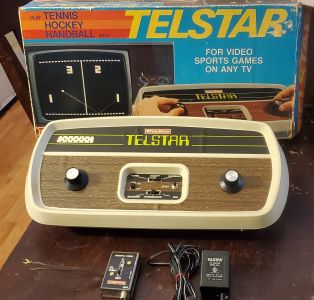 A boxed Telstar with its switch box and a Model 6041 adapter
-
 The centre panel: game switch, ON/OFF, RESET and BEGINNER/INTERMEDIATE/PRO


Related pages
[edit | edit source]- Coleco Telstar Classic and Coleco Telstar Deluxe, the same console in other cases
- Coleco Telstar Ranger, the six-game model in the same case
- Coleco Telstar Alpha, the four-game successor
- General Instrument GIMINI TV Game Circuits, GI's data for the AY-3-8500
- Category:Coleco
References
[edit | edit source]- ↑ 1.0 1.1 1.2 1.3 1.4 1.5 1.6 1.7 David Winter, Pong-Story, "Coleco Telstar systems" (retrieved 2026-10-18): Telstar, released in 1976, played three games with three difficulty levels and was the first system to use GI's AY-3-8500; over a million units sold; variants sold as the Telstar Deluxe in Canada and by Montgomery Ward as "Telstar Video World of Sports"; Coleco's systems were sold partially assembled, with the knobs and decorative stickers fitted by the user.
- ↑ 2.0 2.1 2.2 2.3 2.4 2.5 Arcade-History, "Telstar [Model 6040"] (retrieved 2026-10-19): model 6040, 1976; three Pong games (tennis, hockey, handball); two knobs built into the console; RESET button; ON/OFF and Beginner/Intermediate/Pro switches; black and white; built-in beeper; on-screen score.
- ↑ 3.0 3.1 3.2 Wikipedia, "Coleco Telstar series" (retrieved 2026-10-10): the first Telstar of 1976 sold for $50 and over a million were sold that year (citing Leonard Herman, Phoenix: the Fall and Rise of Videogames, 2nd ed., 1997, p. 20). Used for history only.
- ↑ 4.00 4.01 4.02 4.03 4.04 4.05 4.06 4.07 4.08 4.09 Lon.TV, "This Was the Best Selling Game Console of 1976", blog post, 4 February 2026 (retrieved 2026-10-19): a Telstar model 6040 bought for a historical-society display; launched at $50; AY-3-8500 with the game logic in the chip; sound from a built-in speaker; RF output for VHF channel 3 through a switch box; designed to run on six C cells, with a power connector for an optional supply; on his unit the game selector switch was stuck and the difficulty slider did not resize the paddles at the "pro" setting.
- ↑ 5.0 5.1 5.2 Photograph by Chris Yarzab, File:Telstar (51908701248).jpg (CC BY 2.0, from Wikimedia Commons), read at full size: a Telstar model 6040 with its box, the antenna switch box (GAME/TV, "Made in U.S.A.") and a TELSTAR AC Adaptor Model 6041 labelled "OUTPUT: 9V DC 100mA".
- ↑ 6.0 6.1 David Winter, Pong-Story, "Coleco Telstar" (retrieved 2026-10-18): first model, 1976; Ralph Baer's account that Coleco's first Telstar failed the FCC radio-frequency interference tests until he slipped a ferrite toroid over the shielded coaxial cable coming out of the unit, with two tight loops through the ring just inside the cabinet, after which the unit passed; two versions of the console, one with linear speaker holes at the upper left that shows a solid centre line in tennis and one with small round holes that shows a dashed line, believed to reflect a first run and a revision of the AY-3-8500.
- ↑ David Winter, Pong-Story, "Coleco Telstar Ranger" (retrieved 2026-10-18): the Ranger uses the same case as the Telstar, in black.
- ↑ David Winter, Pong-Story, "PONG in a Chip" (retrieved 2026-10-18): two versions of the AY-3-8500 exist, the early one with a dashed central line about twice as large and solid horizontal boundaries; the undocumented seventh game, Handicap, is played when none of the six games is selected; game selection switches "(rotary or linear) which could fail after many game selections".
- ↑ Photograph by Jzh2074, File:Coleco Telstar (1976) 2.jpg (CC BY-SA 4.0, from Wikimedia Commons): cream case, woodgrain panels, speaker grille at the upper left.
- ↑ Photograph by Sintegrity, File:Coleco Telstar (3).jpg (CC BY-SA 4.0, from Wikimedia Commons): centre panel with TENNIS/HOCKEY/HANDBALL slide switch, ON/OFF slide switch, RESET push button and BEGINNER/INTERMEDIATE/PRO slide switch.
- ↑ 11.0 11.1 Cameron Coward, "Two Secret Games Discovered on Vintage Coleco Telestar Pong Chip", Hackster.io (retrieved 2026-10-19), on a video by Dave's Garage: the Telstar's three games (hockey, handball, tennis) come from an AY-3-8500, which needs an external clock and outputs its picture elements on separate pins; the chip also holds two shooting games not enabled on that console, reachable by modifying the game selection switch.
- ↑ General Instrument, GIMINI TV Game Circuits, January 1978, pp. 4-6, File:General Instrument GIMINI TV Game Circuits (January 1978).pdf: AY-3-8500 pin functions (VSS pin 2, sound pin 3, VCC pin 4, ball speed pin 7 open for low speed and grounded for high, bat size pin 13 open for large bats and grounded for small, sync pin 16, clock pin 17 at 2.012160 MHz ±1%, game inputs pins 18 to 23 grounded to select); standard conditions VCC +6 to +7 V, +12 V maximum; supply current 40 mA typical, 60 mA maximum at +7 V; control inputs need 1 kΩ or less to VSS; vertical bat movement; scores 0 to 15.
- ↑ Photograph by Evan-Amos, File:Coleco-Telstar-AC-Adaptor.jpg (public domain, from Wikimedia Commons): label "TELSTAR AC ADAPTOR MODEL 6041 ... INPUT: 117V 60Hz 5W OUTPUT: 9 V DC 200mA".
