

Coleco Zaxxon Mini-Arcade
 | |
| The game controls and features as drawn in Coleco's instruction guide 96232A (1983). No freely licensed photograph of the game was found; credited photographs are in the article. | |
| Specifications | |
|---|---|
| Manufacturer | Coleco (the hosted guide is from Coleco (Canada) Limitée) |
| Type | Tabletop electronic game |
| Released | 1983[1][2] |
| Intro price | US$60 (November 1983)[3] |
| CPU | Hitachi HD38820A62, a 4-bit PMOS microcontroller[4][5] |
| Memory | On the microcontroller: 160 × 4-bit RAM, (2,048 + 128) × 10-bit ROM[5] |
| Storage | — |
| Display | Two vacuum fluorescent tubes combined through a part-reflecting mirror[6][7] |
| Sound | Not documented |
| Power | Four D alkaline cells[1] |
| OS / Firmware | — |
| Model no. | 2396[1] |
The Coleco Zaxxon Mini-Arcade is a battery-powered tabletop version of Sega's Zaxxon arcade game, sold by Coleco in 1983 as model 2396.[1][3] Its picture comes from two vacuum fluorescent display (VFD) tubes: one is seen through a tinted mirror sheet and the other is reflected in it, so that the player's fighter appears to fly over the fortress walls.[6][7] The game runs on four D cells and has an eight-way control stick between two fire buttons.[1][6]
History
[edit | edit source]Electronic Games reported in March 1983 that Coleco had announced Zaxxon as one of its Mini-Arcade titles for the year.[8] The magazine's June issue listed it with Ms. Pac-Man and Donkey Kong Junior as Coleco's new tabletop games for 1983 and said its playfield combined two vacuum fluorescent displays; the July preview of stand-alone games pictured it.[2][9] Joyce Worley reviewed it in the November 1983 issue at a price of $60; her review notes that Coleco had already brought Zaxxon to the ColecoVision, Intellivision and Atari 2600 as cartridges.[3]
Coleco made the game under licence from Sega.[10] The guide names Zaxxon and Sega as trademarks of Sega Enterprises, © 1982, and the marquee in its drawing of the game carries the Sega name.[1] The hosted guide, no. 96232A, is the Canadian edition, published by Coleco (Canada) Limitée of Montreal and printed in Japan.[1] Mini-Arcade.com dates the game to 1982;[11] the guide's copyright and the 1983 magazine coverage place it in 1983.[1][2]
Bandai sold a different VFD Zaxxon tabletop in Japan. It uses a single tube, half of which is reflected in a semi-transparent mirror, and a Hitachi HD38800 microcontroller, where the Coleco game has two tubes and an HD38820.[12][4]
Game and controls
[edit | edit source]
Moving the Level 1/Off/Level 2 switch to either level turns the game on; Level 1 is the easier game. Play starts when the stick is pushed in any direction.[1] The stick works like an aircraft control column. Pulling it towards the player makes the fighter climb, pushing it away makes it dive, and pushing it sideways banks it left or right; the diagonals combine a climb or dive with a bank.[1] Either fire button fires.[1] Holding a fire button while moving the switch to Level 1 or Level 2 starts a demonstration.[1]
The fighter crosses an asteroid fortress, flying over its walls or through the gaps in them and shooting tanks, missiles and fuel arsenals, then flies through open space against enemy squadrons to the next asteroid, where the Zaxxon robot appears.[1] Fuel arsenals score 4 points, tanks 6, missiles 2 and Zaxxon 20. The player starts with four fighters and gains one at 100 points. The word BEST appears under the score once it passes the best score, and the best score since the game was switched on can be shown by pulling the stick after a game.[1][3]
Hardware
[edit | edit source]
Display
[edit | edit source]The larger tube sits in a black plastic holder on the main board, under a magenta tint. The smaller tube sits under an orange tint on a separate board behind a clear, tinted mirror sheet.[13][7] The player looks through the mirror at the smaller tube and sees the larger tube reflected in it.[7] In Retrofixes' photographs of the unlit tubes, the small one carries rows of fighter shapes and the large one the walls, ground targets and score digits, and the post captions the small tube as the one that "creates the Flying Zaxxon ship" and the large one as making "the background effects and enemy ships".[7] The Handheld Museum describes the arrangement the other way round, with the player's ship and airborne enemies on the reflected tube,[6] and HotHardware repeats that description.[14] According to the Handheld Museum, only the player's ship has real depth on the Coleco game.[12]
Electronic Games described the fighter and all the missiles as red, the walls as blue, the ground targets as a mix of the two, and the score as green. The asteroid surface is not drawn, so the walls appear to hang in space.[3] The Handheld Museum's photograph of a game in play also shows a red BEST legend and a yellow Zaxxon robot.[6]
Boards and controls
[edit | edit source]The base holds the main board and the small tube's board at the back and the control board at the front. The control board carries the two fire buttons and eight metal leaf contacts arranged round the stick, which presses them through an eight-armed plastic actuator. A flat ribbon of wires joins it to the main board.[7][13] The Handheld Museum notes that the eight contacts make it a true eight-way stick.[6] The aircraft-style handle comes off easily, and games are found with only the short straight shaft left.[6][3]
MAME's list of Hitachi microcontroller mask numbers gives the game's chip as HD38820A62 and marks its program as not dumped.[4] The HD38820 is a PMOS part of Hitachi's HMCS45 group; Hitachi specified its PMOS microcontrollers for a −10 V supply, with 50 V outputs for driving vacuum fluorescent displays directly.[5][15] At least six radial electrolytic capacitors are visible on the main board in the Handheld Museum's photograph.[13] No schematic or parts list for the game is known.
Case and power
[edit | edit source]The case is large and heavy for a battery game, and it takes four D alkaline cells in a compartment under the base.[6][1] Coleco's guide mentions no mains adaptor. It warns that weak cells cause an erratic display or erratic play, and tells owners to switch the game off after use to save the cells.[1] Six screws hold the two halves of the case together.[7]
Known faults
[edit | edit source]- Corroded battery contacts. Mini-Arcade.com says corrosion can start within weeks on D-cell VFD games left with batteries in; see Battery Explosion, Capacitor or Corrosion Damage for leakage that has spread.[7][16]
- A dim or hazy picture from dust on the mirror and the faces of the two tubes.[7]
- Stick directions or fire buttons that need hard pressing, from dirty leaf contacts.[7][16]
- A missing stick handle.[6]
- Side decals lifting at the edges.[7]
- A broken mirror sheet. It is glued in and fragile, and Retrofixes advises separating the case halves slowly because of it.[7]
Care is covered in Coleco Zaxxon Mini-Arcade Maintenance, fault finding in Coleco Zaxxon Mini-Arcade Troubleshooting, the two tubes and the mirror in Coleco Zaxxon Mini-Arcade VFD Repair, and the electrolytic capacitors in Coleco Zaxxon Mini-Arcade Capacitor Replacement Guide.
Documentation
[edit | edit source]The wiki hosts Coleco's eight-page instruction guide, no. 96232A; see Coleco Zaxxon Mini-Arcade Documentation. The guide says the game has no serviceable parts. In Canada Coleco repaired or replaced a faulty game within 90 days of purchase; after that it serviced the game, or exchanged it for a reconditioned one, for $15.[1]
Gallery
[edit | edit source]-
 The display in play (photo: Rik Morgan, Handheld Museum)
-
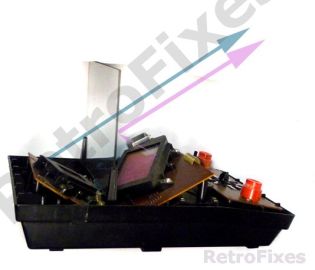 Side view with the light paths drawn in (photo: Retrofixes)
-
 The eight stick contacts and the fire buttons (photo: Retrofixes)


Related pages
[edit | edit source]- Coleco Zaxxon Mini-Arcade Maintenance
- Coleco Zaxxon Mini-Arcade Troubleshooting
- Coleco Zaxxon Mini-Arcade VFD Repair
- Coleco Zaxxon Mini-Arcade Capacitor Replacement Guide
- Coleco Zaxxon Mini-Arcade Documentation
- Coleco Pac-Man Mini-Arcade and Coleco Ms. Pac-Man Mini-Arcade, other games in Coleco's Mini-Arcade range
References
[edit | edit source]- ↑ 1.00 1.01 1.02 1.03 1.04 1.05 1.06 1.07 1.08 1.09 1.10 1.11 1.12 1.13 1.14 1.15 1.16 Coleco (Canada) Limitée, The Official Zaxxon by Sega: Instructions and Game Rules, guide no. 96232A, model no. 2396, © 1983: cover (model number, features, four D alkaline cells); p. 2 (game description and the labelled drawing of the controls); p. 3 (inserting the batteries, weak batteries, demonstration mode, the stick's eight directions, climbing); p. 4 (diving and banking, either fire button fires, starting a game on Level 1 or Level 2, steps 2 and 3); p. 5 (steps 4 and 5 and the display key); p. 6 (step 6, BEST and the best score, the scoring chart, four fighters and a bonus fighter at 100 points, special information including "do not attempt to open game", care of the game); p. 7 (90-day limited warranty and service policy for Canada); p. 8 (FCC notice, Sega trademarks © 1982 Sega Enterprises, © 1983 Coleco (Canada) Limitée, printed in Japan). Hosted as File:Coleco Zaxxon Mini-Arcade Instructions 96232A.pdf.
- ↑ 2.0 2.1 2.2 "More Mini-Arcades A Comin'", Electronic Games vol. 1 no. 16 (June 1983), p. 10: Coleco's new tabletop games for 1983 include Zaxxon, whose "playfield combines two vacuum flourescent displays to produce multi-colored 3-D fun". archive.org.
- ↑ 3.0 3.1 3.2 3.3 3.4 3.5 Joyce Worley, "Stand-Alone Scene: Two Games for Thrill-Seekers", Electronic Games vol. 2 no. 9 (November 1983), pp. 117 to 119: Coleco, $60; two vacuum fluorescent displays; Coleco's ColecoVision, Intellivision and Atari 2600 versions; four fighters and a fifth at 100 points; 4, 6, 2 and 20 points for fuel arsenals, tanks, missiles and Zaxxon; twin fire buttons either side of an aircraft-style joystick; the fighter and all missiles red, the walls blue, ground targets in both colours, the score green; the ground itself not drawn; the high score kept until the game is switched off. archive.org.
- ↑ 4.0 4.1 4.2 MAME source,
src/mame/handheld/hh_hmcs40.cpp: the list of Hitachi HMCS40 mask numbers at the head of the file gives "A62 HD38820 1983, Coleco Zaxxon", marked as not dumped; the driver notes for Bandai Zaxxon (HD38800B19, one NEC FIP11BM24T tube, half of it reflected with a one-way mirror). github.com/mamedev/mame. - ↑ 5.0 5.1 5.2 MAME source,
src/devices/cpu/hmcs40/hmcs40.cppandhmcs40.h: the HD38820 is the PMOS member of Hitachi's HMCS45 group, in a 54-pin flat package or 64-pin DIP, with 44 I/O lines, (2,048 + 128) × 10-bit ROM and 160 × 4-bit RAM. github.com/mamedev/mame. - ↑ 6.0 6.1 6.2 6.3 6.4 6.5 6.6 6.7 6.8 Rik Morgan, Handheld Museum, "Coleco Zaxxon": 1983, two VFDs, four D batteries, model 2396; mirrors and two VFDs give the 3-D effect, with the player's ship appearing to fly over the walls; the planet surface and ground enemies on one VFD and the player's ship and airborne enemies on the VFD reflected off a mirror; a true eight-way joystick with eight metal contacts round the stick; one of the largest games on the site and heavy on four D cells; games seen for sale with the stick handle missing, leaving a short straight stick; holding the fire button while switching on runs a graphics test and then a demonstration, holding the stick runs the graphics test only; the author's game is the Canadian version, photographed boxed and in play. handheldmuseum.com. Collector's notes.
- ↑ 7.00 7.01 7.02 7.03 7.04 7.05 7.06 7.07 7.08 7.09 7.10 7.11 Retrofixes, "Restoring Zaxxon TableTop Mini Arcades", November 2014: two VFDs and a mirror; original price $60, released 1983; six screws on the underside; corroded battery contacts cleaned with vinegar and cotton buds, with light sandpaper for the worst cases; separating the two halves slowly because of the mirror inside; cleaning the tubes makes a large difference to play; one tube reflects off the mirror and the other is seen through it (annotated photograph); cleaning the mirror gently with Windex and a microfibre cloth; the mirror is usually glued in and is fragile; captions saying that one tube "creates the Flying Zaxxon ship" and the other "the background effects and enemy ships"; cleaning the stick and buttons with alcohol or electrical cleaner on a swab; re-fixing peeling decals with paper cement; polishing the case with Novus No. 1 without soaking the decals; 19 photographs. retrofixes.blogspot.com. Owner's restoration report.
- ↑ "Science Fiction Games Go Portable", Electronic Games vol. 1 no. 13 (March 1983), p. 57, "Zaxxon is coming!": Coleco had announced Zaxxon as one of its mini-arcade titles for 1983. archive.org.
- ↑ The editors of Electronic Games, "Stand-Alone Preview '83", Electronic Games vol. 1 no. 17 (July 1983), pp. 24 and 25: a photograph of the game, and "Two screens combine with a mirror for 3-D thrills on the mini-playfield" (p. 25). archive.org.
- ↑ Sega Retro, "Zaxxon (tabletop)": made by Coleco under licence from Sega and released in 1983; the only Sega game in Coleco's tabletop series; two VFD screens and a mirror; closer in look to the arcade cabinet than Bandai's FL Zaxxon. segaretro.org.
- ↑ Steven Read, Mini-Arcade, "Zaxxon": Coleco, 1982, VFD; two displays, one projected on the other by a mirror; two fire buttons, for left- and right-handed players; a large case to hold the projection arrangement. miniarcade.com.
- ↑ 12.0 12.1 Rik Morgan, Handheld Museum, "Bandai Zaxxon": CPU Hitachi HD38800-B19, four C batteries; one VFD split in two, half of it reflected in a semi-transparent mirror, "unlike Coleco's Zaxxon which uses two"; on the Bandai game all the ships have depth, "not just the player's ship like on the Coleco version". handheldmuseum.com.
- ↑ 13.0 13.1 13.2 Rik Morgan, Handheld Museum, "Game Guts!": photograph of an opened Coleco Zaxxon, captioned "Notice the two VFD displays seperated by a mirror". handheldmuseum.com.
- ↑ Robert Maloney, "Retro-Gaming with Coleco", HotHardware, 30 September 2004, page 5: Zaxxon's two VFDs and mirror, with the planet surface and ground enemies on one VFD and the player's ship and airborne enemies on the other, reflected off the mirror; the 3-D effect hard to judge in play. hothardware.com.
- ↑ Hitachi, Full Line Condensed Catalog (1982), "4-bit Single-chip Microcomputers HMCS40 Series", pp. 104 to 106: the PMOS parts run from −10 V and have 50 V outputs "for direct vacuum fluorescent drive". bitsavers.org.
- ↑ 16.0 16.1 Steven Read, Mini-Arcade, "How to fix a handheld game": dirty contacts as the cause of a stick or button that needs hard pressing, moves two or three steps, or hesitates; cleaning contacts with a pencil eraser and alcohol; on VFD tabletops that use C or D cells, corrosion can build up on the terminals within weeks if the batteries are left in; checking for fresh batteries before deciding a game is faulty; looking for cracks or burnt areas on a VFD that does not light. miniarcade.com.