

Coleco Telstar Combat!
 | |
| A Telstar Combat! from above: two handles for each tank, and the ON/OFF switch, game selector and RESET in the centre | |
| Specifications | |
|---|---|
| Manufacturer | Coleco Industries, Inc., Amsterdam, New York[1] |
| Type | Dedicated home video game console (tank battle) |
| Released | 1977[1][2] |
| Intro price | About US$59.95 (winter 1977-78)[3] |
| CPU | None; General Instrument AY-3-8700 game chip[2][4] |
| Memory | None |
| Storage | None |
| Display | Black and white, RF output on VHF channel 3[3][5] |
| Sound | Engine, gunfire and explosion sounds from the console[1][3] |
| Input | Two handles per player, the right one with a firing button[6] |
| Power | Six C cells, or Coleco's 9 V AC adapter Model 6041-200MA[7] |
| Dimensions | 15 × 8 × 10½ in (width × height × depth)[3] |
| Weight | 5½ lb[3] |
| OS / Firmware | — |
| Model no. | 6065 |
The Coleco Telstar Combat! (model 6065) is a two-player tank battle TV game made by Coleco and released in 1977.[1][2] Each player drives a tank with a pair of upright handles and fires with a button on the right-hand handle. It has four games (Combat, Robot Battle, Camouflage Battle and Night Battle), plays in black and white on channel 3, and runs on six C cells or Coleco's 9 V adapter.[1][7][3] The games come from General Instrument's AY-3-8700 tank chip.[2]
History
[edit | edit source]Pong-Story lists the Combat! among the Telstars although it is not a ball-and-paddle game, because Coleco made it and because it uses GI's AY-3-8700, which offers four versions of a tank battle.[2] Coleco's guide for model 6065 is dated 1977, and Video magazine's winter 1977-78 buyer's guide gave its price as about $59.95.[1][3]
Hardware
[edit | edit source]| Part | Detail |
|---|---|
| Game chip | General Instrument AY-3-8700[2][4] |
| Picture | Black and white: one white tank, one black tank, mines and white barriers[3][8] |
| TV output | Game cable to an antenna switch box; factory set for channel 3 only[5] |
| Controls | Two handles per tank (tank control and firing control), ON-OFF switch, game select switch 1-4, RESET[6][5] |
| Power | Six C cells behind a slide-out door in the base, or the Telstar 9 V AC adapter Model 6041-200MA in a jack on the right-hand side[7][5] |
| Size and weight | 15 × 8 × 10½ in; 5½ lb[3] |
General Instrument's 1978 data book documents the tank chip under the number AY-3-8710, with one page headed AY-3-8700. It gives a supply of +6 to +7 V, a maximum supply current of 75 mA and a 4.0909 MHz clock, and draws one tank white, the other black, on a grey background.[9] The AY-3-8710 data do not match the Combat! in every respect: GI's game ends at 16 hits, Coleco's at 10 points.[9][8] No schematic or board photograph of the Combat! has been published.
Controls
[edit | edit source]Each player has two handles. The left handle of each pair slides over a tank control lever and steers; the right handle slides over the cannon firing lever, and two wires from the button in its top connect to two terminals on that lever.[6] Pushing both handles forward drives the tank forward, both back drives it in reverse, and one forward and one back rotates it; the longer the handles are held, the faster the tank goes. To stop, the handles are moved briefly the opposite way and then returned to the centre.[8] GI's reference circuit drives each tank through spring-loaded, centre-off switches.[10]
| Control | Positions | Function |
|---|---|---|
| ON-OFF | Slide switch | Power[5] |
| Game select switch | 1, 2, 3, 4 | Combat, Robot Battle, Camouflage Battle, Night Battle[8][11] |
| RESET | Push button | Starts a game; Robot Battle needs it held for at least two seconds[11][12] |
Games
[edit | edit source]In Combat the white tank starts at the top left and the black tank at the bottom right. A tank that has fired cannot fire again for three to four seconds. Barriers stop shells, shells can be curved by turning while firing, and a tank that runs onto a mine gives a point to the other player. A tank that leaves the bottom of the field is captured. The first to 10 points wins; the number 10 is never shown, and the game is over when a "0" flashes.[8] Robot Battle and Camouflage Battle are one-player games against a black tank that the console moves, and in Night Battle the black tank is invisible except when a shell is fired or a tank hits a mine.[11]
Power
[edit | edit source]The six C cells go in through a slide-out door in the base, in the order shown in the guide, with the two centre cells last. Coleco advised limiting play to two hours at a time on ordinary cells, or using alkaline cells for longer play, and not leaving cells in an unused game.[7] The alternative is the Telstar 9 V AC adapter Model 6041-200MA; Coleco warned that any other 9 V adapter could permanently damage the game.[7] The label on a Model 6041 reads 9 V DC 200 mA.[13]
Repair
[edit | edit source]Coleco's guide says the game contains no serviceable parts and that opening it voids the warranty. Coleco sold a complete tank handle assembly as a spare for $10.00.[12] No service manual or schematic for the Combat! has been found. Its repair guides are:
- Coleco Telstar Combat! General Maintenance: the cell compartment, the adapter, the handles and their firing-button wiring, the switches and the suction cups.
- Coleco Telstar Combat! Troubleshooting Guide: Coleco's chart, the game's normal oddities, and reference values from GI's data for the tank chip.
- Coleco Telstar Combat! Capacitor Replacement Guide: what is known about the capacitors and how to record your own board's parts.
Documentation
[edit | edit source]Coleco's installation instructions (Guide No. 57992 B) are hosted here; see Coleco Telstar Combat! Documentation.[1] GI's data for the tank chip is in the data book described on General Instrument GIMINI TV Game Circuits.
Gallery
[edit | edit source]-
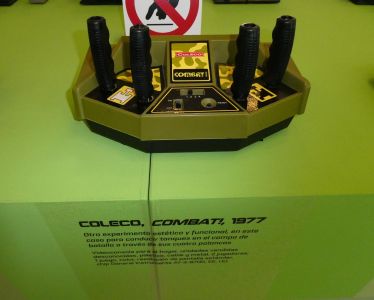 A Combat! on a museum plinth; the label names the AY-3-8700
-
 A Combat! with its box at the Pixel Museum


Related pages
[edit | edit source]- Coleco Telstar Arcade, the cartridge Telstar of 1977
- Coleco Telstar Alpha, the four-game ball-and-paddle Telstar of the same year
- Category:Coleco
References
[edit | edit source]- ↑ 1.0 1.1 1.2 1.3 1.4 1.5 1.6 Coleco Industries, Telstar Combat! Installation Instructions and Game Rules, Model No. 6065, Guide No. 57992 B, 1977, p. 1, File:Coleco Telstar Combat Installation Instructions (Guide 57992B).pdf: four tank battle games (Combat, Robot Battle, Camouflage Battle and Night Battle); realistic battle sound effects; dual tank controls with built-in firing buttons; automatic digital display scoring; plays on any TV; battery operated with six C batteries, not included.
- ↑ 2.0 2.1 2.2 2.3 2.4 2.5 David Winter, Pong-Story, "Coleco Telstar Combat" (retrieved 2026-10-18): model 6065, released in 1977; not a Pong system but a tank combat game; uses General Instrument's AY-3-8700, which offers four variants of the tank game; a case with "ergonomic" joysticks.
- ↑ 3.0 3.1 3.2 3.3 3.4 3.5 3.6 3.7 3.8 "Telstar Combat from Coleco", in "Video Games", Video buyer's guide, Winter 1978, p. 23, Internet Archive scan (retrieved 2026-10-19): Model 6065; four tank battle games (Combat, Night Battle, Robot Battle and Camouflage Combat); dual controls with firing buttons; on-screen digital scoring; game displays in black and white; sound effects of engines, shells and exploding tanks; six "C" batteries, not included; weighs 5½ pounds and measures 15 × 8 × 10½ in (w/h/d); retails for approximately $59.95.
- ↑ 4.0 4.1 Photograph by Jzh2074, File:Coleco Telstar Combat! museum display.jpg (CC BY-SA 4.0, from Wikimedia Commons), read at full size: museum label "Coleco, Combat!, 1977 ... chip General Instruments AY-3-8700, EE. UU."
- ↑ 5.0 5.1 5.2 5.3 5.4 Coleco, Guide No. 57992 B, p. 4: switch box connections (300 ohm twin lead; a 75 to 300 ohm balun for cable TV); pre-set at the factory for use only on channel 3; adjust fine tune, contrast for a white picture with a grey background, and horizontal or vertical hold; panel diagram: white tank player on the left, black tank player on the right, each with a tank control and a tank firing control, ON-OFF switch, game select switch 1 to 4, RESET button, game cable on the right side, AC adapter jack ("use only Coleco adapter Model #6041-200MA").
- ↑ 6.0 6.1 6.2 Coleco, Guide No. 57992 B, p. 3: each tank has two handles; the right handle carries the button that fires the cannon, and its two wires connect to two terminals on the cannon firing lever (the wires are interchangeable); "If terminal breaks loose from lever, game operation will not be affected. However, refastening with household glue, etc., is suggested"; lubricate the tank control levers with soap or Vaseline before sliding the handles on; align the grooves inside each handle with the ribs on the lever; some force may be needed; "Tank Handles are for play of game. Do not use for lifting unit."
- ↑ 7.0 7.1 7.2 7.3 7.4 Coleco, Guide No. 57992 B, p. 2: four rubber suction cups pressed and twisted into holes in the corners of the base ("Do not press too hard so as to damage front of the unit"); six C batteries behind a slide-out door, inserted in the order and direction shown, the two centre batteries last; "Limit use to 2 hours at a time or use Alkaline batteries for extended service"; avoid leaving batteries in the unit; replace batteries first if the game does not work; for extended operation use only the Telstar 9 volt AC adapter Model #6041-200MA; any other 9 V adapter can permanently damage the game.
- ↑ 8.0 8.1 8.2 8.3 8.4 Coleco, Guide No. 57992 B, p. 5: the field may not be centred on screen and may vary from set to set; driving the tanks with the handles (forward, reverse, stop, rotate left and right), with speed rising the longer the handles are held; do not turn brightness and contrast to maximum on a black-and-white set, which can leave a faint game image on the screen; shut the Telstar off when not in use; Combat rules: white tank top left, black tank bottom right; each tank cannot fire again for 3 to 4 seconds after a shot; barriers stop shells; shells can be curved by turning; mines score for the other player; a tank leaving the bottom boundary is captured, and if a tank fails to reappear the game is over and RESET restarts it; 10 points to win, the game ending when "0" flashes on a display, as the number 10 does not appear; the score may vibrate at all times because of the force of the explosions.
- ↑ 9.0 9.1 General Instrument, GIMINI TV Game Circuits, January 1978, pp. 38-41, File:General Instrument GIMINI TV Game Circuits (January 1978).pdf: data sheet for the AY-3-8710/8710-1 "Battle" circuit, with one page headed AY-3-8700/8700-1: 28-lead package for battery systems; two tanks with three forward and three reverse speeds and 32 angles, mines and fixed barriers; one tank white, one black, background grey; firing about once every four seconds; the game ends at 16 hits; clock input 4.0909 MHz; VCC +6.0 to 7.0 V; 12 V maximum on any pin; maximum supply current 75 mA; tanks driven by connecting the A, B, C and D inputs to a strobe output (A and B forward, C and D reverse, B and D clockwise, A and C anticlockwise); reset by momentarily grounding the reset input. The System Diagram (p. 38) runs from +12 V (battery or AC adaptor) through a 2N2219 regulator set to 8.0 V, with 250 µF on the 12 V line that feeds the speaker driver (after a 100 Ω resistor) and 100 µF on the base feed of the series 2N2219, 5 µF coupling capacitors in the sound mixer, 200 µF to an 8 Ω speaker, an adjustable 70-120 µH coil to set the clock to 4.0909 MHz, and a 5 kΩ potentiometer to set the video to 3.0-3.2 V peak.
- ↑ General Instrument, GIMINI TV Game Circuits, January 1978, application note "A Tank 'Battle' TV Game using the AY-3-8710-1", pp. 87-90, File:General Instrument GIMINI TV Game Circuits (January 1978).pdf: GI's reference design runs the chip from an adjustable regulator set between 6.5 and 8.0 V, with a 4.0909 MHz clock from a CMOS 4011A that is "critical for exact frequency and output levels; picture will not appear if incorrectly adjusted"; the tank controls are spring-loaded centre-off switches and the fire buttons normally open; sound through a CMOS 4001A to the speaker driver; an Astec UM1082 modulator fed at 6.8 V from a zener; black and white objects on a grey background.
- ↑ 11.0 11.1 11.2 Coleco, Guide No. 57992 B, p. 6: Robot Battle (game 2; push RESET for a minimum of 2 seconds to start; a single-player game against a black tank that moves at random and fires continuously); Camouflage Battle (game 3; the black tank crosses the screen from right to left); Night Battle (game 4; brightness and contrast set so that the black tank and the mines are barely visible; the black tank is invisible except when a tank hits a mine or a shell is fired).
- ↑ 12.0 12.1 Coleco, Guide No. 57992 B, p. 7: "Telstar - Trouble Shooting Guide": "Be sure all connections to television and switch box are secure. For units using batteries, replace batteries first before trouble shooting. DO NOT OPEN. THIS DEVICE DOES NOT CONTAIN ANY SERVICEABLE PARTS. Warranty is voided if opened or tampered with."; "Push RESET button on Telstar before starting any game"; symptoms and remedies (no game or faint picture; stripes or dots; picture rolls or flutters, bottom line off screen or buzzing; a line moving across the screen; tank not on screen; black tank and mines still visible in night games; white boundary of game not straight); accessories from Coleco Industries, P.O. Box 1250, Gloversville, N.Y.: complete tank handle assembly $10.00, No. 6041-200MA AC adapter $5.00, No. 6111 switch kit $5.00.
- ↑ Photograph by Evan-Amos, File:Coleco-Telstar-AC-Adaptor.jpg (public domain, from Wikimedia Commons): label "TELSTAR AC ADAPTOR MODEL 6041 ... INPUT: 117V 60Hz 5W OUTPUT: 9 V DC 200mA".
