

Coleco Telstar Alpha
 | |
| A Telstar Alpha with HOCKEY, HANDBALL, TENNIS and SQUASH on its game switch | |
| Specifications | |
|---|---|
| Manufacturer | Coleco Industries, Inc., Amsterdam, New York[1] |
| Type | Dedicated home video game console (Pong-type TV game) |
| Released | 1977[2] |
| CPU | None; General Instrument AY-3-8500 game chip[2] |
| Memory | None |
| Storage | None |
| Display | RF output to a television on VHF channel 3, black and white[3] |
| Sound | Hit, score and rebound sounds[1] |
| Power | Six C cells, or Coleco's 9 V AC adapter Model 6041[1] |
| Dimensions | 12 7/8 × 7 1/4 × 2 1/2 in (32.7 × 18.4 × 6.4 cm)[4] |
| OS / Firmware | — |
| Model no. | 6030 |
The Coleco Telstar Alpha (model 6030) is a black-and-white Pong-type TV game made by Coleco and released in 1977.[2][1] It plays four bat-and-ball games (tennis, hockey, handball and jai alai) on a television tuned to channel 3, with two paddle knobs fixed to the console and on-screen scores from 0 to 15. It runs on six C cells or Coleco's 9 V adapter.[1][3] The games come from a single General Instrument AY-3-8500 chip.[2]
History
[edit | edit source]Pong-Story describes the Alpha as the successor to the first three Telstars, the Telstar, Telstar Classic and Telstar Ranger, differing from them in its smaller case and its fourth game, jai alai, which is also known as squash. It was cheap and sold in large numbers, and it was sold in Europe as the Telstar Alpha Europa.[2] Coleco's instructions for model 6030 are dated 1977.[1]
The name of the fourth game varies between units. Coleco's guide and one photographed console label it JAI ALAI;[3][5] another console reads SQUASH,[6] and a unit marked EUROPA has TENNIS, FOOTBALL, HANDBALL and SQUASH on its game switch.[7]
Hardware
[edit | edit source]| Part | Detail |
|---|---|
| Game chip | General Instrument AY-3-8500[2] |
| Picture | Black and white; scores 0 to 15 at the top of the screen[1][8] |
| TV output | Game cable with a phono plug to an antenna switch box; factory set for channel 3[3][9] |
| Controls | Two paddle knobs, RESET button, four-position game switch, three-position Variable Action Control, ON-OFF switch[3] |
| Power | Six C cells behind a slide-out door in the base, or the Telstar 9 V AC adapter Model 6041 in a socket at the rear[1][9] |
General Instrument designed the AY-3-8500 to be battery powered and to need few external parts. The chip makes the games, the scores and the sounds, and takes its timing from a 2 MHz clock; GI's data sheet gives a supply of +6 to +7 V and a typical current of 40 mA.[10] No schematic, parts list or board photograph of the Alpha has been found, so the parts around the chip on Coleco's board are not known.
Controls
[edit | edit source]| Control | Positions | Function |
|---|---|---|
| Game select switch | TENNIS, HOCKEY, HANDBALL, JAI ALAI | Chooses the game[3] |
| Variable Action Control | BEGINNER, INTERMEDIATE, PRO | Ball speed and paddle size: Beginner is the slowest ball with the largest paddle, Pro the fastest[8] |
| RESET | Push button | Starts a new game; also clears lines moving across the screen[8] |
| ON-OFF | Slide switch | Power[3] |
| Left and right paddle controls | Knobs | Move each player's paddle up and down[3][8] |
Coleco left the paddle knobs and the panel decals for the owner to fit. Each knob presses onto its post, with a flat inside the knob lined up with a flat on the post, and the name panel and the left, centre and right panel decals are self-adhesive.[11][12]
Games
[edit | edit source]In tennis the ball serves automatically towards the side that has just missed, and play ends at 15 points; after that the ball still bounces but no hits or scores count until RESET is pressed. Hockey gives each player a goalie and a forward that move together. Handball is a one-player game against the console; Coleco notes that on some units two scores appear, the left counting points against the player and the right counting consecutive hits. In jai alai the two players hit the ball in turn against the back wall, and a ball hit out of turn passes through the paddle.[8]
Power
[edit | edit source]The six C cells go into a compartment behind a battery door that slides out of the base. Coleco sold the TELSTAR 9 volt AC adapter Model 6041 as the alternative and warned that any other 9 V adapter could permanently damage the game and might break FCC rules.[1] The order form lists it as the No. 6041-200MA.[11] The label on a Model 6041 reads "INPUT: 117V 60Hz 5W" and "OUTPUT: 9 V DC 200mA".[13] Neither the label nor the guide gives the plug polarity, so measure any replacement supply before connecting it.
Coleco's guide tells the owner not to leave cells in an unused Telstar, and to replace the cells first whenever the game does not work.[1] Leaking cells corrode the contacts; see Battery Explosion, Capacitor or Corrosion Damage.
Repair
[edit | edit source]Coleco's guide says the Telstar contains no serviceable parts and that opening it voids the warranty. The 1977 guide gives a 90-day warranty, then service for $10 at Coleco's Telstar Division in Amsterdam, New York, up to two years from purchase.[14] No service manual or schematic for the Alpha has been found. The Alpha has its own repair guides:
- Coleco Telstar Alpha General Maintenance: the battery compartment, the adapter, cleaning the switches and paddle controls, and the RF lead and switch box.
- Coleco Telstar Alpha Troubleshooting Guide: what should happen at power-on, reference values for the AY-3-8500, Coleco's own symptom chart and bench checks.
- Coleco Telstar Alpha Capacitor Replacement Guide: what is known about the electrolytic capacitors and how to record your own board's values.
Documentation
[edit | edit source]Coleco's installation instructions (Guide No. 57659 B) and the decal supplement (No. 76638) are hosted here; see Coleco Telstar Alpha Documentation.[1][11] General Instrument's 1978 data book for the AY-3-8500 is described on General Instrument GIMINI TV Game Circuits.
Gallery
[edit | edit source]-
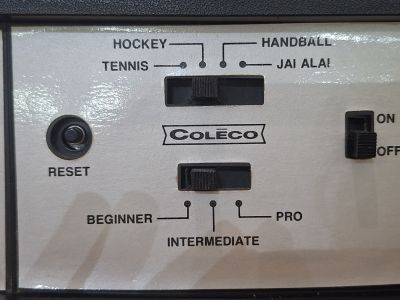 The centre panel of a unit labelled TENNIS, HOCKEY, HANDBALL, JAI ALAI
-
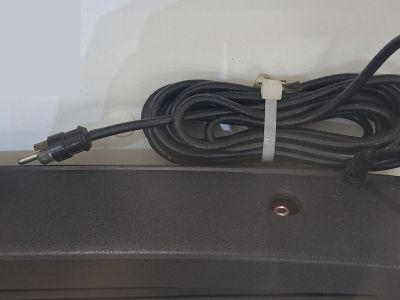 Rear: the game cable with its phono plug and the adapter socket in its recess
-
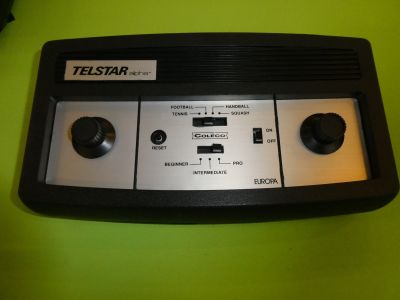 A Telstar Alpha marked EUROPA, with FOOTBALL and SQUASH on the game switch
-
 Bottom view from Coleco's guide: battery door, cell order and the recess for the switch box


Related pages
[edit | edit source]- Coleco Telstar, Coleco Telstar Classic and Coleco Telstar Ranger, the Telstars that came before it
- Coleco Telstar Colormatic, a colour model with the same four games and wired paddles
- Coleco Telstar Colortron, a later colour model with four games
- Category:Coleco
References
[edit | edit source]- ↑ 1.00 1.01 1.02 1.03 1.04 1.05 1.06 1.07 1.08 1.09 1.10 Coleco Industries, Telstar Installation Instructions and Game Rules, Model No. 6030, Guide No. 57659 B, 1977, p. 1, File:Coleco Telstar Alpha Installation Instructions (Guide 57659B).pdf: four video games (tennis, hockey, handball, jai alai); automatic digital display scoring 0-15; three-position speed and paddle size; hit, score and rebound sounds; battery operated with six C cells; the exclusive TELSTAR 9 volt AC adapter Model #6041; "Use of any 9 volt adapter other than the TELSTAR Model #6041 can permanently damage your game"; avoid leaving batteries in the unit; "If your Telstar does not work, replace batteries as your first procedure"; bottom view with the slide-out battery door, the switch box stored in the base and the bumper posts and holes; Coleco Industries, Inc., Amsterdam, N.Y.
- ↑ 2.0 2.1 2.2 2.3 2.4 2.5 David Winter, Pong-Story, "Coleco Telstar Alpha" (retrieved 2026-10-18): model 6030, released in 1977, uses the AY-3-8500 and plays four games at three difficulty levels; successor of the Telstar, Telstar Classic and Telstar Ranger, differing in its case and fourth game (jai-alai, also known as squash); sold in large quantities as it was cheap; also released in Europe as the "Telstar Alpha Europa".
- ↑ 3.0 3.1 3.2 3.3 3.4 3.5 3.6 3.7 Coleco, Guide No. 57659 B, p. 2: connecting the antenna switch box (300 ohm twin lead, a 75 to 300 ohm balun for cable TV); the game is pre-set for channel 3; adjusting fine tune, contrast and the horizontal and vertical hold; the panel diagram (left and right paddle controls, reset button, game select switch TENNIS/HOCKEY/HANDBALL/JAI ALAI, Variable Action Control BEGINNER/INTERMEDIATE/PRO, ON-OFF switch, game cable); "AC adapter (optional) use only Coleco adapter Model #6041".
- ↑ Tempe History Museum, "Coleco Telstar Alpha Console", catalogue number 2019.3.12 (retrieved 2026-10-19): dimensions 12 7/8 × 7 1/4 × 2 1/2 in. (32.7 × 18.4 × 6.4 cm); four games, difficulty switches and two paddle controllers.
- ↑ Photograph by Sintegrity, File:Coleco Telstar Alpha (4).jpg (CC BY-SA 4.0, from Wikimedia Commons): centre panel with RESET, ON/OFF, game switch labelled TENNIS, HOCKEY, HANDBALL, JAI ALAI, and BEGINNER/INTERMEDIATE/PRO switch.
- ↑ Photograph by Keith Pomakis, File:Coleco Telstar Alpha.jpg (CC BY-SA 2.5, from Wikimedia Commons): game switch labelled HOCKEY, HANDBALL, TENNIS, SQUASH.
- ↑ Photograph by Jzh2074, File:Coleco Telstar Alpha (1977) 2.jpg (CC BY-SA 4.0, from Wikimedia Commons), read at full size: panel marked EUROPA, game switch labelled TENNIS, FOOTBALL, HANDBALL, SQUASH.
- ↑ 8.0 8.1 8.2 8.3 8.4 Coleco, Guide No. 57659 B, p. 3: to play the game; Variable Action Control settings; the reset button starts a new game and removes vertical or horizontal lines moving across the screen; after 15 points the ball moves through the paddle but does not score; rules for tennis, hockey, handball (two scores on some units) and jai alai.
- ↑ 9.0 9.1 Photograph by Sintegrity, File:Coleco Telstar Alpha (7).jpg (CC BY-SA 4.0, from Wikimedia Commons): rear of the console with the coiled game cable ending in a phono plug and a round socket in a recess in the case.
- ↑ General Instrument, GIMINI TV Game Circuits, January 1978, pp. 4-6, File:General Instrument GIMINI TV Game Circuits (January 1978).pdf: the AY-3-8500 "is intended to be battery powered and a minimum number of external components are required"; standard conditions VCC +6 to +7 V; power supply current 40 mA typical, 60 mA maximum at +7 V; clock input 2.012160 MHz ±1%.
- ↑ 11.0 11.1 11.2 Coleco, Telstar alpha: Applying Panel Decals & Control Knobs, Supplement No. 76638, Model No. 6030, 1977, page 5 of File:Coleco Telstar Alpha Installation Instructions (Guide 57659B).pdf: name, left, centre and right panel decals; knobs placed on posts with the flat on the knob aligned to the flat on the post; accessories No. 6041-200MA AC Adapter and No. 6111 Switch Kit, $5.00 each.
- ↑ David Winter, Pong-Story, "Coleco Telstar systems" (retrieved 2026-10-18): Coleco sold its systems partially assembled, electronically ready, with the knobs and decorative stickers for the user to fit.
- ↑ Photograph by Evan-Amos, File:Coleco-Telstar-AC-Adaptor.jpg (public domain, from Wikimedia Commons), read at full size: label "TELSTAR AC ADAPTOR MODEL 6041 ... INPUT: 117V 60Hz 5W OUTPUT: 9 V DC 200mA MADE IN TAIWAN".
- ↑ Coleco, Guide No. 57659 B, p. 4: "Telstar - Trouble Shooting Guide" ("Do not open. This device does not contain any serviceable parts. Warranty is voided if opened or tampered with."); 90-day limited warranty; service policy at $10.00, with no obligation to service a Telstar more than 2 years after purchase; returns to Coleco Industries, Telstar Division, Bldg. #52, 10 Park St., Amsterdam, New York.
