Tandy 1000 SL
 | |
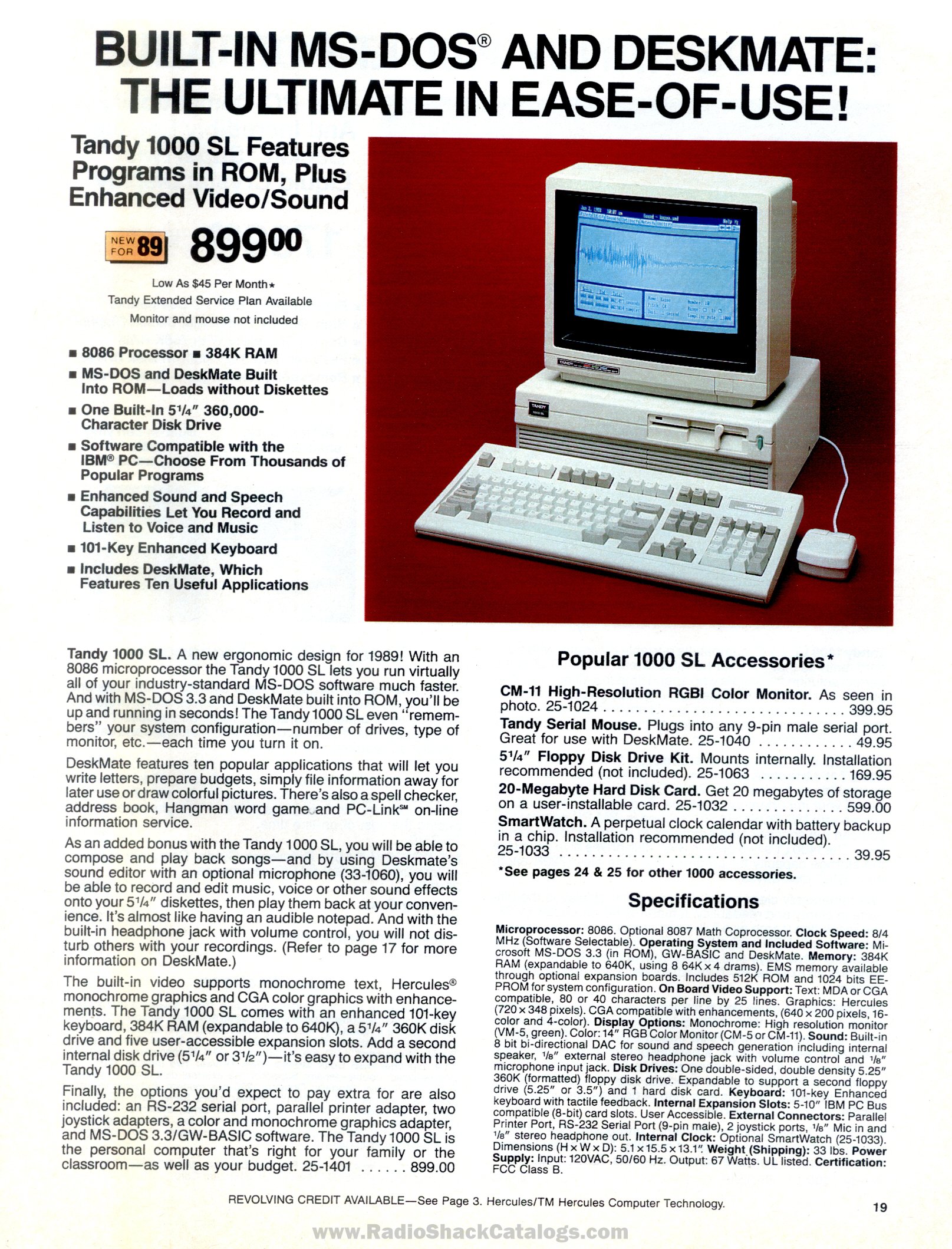
| A Tandy 1000 SL with CM-11 monitor and Tandy serial mouse, from Radio Shack's 1989 computer catalogue | |
| Specifications | |
|---|---|
| Manufacturer | Tandy Corporation, sold by Radio Shack |
| Type | Desktop personal computer (IBM PC compatible) |
| CPU | Intel 8086, 8 MHz or 4 MHz (software selectable); socket for an 8087 |
| Memory | 384 KB, expandable to 640 KB on the main board |
| Storage | One 5.25-inch 360 KB floppy drive; room for a second floppy drive and a hard disk card |
| Display | Built-in Tandy video: CGA compatible with extra modes, and Hercules-compatible monochrome |
| Sound | Three-voice sound circuit and an 8-bit DAC with microphone input |
| Power | Internal supply, 67 W output, 120 V AC |
| OS / Firmware | MS-DOS 3.3 and DeskMate in ROM |
| Model no. | 25-1401 |
The Tandy 1000 SL is a desktop IBM PC compatible in the Tandy 1000 family, introduced in Radio Shack's 1989 catalogue as "a new ergonomic design for 1989". It has an 8086 processor, MS-DOS 3.3 and DeskMate in ROM, an EEPROM that holds the machine's configuration, and new video and sound hardware with a digital-to-analogue converter for recording and playing back sound.[1] Wikipedia describes the SL and TL as updates of the Tandy 1000 SX and Tandy 1000 TX with redesigned cases and a more integrated main board, and notes that the composite video output was dropped.[2]
History
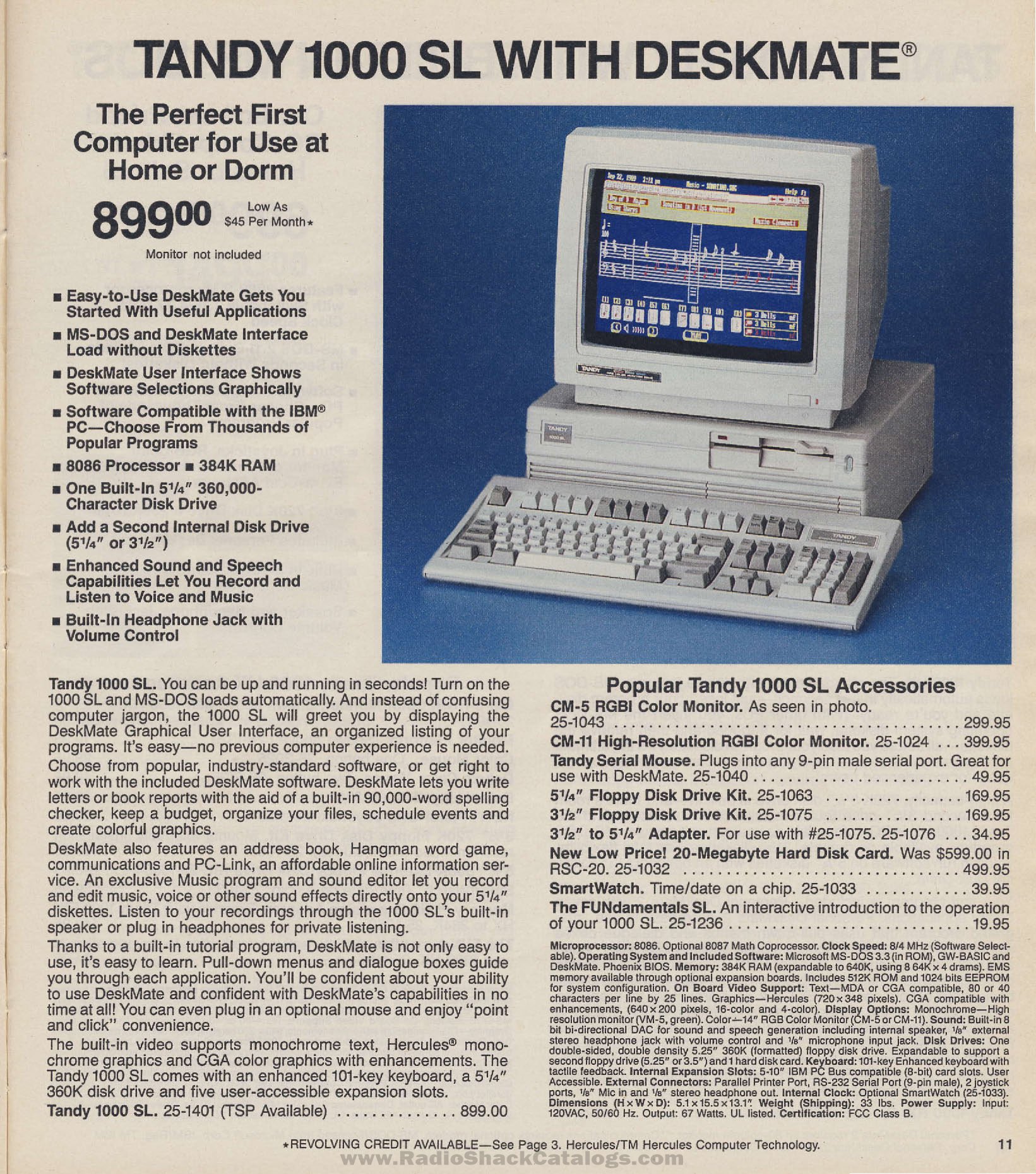
[edit | edit source]The SL cost $899 in the 1989 catalogue, catalogue number 25-1401, and was still listed at that price in 1990.[1][3] It was sold alongside the 80286-based Tandy 1000 TL, and was followed by the Tandy 1000 SL/2, which has a 3.5-inch drive and 512 KB of memory.[2] The Tandy 1000 FAQ lists a rare 1000 PC that is "mostly the same as the SL".[4] One collector reports that some SLs were sold to stores with a network boot option, as terminals for point-of-sale systems.[5]
Specifications
[edit | edit source]| Item | Specification |
|---|---|
| Processor | 8086, 8 MHz or 4 MHz, software selectable; optional 8087 maths coprocessor |
| Memory | 384 KB RAM, expandable to 640 KB with eight 64K x 4 DRAMs |
| ROM | 512 KB, holding MS-DOS 3.3 and DeskMate; 1024-bit EEPROM for the configuration |
| Video | MDA or CGA compatible text; Hercules graphics (720 x 348); CGA graphics with enhancements (640 x 200 in 16 colours) |
| Sound | 8-bit bidirectional DAC for sound and speech, internal speaker, 3.5 mm stereo headphone jack with volume control, 3.5 mm microphone jack |
| Storage | One 5.25-inch 360 KB drive; room for a second floppy drive (5.25-inch or 3.5-inch) and one hard disk card |
| Expansion | Five 10-inch 8-bit PC bus slots |
| Ports | Parallel printer port, RS-232 serial (9-pin male), two joystick ports, microphone in, headphone out |
| Clock | None as standard; SmartWatch (25-1033) optional |
| Keyboard | 101-key keyboard |
| Size | 5.1 x 15.5 x 13.1 in (H x W x D); shipping weight 33 lb |
| Power | 120 V AC, 50/60 Hz; supply output 67 W |
Source: Radio Shack catalogue RSC-20.[1] The 1990 catalogue adds that the BIOS is by Phoenix.[3]
Hardware
[edit | edit source]Processor and memory
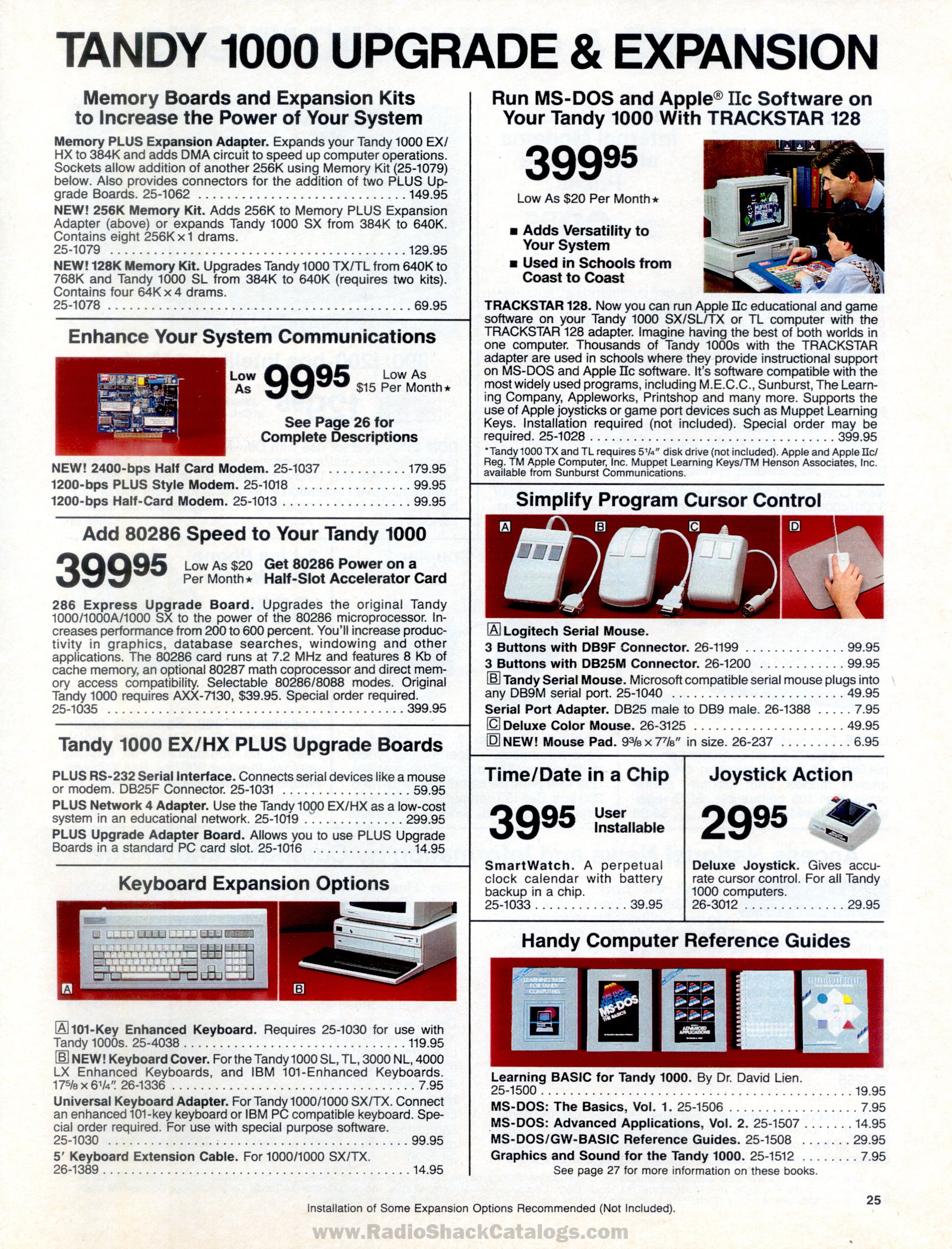
[edit | edit source]The 8086 is socketed and can be replaced with a NEC V30, which the FAQ says gives about a 30% speed-up.[6] Memory beyond 384 KB goes in sockets on the main board; Tandy's 128K memory kit took the SL from 384 KB to 640 KB with two kits.[7][8] The video circuit shares system memory, so DOS reports less than the total installed.[8]
Video
[edit | edit source]The FAQ calls the SL's video "Tandy Video II" or ETGA. It drives a digital CGA monitor or a monochrome TTL monitor; pressing Ctrl-Alt-Shift-V restarts the machine and switches the monitor type, which is stored in the EEPROM. With a monochrome monitor the video is Hercules compatible. It keeps the earlier Tandy modes and adds a 640 x 200 16-colour mode that the BIOS does not support.[9]
Sound
[edit | edit source]Wikipedia describes the sound hardware as an 8-bit DAC and ADC that supports DMA transfers and sampling rates up to 48 kHz. The microphone and earphone jacks, the volume control and the reset button are on a small satellite board, with a jumper that changes the microphone input to line level.[2]
Storage
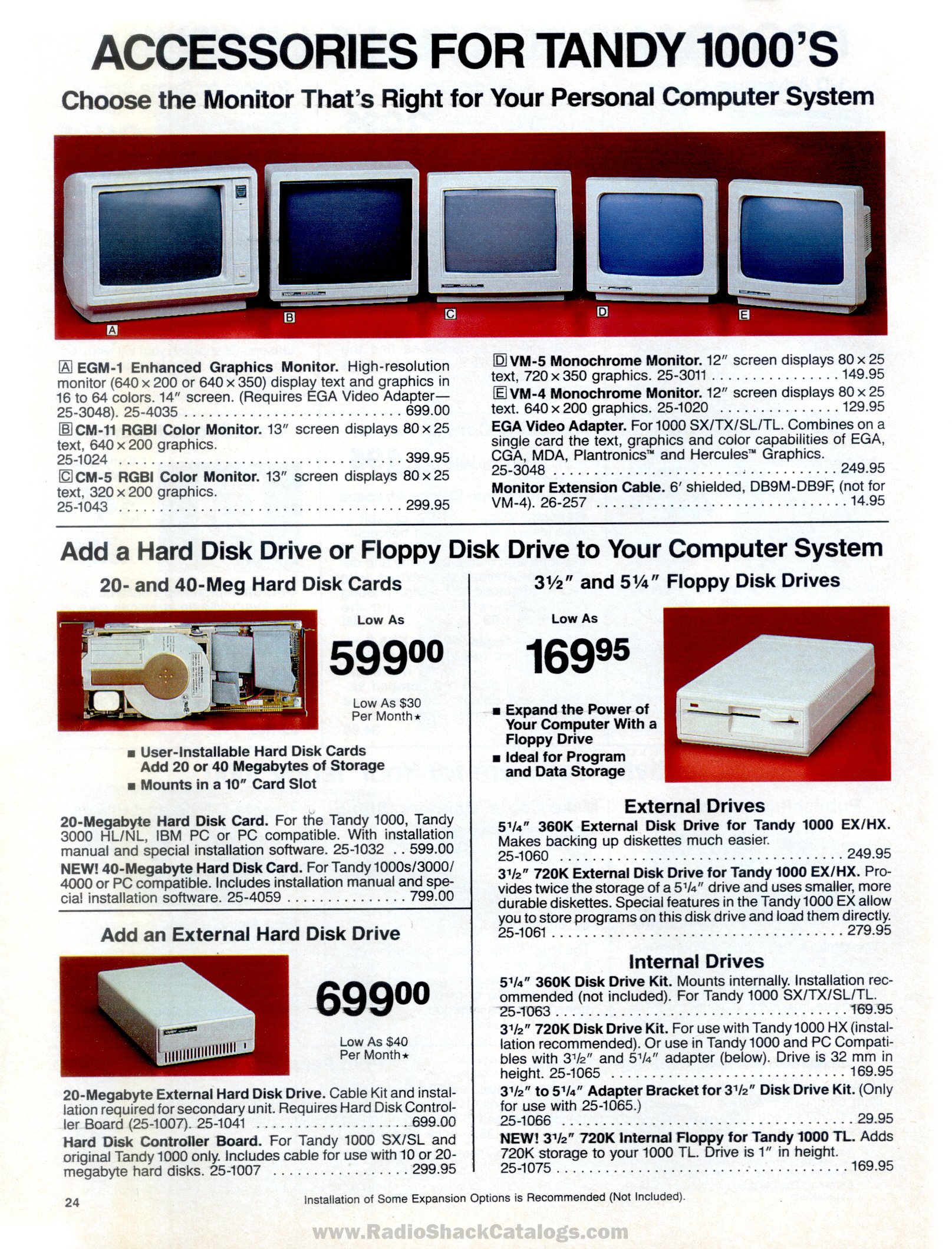
[edit | edit source]The SL uses a standard 360 KB 5.25-inch drive.[10] Wikipedia notes that the SL is the only model in the line with an upper 5.25-inch bay, so it has two 5.25-inch bays.[2] The SL has no built-in hard disk interface. Tandy sold a 20 MB hard disk card and a hard disk controller board (25-1007) for the SX, SL and original 1000.[11] The FAQ says most 8-bit MFM or RLL controllers work, but the Western Digital WD1004 does not.[12]
Keyboard and ports
[edit | edit source]The SL takes an XT keyboard (or an XT/AT switchable one) with a standard 5-pin DIN plug.[13] An owner who tried AT keyboards got wrong characters until told the SL needs an XT keyboard or a converter.[14] The printer port is a card-edge connector that needs a Tandy 1000 printer cable.[15]
Clock
[edit | edit source]The SL has no clock as standard. The SmartWatch (Dallas DS1216E) fits a special socket on the main board.[16]
Power supply
[edit | edit source]The catalogue gives the supply's output as 67 W from a 120 V AC, 50/60 Hz input.[1] No service data for the SL supply has been found; Tandy's Tandy 1000 SL Technical Reference Manual (25-1516) was sold for $49.95 in 1989.[17]
Known faults
[edit | edit source]- The machine stops at power-on with "Err I/O of port 378h". Owners have linked it to a printer cable fitted upside down, a failed EEPROM and other faults on the main board; one case was not solved. See Tandy 1000 SL Troubleshooting Guide.[18]
- A corrupted EEPROM can leave the machine stopped at the memory count.[19]
- One owner keeps a dead SL main board with corrosion from leaking capacitors as a source of spare chips.[18]
- One owner reports zinc whiskers on his SL's chassis.[18]
Documentation
[edit | edit source]- Tandy 1000 SL/2 Installation and Operation (1989), for the closely related SL/2. File:Tandy 1000 SL2 Installation and Operation Manual (1989).pdf
- The Tandy 1000 SL Technical Reference Manual (25-1516) is not hosted here.
Related pages
[edit | edit source]- Tandy 1000 SL General Maintenance
- Tandy 1000 SL Troubleshooting Guide
- Tandy 1000 SL/2
- Tandy 1000 TL
- Tandy 1000
References
[edit | edit source]- ↑ 1.0 1.1 1.2 1.3 Radio Shack, computer catalogue RSC-20 (1989), p. 19, "Built-in MS-DOS and DeskMate: the ultimate in ease-of-use!", page scan at RadioShackCatalogs.com (retrieved 2026-10-22).
- ↑ 2.0 2.1 2.2 2.3 "Tandy 1000", Wikipedia (retrieved 2026-10-21). Sections "Tandy 1000 SL and TL series" and "1000 SL and SL/2".
- ↑ 3.0 3.1 Radio Shack, computer catalogue RSC-21 (1990), p. 11, "Tandy 1000 SL with DeskMate", page scan at RadioShackCatalogs.com (retrieved 2026-10-22).
- ↑ Jeff Hayes, "Tandy 1000-series FAQ", version 2.52, 25 October 2005, TVDog's Tandy 1000 archive (retrieved 2026-10-21). Section I.
- ↑ "Tandy 1000 SL", Vintage Computer Federation forum, April 2024, thread. Posts by almoerman (21 and 27 April 2024) and kb2syd (26 April 2024).
- ↑ Hayes, "Tandy 1000-series FAQ" (2005), sections II.F.1 and II.F.2.
- ↑ Radio Shack, computer catalogue RSC-20 (1989), p. 25, "128K Memory Kit", page scan at RadioShackCatalogs.com (retrieved 2026-10-22).
- ↑ 8.0 8.1 Hayes, "Tandy 1000-series FAQ" (2005), sections II.A.1 and II.A.3.
- ↑ Hayes, "Tandy 1000-series FAQ" (2005), section II.B.5.
- ↑ Hayes, "Tandy 1000-series FAQ" (2005), sections II.C.2 and II.C.5.
- ↑ Radio Shack, computer catalogue RSC-20 (1989), p. 24, "Hard Disk Controller Board", page scan at RadioShackCatalogs.com (retrieved 2026-10-22).
- ↑ Hayes, "Tandy 1000-series FAQ" (2005), section II.D.1.
- ↑ Hayes, "Tandy 1000-series FAQ" (2005), section II.E.1.
- ↑ "Need help with Tandy 1000SL keyboard problem", Vintage Computer Federation forum, June 2024, thread. Posts by D50_Dude, eswan and keenerb (5-8 June 2024).
- ↑ Hayes, "Tandy 1000-series FAQ" (2005), section II.H.2, printer cable selection grid.
- ↑ Hayes, "Tandy 1000-series FAQ" (2005), sections III.E.2 and IV.G.
- ↑ Radio Shack, computer catalogue RSC-20 (1989), p. 27, technical reference manuals, page scan at RadioShackCatalogs.com (retrieved 2026-10-22).
- ↑ 18.0 18.1 18.2 "1000SL Err I/O of port 378h, not booting", Vintage Computer Federation forum, February 2021 to November 2024, thread. Posts by keenerb, Trixter, bakemono, ACC and Cloudschatze.
- ↑ Hayes, "Tandy 1000-series FAQ" (2005), sections II.K.8 and III.F.2.