Tandy 1000 TL/2
 | |
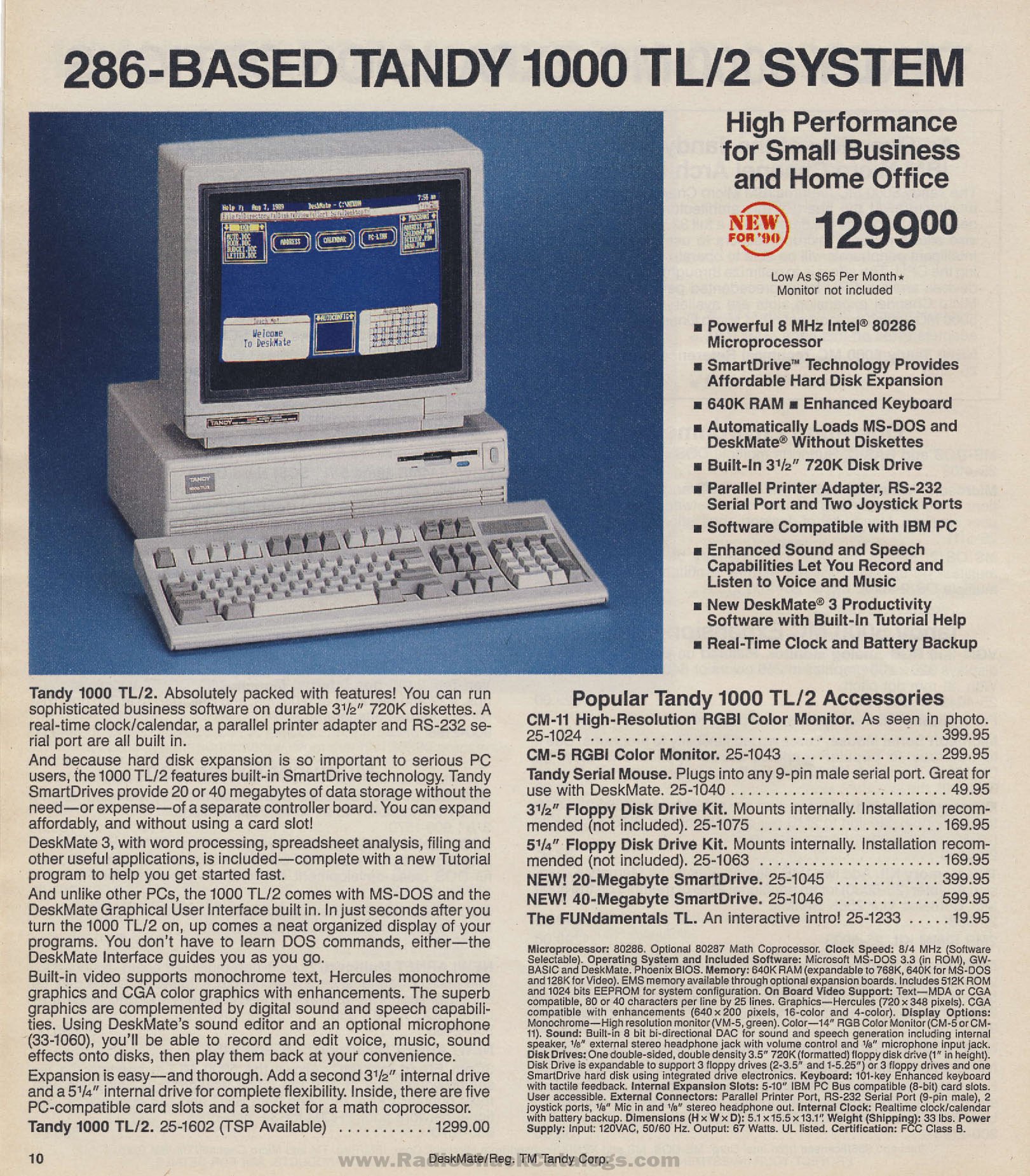
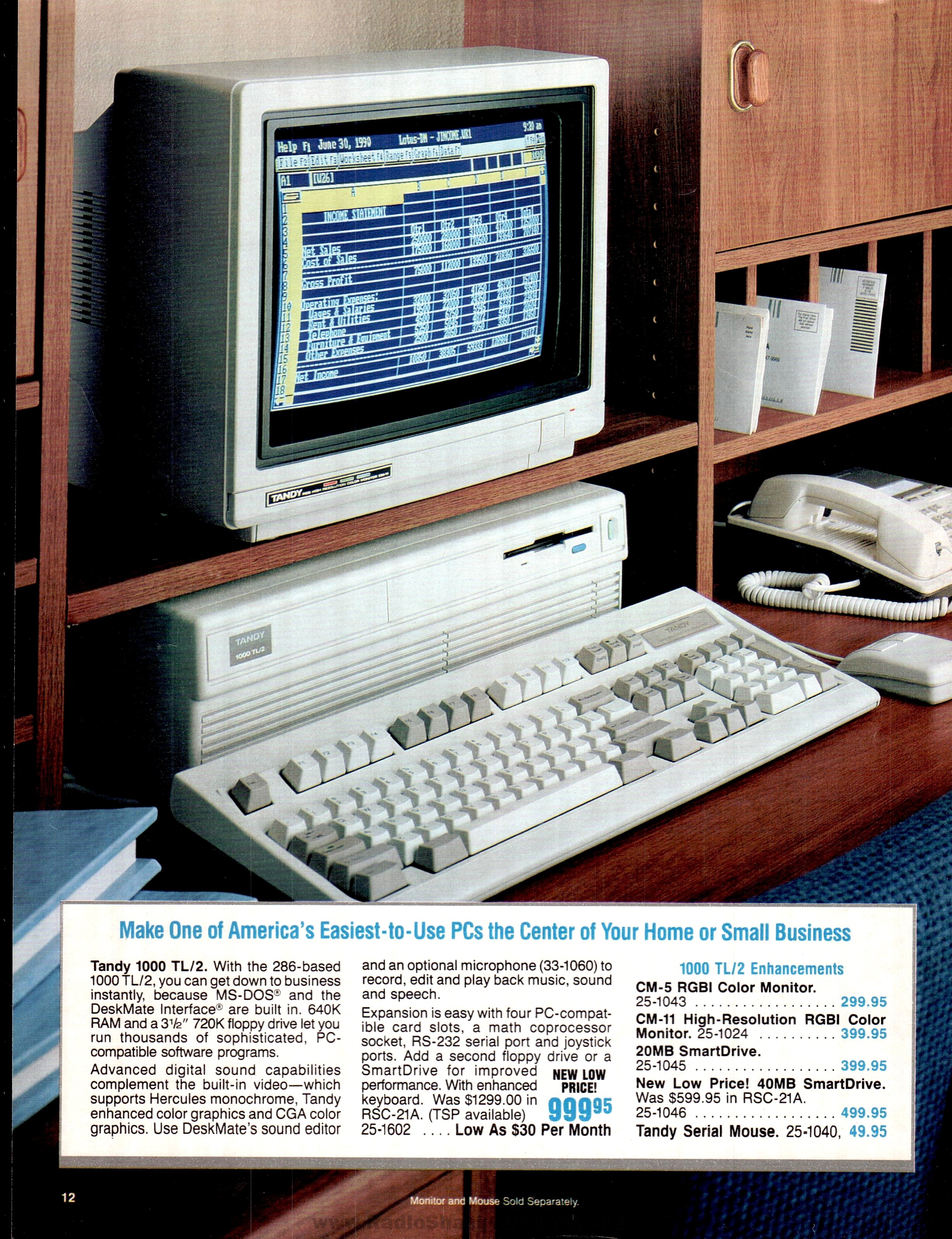
| A Tandy 1000 TL/2 with CM-11 monitor, from Radio Shack's 1990 computer catalogue | |
| Specifications | |
|---|---|
| Manufacturer | Tandy Corporation, sold by Radio Shack |
| Type | Desktop personal computer (IBM PC compatible) |
| CPU | Intel 80286, 8 MHz or 4 MHz (software selectable); socket for an 80287 |
| Memory | 640 KB, expandable to 768 KB (128 KB of it for video) |
| Storage | One 3.5-inch 720 KB floppy drive; built-in XT IDE ("SmartDrive") hard disk interface |
| Display | Built-in Tandy video: CGA compatible with extra modes, and Hercules-compatible monochrome |
| Sound | 8-bit DAC for sound and speech, with microphone input |
| Power | Internal supply, 67 W output; 120 V AC (US) or 240 V AC (Australia) |
| OS / Firmware | MS-DOS 3.3 and DeskMate 3 in ROM |
| Model no. | 25-1602 |
The Tandy 1000 TL/2 is a revised Tandy 1000 TL, introduced in Radio Shack's 1990 catalogue. It keeps the TL's 8 MHz 80286, video, sound and DOS in ROM, and adds a built-in interface for Tandy's XT IDE "SmartDrive" hard disks, so a 20 MB or 40 MB drive can be fitted without a controller card.[1] The interface is XT IDE, which is not compatible with the common AT IDE drives.[2]
History
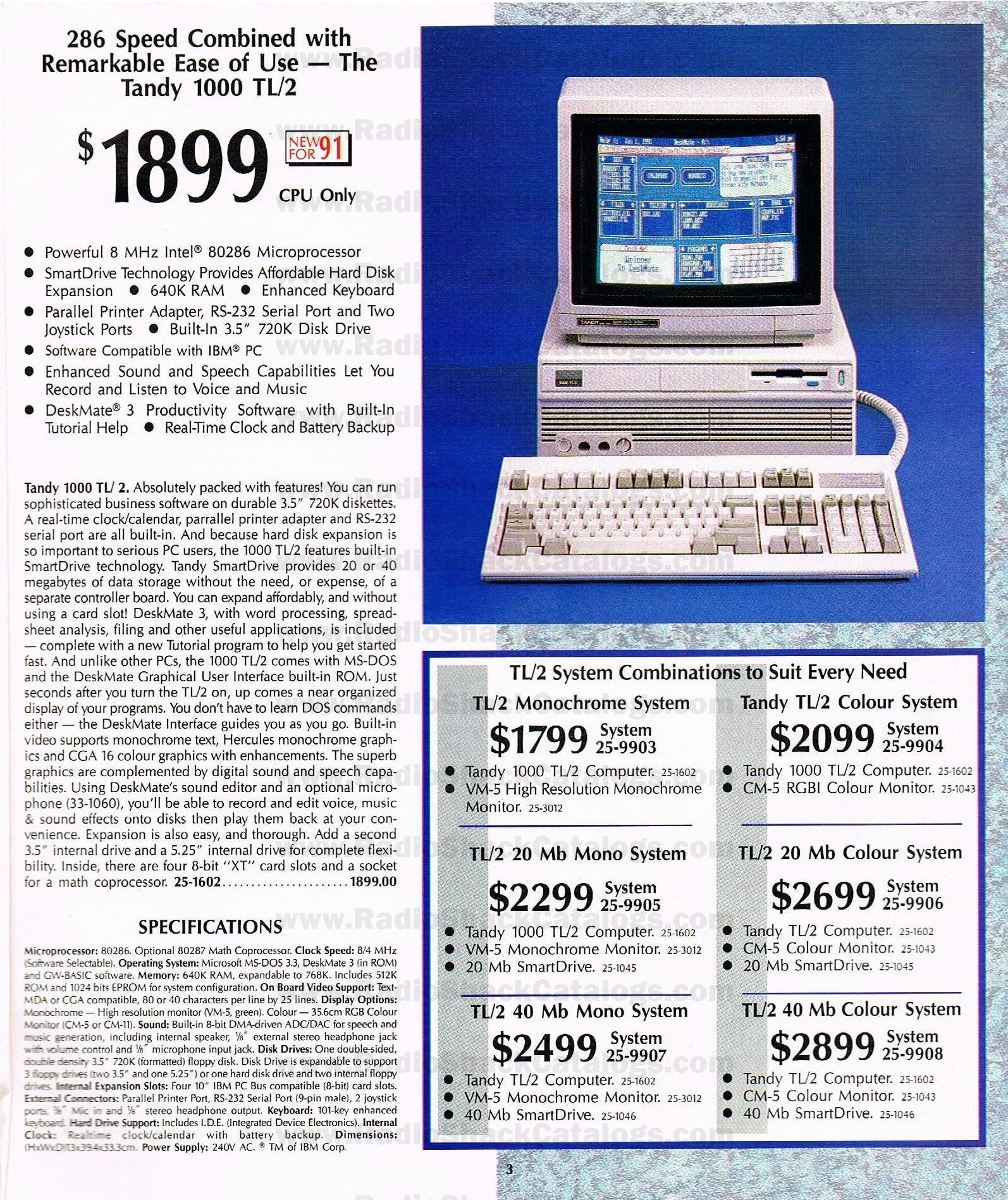
[edit | edit source]The TL/2 cost $1,299 in the 1990 catalogue, catalogue number 25-1602, with 20 MB (25-1045) and 40 MB (25-1046) SmartDrives as options.[1] Radio Shack's 1991 catalogue cut the price and offered TL/2 home-office and point-of-sale systems.[3] Tandy Australia sold a 240 V version.[4] The Tandy 1000 TL/3 replaced it.[2]
Specifications
[edit | edit source]| Item | Specification |
|---|---|
| Processor | 80286, 8 MHz or 4 MHz, software selectable; optional 80287 maths coprocessor |
| Memory | 640 KB RAM, expandable to 768 KB (640 KB for MS-DOS, 128 KB for video) |
| ROM | 512 KB, holding MS-DOS 3.3 and DeskMate; Phoenix BIOS; 1024-bit EEPROM for the configuration |
| Video | MDA or CGA compatible text; Hercules graphics (720 x 348); CGA graphics with enhancements (640 x 200 in 16 colours) |
| Sound | 8-bit bidirectional DAC, internal speaker, 3.5 mm stereo headphone jack with volume control, 3.5 mm microphone jack |
| Storage | One 3.5-inch 720 KB drive, 1 inch high; up to three floppy drives (two 3.5-inch, one 5.25-inch), or three floppy drives and one SmartDrive hard disk |
| Expansion | 10-inch 8-bit PC bus slots: five in the 1990 catalogue, four in the 1991 US and Australian catalogues |
| Ports | Parallel printer port, RS-232 serial (9-pin male), two joystick ports, microphone in, headphone out |
| Clock | Real-time clock and calendar with battery backup |
| Size | 5.1 x 15.5 x 13.1 in (H x W x D); shipping weight 33 lb |
| Power | 120 V AC, 50/60 Hz; supply output 67 W |
Source: Radio Shack catalogue RSC-21, except where noted.[1] The slot count conflicts: the 1990 catalogue gives five, while the 1991 US catalogue, the Australian catalogue and Wikipedia give four.[3][4][2] Count the slots on the machine in hand.
Hardware
[edit | edit source]Memory and processor
[edit | edit source]The extra 128 KB uses four 64K x 4 DRAMs of 120 ns in the sockets next to the other RAM chips, in front of the expansion slots; there is no jumper.[5] An owner reports an 80287XL working in his TL/2, and the FAQ says 386 and 486 daughterboards such as Improve Technologies' "Make it 486" fit in place of the 80286.[6][7]
Hard disk interface
[edit | edit source]The built-in interface takes only XT IDE drives, which were never made larger than 40 MB, and XT IDE drives cannot be chained. The FAQ lists suitable drives, among them the Seagate ST325X and ST351A/X and the Western Digital WD93028 and WD93044-X.[8]
- Tandy's SmartDrives were installed with HINSTALL.PDM from DeskMate. Do not run Tandy DOS's HSECT or AUTOFMT on an XT IDE drive; the FAQ says they make it unusable.[8]
- To boot from the hard disk, set the system setup program to boot from DISK with MS-DOS as the start-up program.[8]
- For a larger drive, fit an AT IDE or SCSI controller in a slot. MFM and RLL controllers do not work in the TL/2. An added controller's ROM should be set to CC00h or CE00h to avoid the built-in controller at C800h. Tandy's XT IDE card (25-1088) does not work in the TL/2, but its AT IDE hardcard (25-1095) and the Silicon Valley ADP50T do.[8]
- One owner runs a Lo-tech XT-CF CompactFlash adapter in a TL/2. It worked with the card's offset BIOS at C800h and port 300h, alongside a 2 MB EMS card set to D000h; a 3 MB EMS card would not work with it.[9]
Floppy drives, keyboard and ports
[edit | edit source]The 3.5-inch drives take their power through the data cable.[10] The keyboard is an XT type with a 5-pin DIN plug, and the printer port is a card-edge connector that needs a Tandy 1000 printer cable.[11]
BIOS
[edit | edit source]The FAQ lists BIOS 02.00.01 as the TL/2's latest. Tandy sold it as an upgrade to DeskMate 3.05, and on the TL/2 it also corrects a possible loss of sound with a VGA card fitted.[12]
Power supply
[edit | edit source]The catalogue gives the supply's output as 67 W.[1] No service data for the TL/2 supply has been found.
Known faults
[edit | edit source]Faults reported on the TL family, including floppy drive and boot-device problems, are covered in Tandy 1000 TL Troubleshooting Guide. EEPROM corruption can stop the machine at the memory count.[13]
Related pages
[edit | edit source]- Tandy 1000 TL General Maintenance
- Tandy 1000 TL Troubleshooting Guide
- Tandy 1000 TL
- Tandy 1000 TL/3
- Tandy 1000
References
[edit | edit source]- ↑ 1.0 1.1 1.2 1.3 Radio Shack, computer catalogue RSC-21 (1990), p. 10, "286-based Tandy 1000 TL/2 system", page scan at RadioShackCatalogs.com (retrieved 2026-10-22).
- ↑ 2.0 2.1 2.2 "Tandy 1000", Wikipedia (retrieved 2026-10-21). Sections "Tandy 1000 SL and TL series" and "1000 TL, TL/2 and TL/3".
- ↑ 3.0 3.1 Radio Shack, computer catalogue RSC-22 (1991), pp. 12-13, "Tandy 1000 TL/2", page scan at RadioShackCatalogs.com (retrieved 2026-10-22).
- ↑ 4.0 4.1 Tandy Australia, computer catalogue no. 293 (1990-91), p. 3, "Tandy 1000 TL/2", page scan at RadioShackCatalogs.com (retrieved 2026-10-22).
- ↑ Jeff Hayes, "Tandy 1000-series FAQ", version 2.52, 25 October 2005, TVDog's Tandy 1000 archive (retrieved 2026-10-21). Sections II.A.1 and II.A.3.
- ↑ "Compatible 287 math co-processor for a Tandy 1000TL", Vintage Computer Federation forum, August 2021, thread. Post by jasa1063, 17 August 2021.
- ↑ Hayes, "Tandy 1000-series FAQ" (2005), section II.F.1.
- ↑ 8.0 8.1 8.2 8.3 Hayes, "Tandy 1000-series FAQ" (2005), sections II.D.1, II.D.2 and II.D.3.
- ↑ "Tandy 1000 TL/2 XT-CF and EMS notes", Vintage Computer Federation forum, August 2025, thread. Post by mhenry1762, 23 August 2025.
- ↑ Hayes, "Tandy 1000-series FAQ" (2005), sections II.C.2 and II.C.5.
- ↑ Hayes, "Tandy 1000-series FAQ" (2005), sections II.E.1 and II.H.2.
- ↑ Hayes, "Tandy 1000-series FAQ" (2005), section III.E.2, BIOS version table.
- ↑ Hayes, "Tandy 1000-series FAQ" (2005), sections II.K.8 and III.F.2.