Tandy 1000 TL General Maintenance

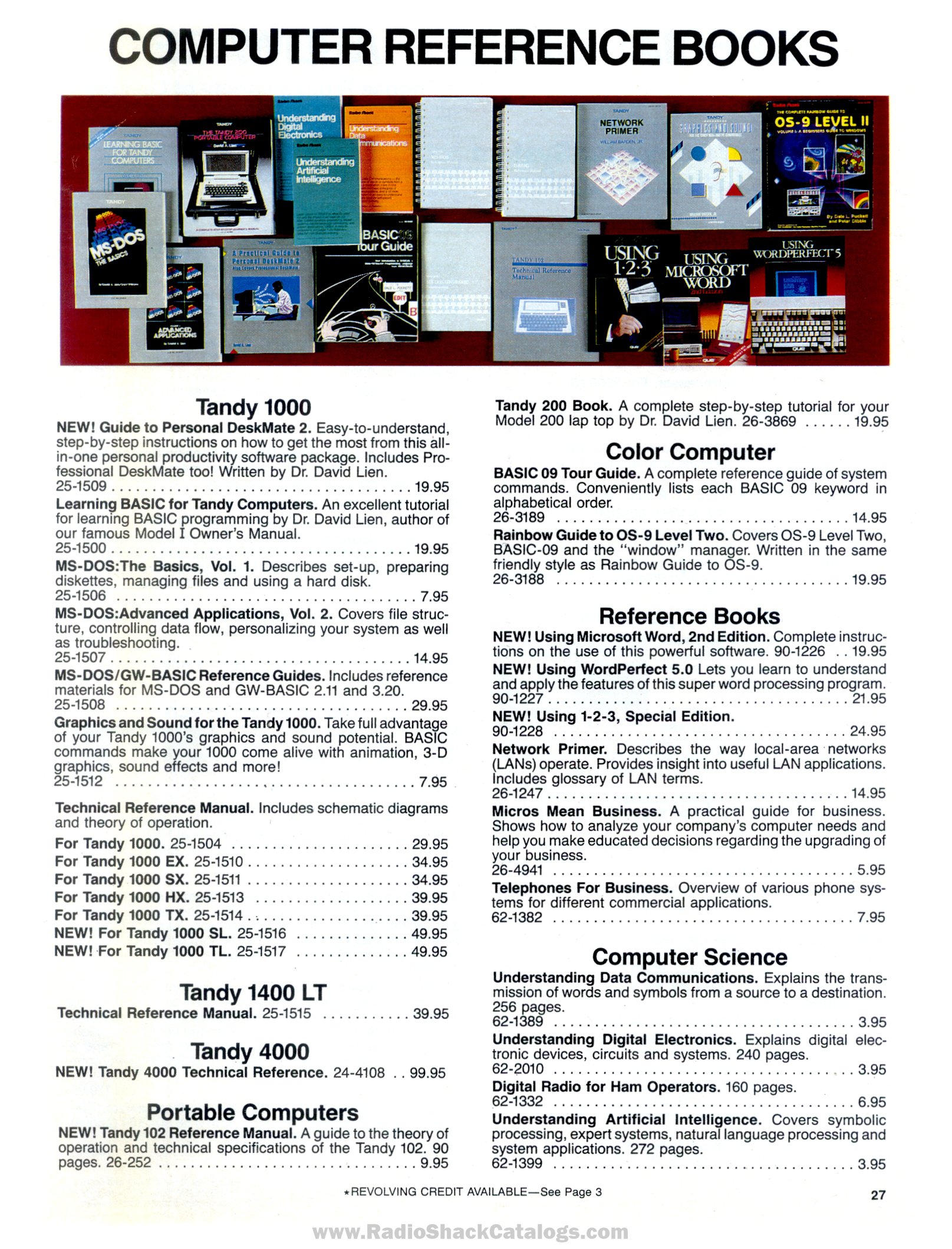
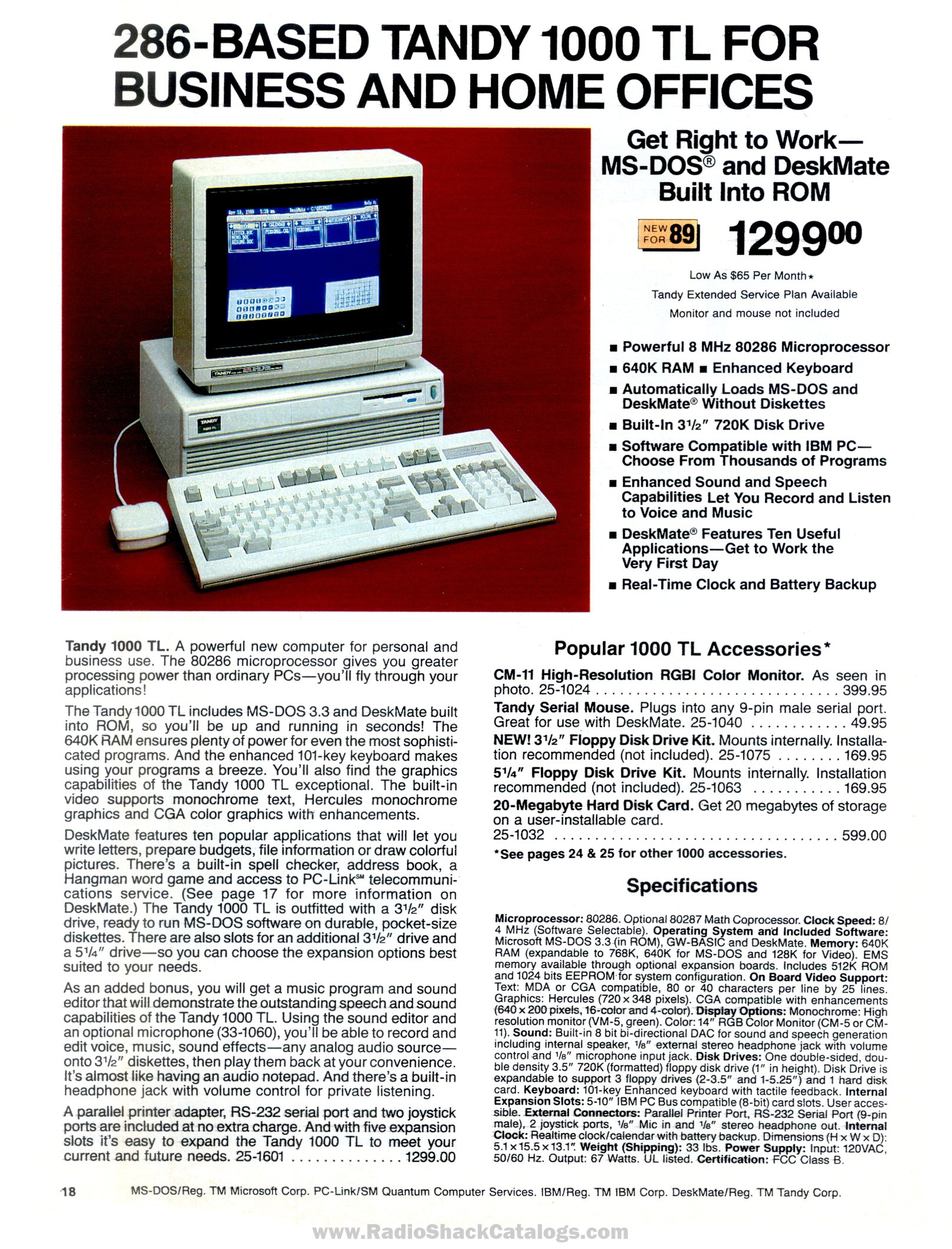
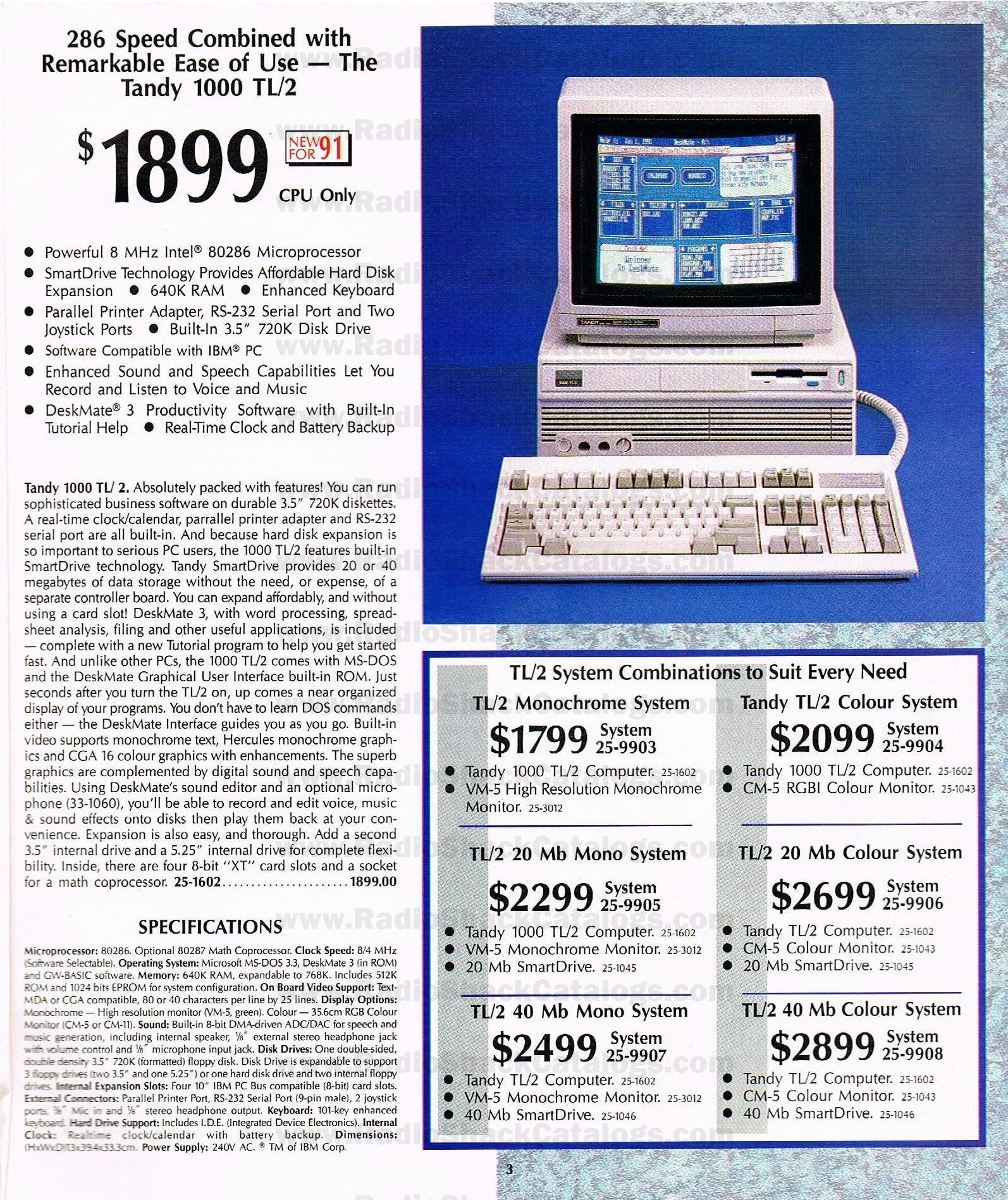
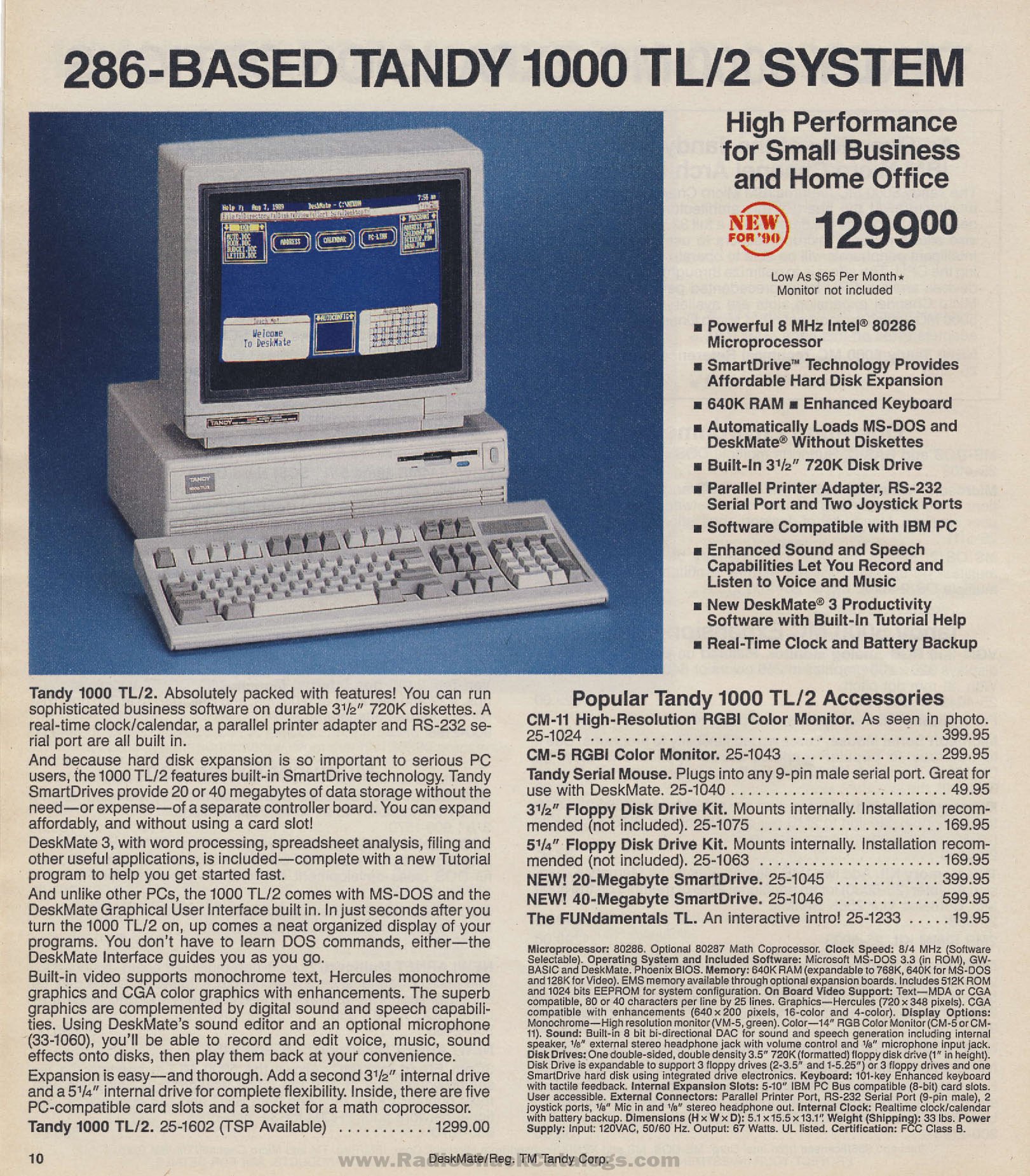
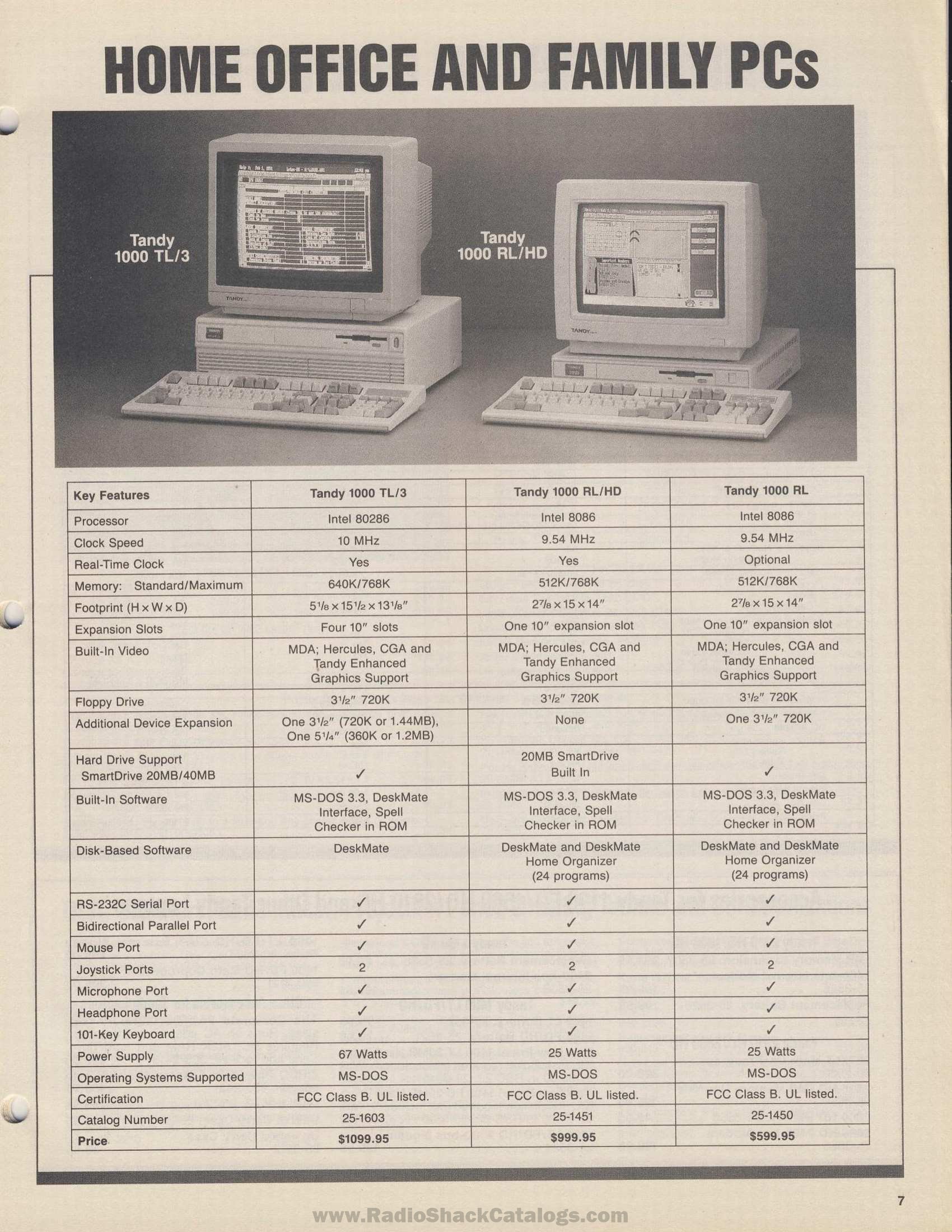
Routine care of the Tandy 1000 TL, Tandy 1000 TL/2 and Tandy 1000 TL/3 covers the power supply, the clock battery, the floppy drives, the TL/2 and TL/3 hard disk interface, memory and processor options, and the EEPROM settings. Tandy's technical reference manual for the TL (25-1517) could not be obtained, so the notes below draw on Radio Shack's catalogues, the Tandy 1000 FAQ, Tandy's 1995 parts list for the TL/3 and owners' reports.[1] Wikipedia and the FAQ treat the TL family's video, sound and EEPROM setup as shared with the SL family.[2][3] Tandy 1000 SL General Maintenance covers the SL/2 owner's manual procedures for the case, jumpers and options.
 | The supply runs from the mains. Unplug the computer before removing the cover. US machines are rated for 120 V AC; Tandy Australia sold 240 V versions of the TL/2. Check the rating label before connecting the machine to the mains. |
Model differences
[edit | edit source]| Item | TL | TL/2 | TL/3 |
|---|---|---|---|
| Processor | 80286, 8/4 MHz | 80286, 8/4 MHz | 80286, 10 MHz |
| Hard disk | Card or controller in a slot | Built-in XT IDE (SmartDrive) | Built-in XT IDE (SmartDrive) |
| Floppy controller | Low density only | Low density only | Accepts 1.44 MB and 1.2 MB drives |
| Slots | Five | Four or five (sources differ) | Four |
| Memory sockets for 640-768 KB | U36-U39, 120 ns | Next to the other RAM, 120 ns | U4-U7, 100 ns |
| Printer port | Card edge | Card edge | 25-pin, bidirectional option |
| Mouse port | None | None | PS/2-style connector |
| Catalogue number | 25-1601 | 25-1602 | 25-1603 |
Sources: Radio Shack catalogues and the Tandy 1000 FAQ.[4][6][7][8]
Power supply
[edit | edit source]All three models have a 67 W supply; the TL/3's is Tandy part TA0455.[4][7][9] No voltage limits or schematic for the TL supplies could be found. With the machine running, check for +5 V on the red wire and +12 V on the yellow wire of a drive power connector, and inspect the supply for leaking or bulging electrolytic capacitors.[10] The TL/3 parts list includes a 680 µF 200 V capacitor (C6) and two fuse ratings listed as F1, 1 A 125 V and 3 A 250 V fast-blow, but does not say which board each sits on.[9]
Clock battery
[edit | edit source]The TL series has a built-in clock powered by a removable 3 V CR2032 coin cell.[3] On the TL/3 the cell sits in holder J3.[9] Replace a flat cell with another CR2032. The battery runs only the clock: the setup settings are in the EEPROM and are not lost when the battery is removed.[11]
Floppy drives
[edit | edit source]- The TL family's 3.5-inch drives are Tandy-style drives that take power through the data cable, on pins 3, 5, 7, 9 and 11 (+5 V) and 29, 31 and 33 (+12 V). Replace one only with another Tandy-style drive, or modify the cable as the FAQ describes; a standard drive on the unmodified cable can damage the drive and the computer.[12]
- The FAQ lists Sony MP-F11W-71 and MP-F11W-72 among suitable low-density drives, and one owner's TL has a Sony MP-F11W-70D.[12][13] That drive has two electrolytic capacitors, which the owner replaced during a repair.[13]
- The cable is straight, not twisted; each drive's select jumper sets A: or B:.[12]
- The second 3.5-inch bay in the TL has only part of a shelf. One owner thinks Radio Shack's drive kit came with a bracket to support the drive; another suggests removing the shared bracket, fitting the drive and refitting the bracket, or securing the drive by its left-hand screw holes.[14]
- After a DOS upgrade, a 720 KB drive may format at 360 KB; add
DRIVPARM=/D:0 /F:2 /H:2 /S:9 /T:80to CONFIG.SYS for drive A:.[15]
General drive cleaning is covered on Floppy Drive Repair.
Hard disks
[edit | edit source]- TL: no built-in interface. Most 8-bit hard disk controllers work.[16]
- TL/2 and TL/3: the built-in interface takes XT IDE drives only, up to 40 MB, one drive. Do not use Tandy DOS's HSECT or AUTOFMT on them. For a larger drive, fit an AT IDE or SCSI controller and set its ROM to CC00h or CE00h. MFM and RLL controllers do not work in the TL/2; only Seagate ones work in the TL/3.[16]
- An XT-CF CompactFlash adapter has been used in a TL/2 with its offset BIOS at C800h and port 300h.[17]
- To boot from a hard disk, set the boot device to DISK with MS-DOS as the start-up program.[16]
Memory and processor
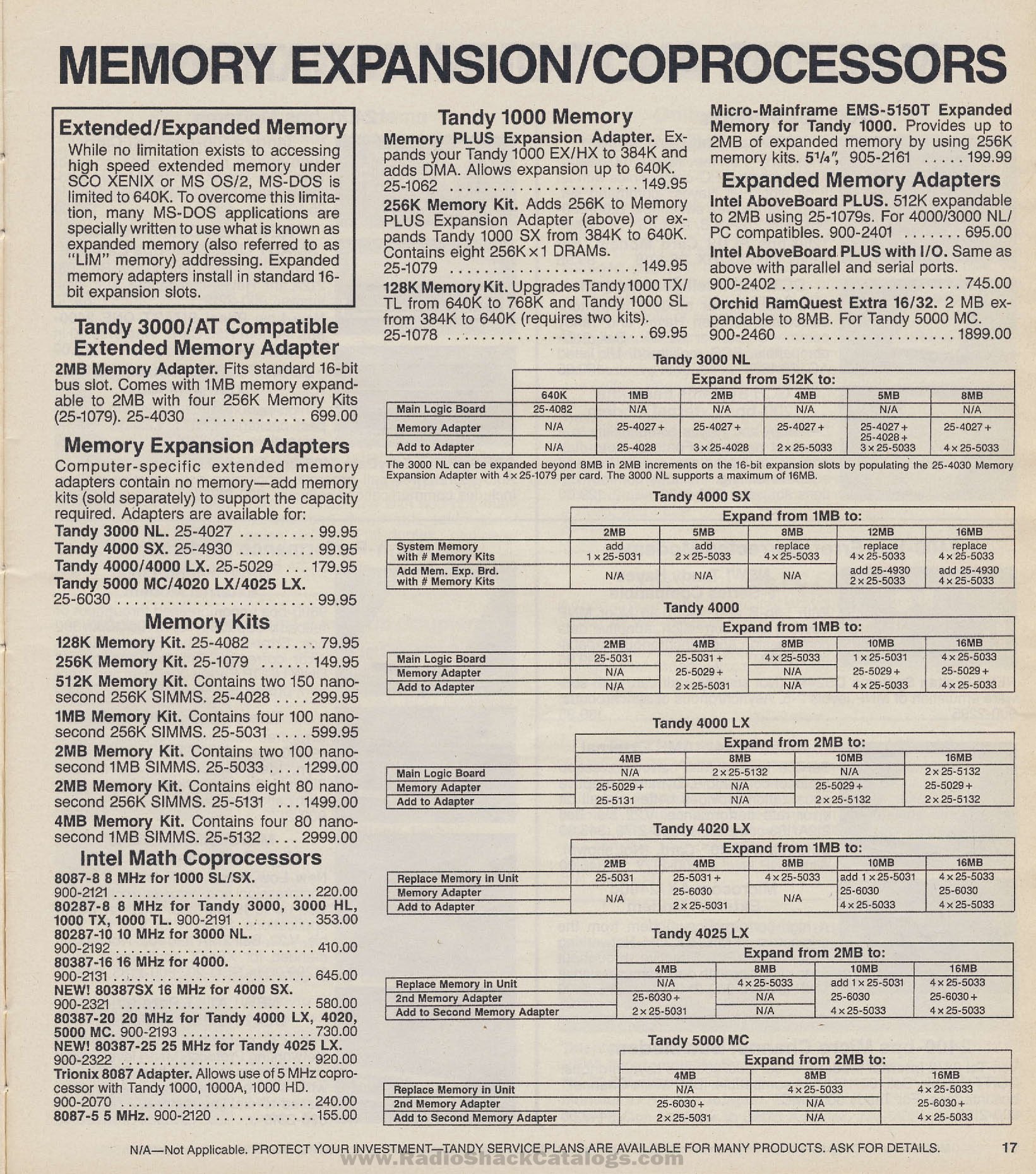
[edit | edit source]- Fit four 64K x 4 DRAMs to go from 640 KB to 768 KB (see the table above). The extra memory goes to video, so DOS gains only part of it.[18]
- The 80287 socket takes an 80287-8, which Radio Shack sold for the TL; an owner reports an 80287XL working in a TL/2.[19][20]
- 386 and 486 daughterboards fit the TL and TL/2, but not the TL/3.[21]
- Expansion cards must be no longer than 10.5 inches.[3]
EEPROM and setup
[edit | edit source]Settings live in a serial EEPROM and are changed with the model's own setup program (SETUPTL on the TL). SETUPTL /A gives access to more settings, including the amount of video memory; /B edits the raw EEPROM bits; /F restores the factory defaults. The FAQ warns that /A and /B can leave the machine unbootable.[22] It also warns that DOS 5 or 6 can scramble the EEPROM on Tandy 1000s with DOS in ROM.[23] On the TL/3, the mouse port may need enabling in the setup program.[24]
Keyboard and printer
[edit | edit source]- The TL and TL/2 take an XT keyboard with a 5-pin DIN plug; the FAQ thinks the TL/3 takes an XT keyboard with a PS/2 plug.[25]
- The TL and TL/2 printer ports are card edges and need a Tandy 1000 printer cable; the TL/3 has a standard 25-pin port.[26]
Maintenance checklist
[edit | edit source]- Check the rating label before connecting the mains.
- Unplug the machine before removing the cover.
- Remove dust from the supply, fan and drives.
- Inspect the supply and main board for leaking electrolytics.
- Replace a flat CR2032 clock cell.
- Clean the floppy heads and check the drive select jumpers.
- Note the setup program's settings before changing DOS versions.
Related pages
[edit | edit source]- Tandy 1000 TL
- Tandy 1000 TL/2
- Tandy 1000 TL/3
- Tandy 1000 TL Troubleshooting Guide
- Tandy 1000 SL General Maintenance
- Recommended Tools
References
[edit | edit source]- ↑ Radio Shack, computer catalogue RSC-20 (1989), p. 27, technical reference manuals, page scan at RadioShackCatalogs.com (retrieved 2026-10-22).
- ↑ Hayes, "Tandy 1000-series FAQ" (2005), section II.B.5.
- ↑ 3.0 3.1 3.2 "Tandy 1000", Wikipedia (retrieved 2026-10-21). Sections "Tandy 1000 SL and TL series" and "1000 TL, TL/2 and TL/3".
- ↑ 4.0 4.1 4.2 Radio Shack, computer catalogue RSC-20 (1989), p. 18, Tandy 1000 TL specifications, page scan at RadioShackCatalogs.com (retrieved 2026-10-22).
- ↑ Tandy Australia, computer catalogue no. 293 (1990-91), p. 3, Tandy 1000 TL/2 specifications, page scan at RadioShackCatalogs.com (retrieved 2026-10-22).
- ↑ Radio Shack, computer catalogue RSC-21 (1990), p. 10, Tandy 1000 TL/2 specifications, page scan at RadioShackCatalogs.com (retrieved 2026-10-22).
- ↑ 7.0 7.1 Radio Shack, computer catalogue RSC-22A (1991), p. 7, "Home office and family PCs", page scan at RadioShackCatalogs.com (retrieved 2026-10-22).
- ↑ Jeff Hayes, "Tandy 1000-series FAQ", version 2.52, 25 October 2005, TVDog's Tandy 1000 archive (retrieved 2026-10-21). Sections II.A.1, II.C.1, II.D.1, II.G.5 and II.H.2.
- ↑ 9.0 9.1 9.2 Tandy National Parts, bill of materials 250-1603 "Tandy 1000 TL-3", January 1995, 25-1603.txt, TVDog's Tandy 1000 archive (retrieved 2026-10-21).
- ↑ Hayes, "Tandy 1000-series FAQ" (2005), section II.C.3, drive power cable colours.
- ↑ Hayes, "Tandy 1000-series FAQ" (2005), sections II.K.8 and III.E.1.
- ↑ 12.0 12.1 12.2 Hayes, "Tandy 1000-series FAQ" (2005), sections II.C.2 and II.C.5.
- ↑ 13.0 13.1 "Disk change not working on Tandy 1000TL floppy drive", Vintage Computer Federation forum, January 2026, thread. Post by jamonyorke, 21 January 2026.
- ↑ "Tandy 1000TL second 3.5", Vintage Computer Federation forum, May 2020, thread. Posts by Smack2k, Quagmire and vwestlife, 1 May 2020.
- ↑ Hayes, "Tandy 1000-series FAQ" (2005), section II.C.6.
- ↑ 16.0 16.1 16.2 Hayes, "Tandy 1000-series FAQ" (2005), sections II.D.1 to II.D.3.
- ↑ "Tandy 1000 TL/2 XT-CF and EMS notes", Vintage Computer Federation forum, August 2025, thread. Post by mhenry1762, 23 August 2025.
- ↑ Hayes, "Tandy 1000-series FAQ" (2005), sections II.A.1 to II.A.3.
- ↑ Radio Shack, computer catalogue RSC-21 (1990), p. 17, "Intel math coprocessors", page scan at RadioShackCatalogs.com (retrieved 2026-10-22).
- ↑ "Compatible 287 math co-processor for a Tandy 1000TL", Vintage Computer Federation forum, August 2021, thread. Post by jasa1063, 17 August 2021.
- ↑ Hayes, "Tandy 1000-series FAQ" (2005), section II.F.1.
- ↑ Hayes, "Tandy 1000-series FAQ" (2005), sections III.F.1 and III.F.2.
- ↑ Hayes, "Tandy 1000-series FAQ" (2005), section III.A.2.
- ↑ Hayes, "Tandy 1000-series FAQ" (2005), section II.G.5.
- ↑ Hayes, "Tandy 1000-series FAQ" (2005), section II.E.1.
- ↑ Hayes, "Tandy 1000-series FAQ" (2005), section II.H.2.