

Macintosh 512K
 | |
| Macintosh 512K | |
| Specifications | |
|---|---|
| Manufacturer | Apple Computer, Inc. |
| Type | Personal computer |
| Released | 10 September 1984 |
| Discontinued | 14 April 1986 |
| Intro price | US$3,195 |
| CPU | Motorola 68000 @ 7.83 MHz |
| Memory | 512 KB, soldered |
| Storage | Internal single-sided 400 KB 3.5-inch floppy drive |
| Display | 9-inch monochrome CRT, 512 × 342 pixels |
| Sound | Four-voice, 8-bit D/A conversion, 22 kHz sampling |
| ROM | 64 KB |
| Ports / interface | DB-19 external floppy; DE-9 mouse; RJ-11 keyboard; 2 × RS-232/RS-422 serial (DE-9) |
| Power | 105–125 V AC, 50–60 Hz, 60 W maximum (US model) |
| Dimensions | 13.6 in H × 9.6 in W × 10.9 in D (34.5 × 24.4 × 27.6 cm) |
| Weight | 16 lb 8 oz (7.5 kg) |
| OS / Firmware | System 1.1 – System 4.1 |
| Predecessor | Macintosh 128K |
| Successor | Macintosh 512Ke |
| Codename | Fat Mac |
| Model no. | M0001W |
The Macintosh 512K is a Macintosh 128K with 512 KB of RAM instead of 128 KB. The processor, the 64 KB ROM, the 9-inch monochrome screen and the single-sided 400 KB floppy drive are the same, and Apple's Service Source covers the two machines in one volume.[1] Apple introduced it on 10 September 1984 at US$3,195 and replaced it with the Macintosh 512Ke on 14 April 1986.[2][3] Its codename was Fat Mac.[3]
The 512K has no SCSI port and no memory sockets, and its drive reads only single-sided 400 KB disks. The Macintosh Plus of 1986 added a SCSI port, SIMM sockets taking up to 4 MB and a double-sided 800 KB drive.[4]
Specifications
[edit | edit source]| Item | Specification |
|---|---|
| CPU | Motorola 68000, 7.83 MHz, 32-bit internal data bus |
| RAM | 512 KB (the same manual covers the 128 KB machine) |
| ROM | 64 KB |
| PRAM | CMOS custom chip with 256 bytes of parameter memory, backed by a 4.5 V user-replaceable battery |
| Floppy drive | Internal single-sided 3.5-inch drive, 400 KB |
| External floppy | DB-19 connector |
| Mouse | DE-9 connector; mechanical tracking, optical shaft encoding at 3.54 pulses per mm (90 per inch) |
| Keyboard | 58 keys, software mapped, RJ-11 connector |
| Serial | Two RS-232/RS-422 ports, DE-9 connectors |
| Sound | Four-voice, 8-bit digital/analogue conversion, 22 kHz sampling rate |
| Video | 9-inch diagonal screen, 512 × 342 bit-mapped display |
| Line voltage | 105–125 V AC, 50–60 Hz |
| Maximum power | 60 W |
| Dimensions | 13.6 × 9.6 × 10.9 in (34.5 × 24.4 × 27.6 cm) |
| Weight | 16 lb 8 oz (7.5 kg) |
The manual prints only the 105–125 V rating. The 220–240 V machine sold elsewhere carries its own rating label (model M0001WP, 220–240 V, 0.5 A, 60 W, shown in the gallery below).
Memory and upgrades
[edit | edit source]The 512 KB is soldered to the logic board. Apple's upgrade path was a set of kits, documented in the Service Source Upgrades chapter:[6]
- The Floppy Drive Upgrade Kit replaces the 400 KB drive with an 800 KB drive and the two ROMs with a pair that supports both drives. The ROMs sit at D5 (ROM HI) and D8 (ROM LOW), notched ends towards the front of the computer. Apple does not recommend this kit for the 128K.
- The Logic Board Upgrade Kit can only be fitted after the Floppy Drive Upgrade Kit. It replaces the logic board with a Macintosh Plus board carrying 1 MB of RAM, and includes a new RFI shield and rear cover. The ROMs are moved across from the old board.
- The 400K Drive ROM Upgrade is needed when a later 400 KB drive with a new stepper motor is fitted to a 128K or 512K; the new ROMs work with both the old and new motors.
Third-party memory boards were also sold. Larry Pina's The Dead Mac Scrolls describes repeatable system errors on a 512K or 512Ke immediately after a Dove MacSnap 524 or 548 board was prised off with a screwdriver: the fix is to repair the traces cut near the 41256 DRAM at G5.[7] For the SIMM-based memory of the later compacts see the Macintosh Plus Memory Upgrade Guide.
Maintenance
[edit | edit source]The 512K is serviced as the same machine as the 128K. See Macintosh 128K/512K General Maintenance, Macintosh 128K/512K Troubleshooting and Macintosh 128K/512K Capacitor Replacement Guide.
The machine contains a CRT and a mains-powered power/sweep board. Read CRT Discharge Procedure before opening the case. Apple warns that the edges of the metal chassis may be sharp, and that a grounding wrist strap must not be worn until the CRT has been discharged.[8]
Voltage adjustment
[edit | edit source]The 128K, 512K and Plus have a published voltage adjustment. Apple's procedure:[9]
- Remove the cover. Set the voltmeter to the 20 V range.
- Connect the Macintosh voltage test cable (Apple part number 077-0135) to the external drive port. Pull the rubber hoods over the plugs not in use: shorting them together can damage the computer.
- Connect the meter's black lead to the chassis and the orange test-cable lead to the meter input. Switch on and adjust the voltage regulator on the power/sweep board to between 11.90 V and 12.75 V.
- Switch off, hood the orange lead, and connect the red lead. Switch on and adjust to between 4.85 V and 5.15 V.
- Repeat both measurements. If the board will not bring both voltages inside those limits, replace the power/sweep board.
Apple says to make the adjustment from the rear of the machine, watching the screen in a mirror, and not to reach around the computer. The voltages must be checked whenever the logic board or the power/sweep board is replaced.[9]
Video adjustment
[edit | edit source]After replacing the CRT or the power/sweep board, Apple sets brightness with the external contrast control fully clockwise (brightness turned up until the white lines just disappear, then contrast back 1/8 turn), and sets the raster to 7 in (177.8 mm) wide and 4.7 in (119.4 mm) high with the width and height controls.[10]
Known faults
[edit | edit source]Apple's symptom charts put the voltage adjustment first for a machine that beeps continuously and tries to power up, or that clicks or chirps. For smoke, or for no picture, no sound and no drive activity, Apple cautions that replacing only the power supply board may damage the new board, and says to replace the power supply board, logic board and internal drive together before switching on.[11] Those are module-level instructions; The Dead Mac Scrolls gives component-level fixes for the same machines:
- A 512K or 512Ke that resets an ImageWriter II connected directly to the printer port several times at start-up, where the same printer works on the modem port and an ImageWriter I works on either port, has a faulty 26LS30 line driver at logic board location B6.[12] The same part at B6 is Pina's fix for a 128K, 512K or 512Ke that does not appear on an AppleTalk network.[13]
- A 128K whose original analogue board has been paired with an upgraded logic board, and which shows repeatable system errors that other Macs do not, has a low +5 V rail. If the voltage adjustment cannot raise it, Pina replaces the 1N5349B (12 V, 5 W) zener diode at CR18 on the analogue board.[14] The 128K and 512K use the same power/sweep board.[15]
- A 512K or 512Ke with the Dove MacSnap fault described under Memory and upgrades.[7]
Service parts
[edit | edit source]Part numbers from Apple's exploded view, which covers both the 128K and the 512K.[15] The two board numbers are copied as printed; both have one digit more than Apple's usual 661-xxxx form.
| Part | Apple part number |
|---|---|
| CRT and yoke assembly | 076-0103 |
| Floppy drive | 661-7615 (400K); 661-0345 (800K) |
| Internal drive cable | 590-0167 (red); 590-0437 (yellow) |
| Internal drive shield | 805-0765 (400K); 805-0217 (800K) |
| CRT socket cable | 590-0160 |
| Power/sweep board | 661-76214 (as printed). Apple's Macintosh Plus Service Source and 1994 Module Identification manual list 661-76214 as the 220 V board; the 110 V module is 661-0461 or 661-0462[16] |
| Logic board | 661-06236 (as printed) |
| Front bezel | 810-0373 |
| Rear housing | 630-5139 |
| Chassis | 805-0766 |
| RFI shroud | 805-0577 |
Documentation
[edit | edit source]- Macintosh 128K/512K Service Source: Apple's module-level manual for the 128K and 512K (specifications, symptom charts, take-apart, upgrade kits, voltage and video adjustments, exploded view).
- The Dead Mac Scrolls: component-level fault entries for the 128K, 512K and 512Ke in chapter 1.
- Chilton's Guide to Macintosh Repair and Maintenance: a repair book written for the 128K and 512K.
- Apple Technical Procedures: Macintosh and Macintosh Plus
Gallery
[edit | edit source]-
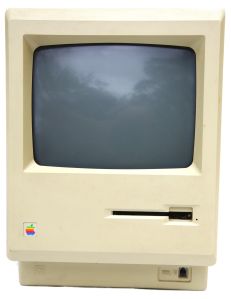 Macintosh 512K
-
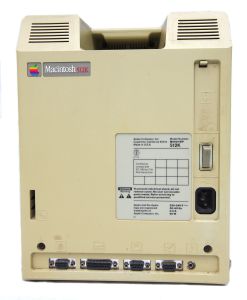 Rear label of a 220–240 V Macintosh 512K (model M0001WP)

Related pages
[edit | edit source]- Macintosh 128K
- Macintosh 512Ke
- Macintosh Plus
- Macintosh 128K/512K General Maintenance
- Macintosh 128K/512K Troubleshooting
- Macintosh 128K/512K Capacitor Replacement Guide
- Sad Mac Error Codes and the Sad Mac Decoder
- CRT Discharge Procedure
- Repair guides for the analog (power/sweep) board, which the 128K, 512K, 512Ke and Plus share, are written on the Plus: Macintosh Plus Power Supply Repair, Macintosh Plus Low Voltage Repair, Macintosh Plus Flyback Transformer Replacement, Macintosh Plus Horizontal Sweep Repair, Macintosh Plus Vertical Deflection Repair, Macintosh Plus Focus Repair, Macintosh Plus Video Adjustment
- Macintosh 128K RAM Chip Replacement, for a Sad Mac code that names a RAM chip
- Mouse repair guides: Apple Mouse Button Switch Replacement, Apple Mouse Cable Repair, Apple Mouse Axle Bearing Repair
References
[edit | edit source]- ↑ Apple Computer, Macintosh Service Source (128K and 512K), Basics, Overview, p. 1 (PDF p. 3). Hosted as File:Macintosh 128k.512k.pdf; see Macintosh 128K/512K Service Source.
- ↑ Apple Macintosh 512K Specs, EveryMac.com—link(accessed 2026-09-30) Introduction and discontinued dates, price, model number M0001W.
- ↑ 3.0 3.1 Macintosh 512K, apple-history.com—link(accessed 2026-09-30) Codename Fat Mac; minimum OS System 1.1/Finder 1.1g, maximum System 4.1/Finder 5.5; price US$3,195; replaced by the 512Ke in April 1986.
- ↑ Apple Computer, Macintosh Plus Service Source, Specifications, Memory, Disk Storage and I/O Interfaces, pp. 3-5 (PDF pp. 7-9). Hosted as File:Macintosh_Plus.pdf.
- ↑ Apple Computer, Macintosh Service Source (128K and 512K), Specifications, pp. 1-8 (PDF pp. 5-12).
- ↑ Apple Computer, Macintosh Service Source (128K and 512K), Upgrades, pp. 1-15 (PDF pp. 45-59).
- ↑ 7.0 7.1 Larry Pina, The Dead Mac Scrolls, Peachpit Press, 1992, chapter 1 "Early Macs", p. 68. Hosted as File:The Dead Mac Scrolls 1992.pdf; see The Dead Mac Scrolls.
- ↑ Apple Computer, Macintosh Service Source (128K and 512K), Take Apart, pp. 1-20 (PDF pp. 24-43).
- ↑ 9.0 9.1 Apple Computer, Macintosh Service Source (128K and 512K), Adjustments, Voltage, pp. 1-6 (PDF pp. 61-66).
- ↑ Apple Computer, Macintosh Service Source (128K and 512K), Adjustments, Video, pp. 14-17 (PDF pp. 74-77).
- ↑ Apple Computer, Macintosh Service Source (128K and 512K), Troubleshooting, Symptom Charts, pp. 2-9 (PDF pp. 15-22).
- ↑ Pina, The Dead Mac Scrolls, p. 72.
- ↑ Pina, The Dead Mac Scrolls, p. 73.
- ↑ Pina, The Dead Mac Scrolls, pp. 69-70.
- ↑ 15.0 15.1 Apple Computer, Macintosh Service Source (128K and 512K), Exploded View (PDF p. 79).
- ↑ Apple Computer, Module Identification (072-8124, June 1994), Power Supplies, sections 3.1.1 and 3.1.2 (PDF pp. 195-196): 661-0461 (beige switch) and 661-0462 (platinum switch) for the 110 V Macintosh power supply, replacing 661-76153; 661-76214 for the 220 V power/sweep board. See Apple Service Module Identification Manual (1994).