

Macintosh Color Classic
 | |
| Macintosh Color Classic | |
| Specifications | |
|---|---|
| Manufacturer | Apple Computer, Inc. |
| Type | Personal computer |
| Released | 10 February 1993 |
| Discontinued | 16 May 1994 |
| Intro price | US$1,390 |
| CPU | Motorola 68030 at 16 MHz, 16-bit data bus |
| Memory | 4 MB soldered, expandable to 10 MB (two 30-pin SIMMs, 100 ns or faster) |
| Storage | Internal 1.4 MB SuperDrive; internal 40, 80 or 160 MB SCSI hard disk |
| Display | 10-inch Trinitron CRT (9-inch viewable), 512 × 384 pixels, 76 dpi |
| Sound | 8-bit mono, 22 kHz; built-in microphone and speaker |
| Graphics | 256 KB VRAM, expandable to 512 KB with a 256 KB VRAM SIMM |
| ROM | 1 MB on board (2 MB maximum) |
| FPU / coprocessor | Socket for an optional Motorola 68882 at 16 MHz |
| Ports / interface | 2 × ADB; DB-25 SCSI; 2 × RS-232/RS-422 serial (mini-DIN-8); sound in and out |
| Expansion | LC-compatible 96-pin processor-direct slot |
| Power | 90–240 V AC universal supply, 47–63 Hz, 100 W maximum |
| Dimensions | 14.5 × 9.9 × 12.6 in (37.0 × 25.2 × 32.15 cm) |
| Weight | 22.5–23.2 lb (10.2–10.5 kg) |
| OS / Firmware | System 7.1 (with System Enabler 401) to Mac OS 7.6.1 |
| Predecessor | Macintosh Classic II |
| Successor | Macintosh Color Classic II |
| Codename | Slice |
| Model no. | M1600 |
The Macintosh Color Classic is a compact Macintosh with a 10-inch Sony Trinitron colour screen, introduced on 10 February 1993 at US$1,390 and discontinued on 16 May 1994. Apple also sold it as the Macintosh Performa 250.[1] Internally it follows the Macintosh LC II: a 68030 at 16 MHz on a 16-bit data bus, with an LC-compatible processor-direct slot. The logic board slides out of the back of the machine once the I/O door is open.[1][2]
Specifications
[edit | edit source]Apple's figures.[3]
| Item | Specification |
|---|---|
| CPU | Motorola 68030, 16 MHz, built-in PMMU, 256-byte instruction and data caches |
| Addressing | 16-bit data bus, 32-bit address bus, 16-bit internal registers |
| Coprocessor | Socket for an optional 68882 at 16 MHz |
| RAM | 4 MB on board, expandable to 10 MB (100 ns or faster SIMMs); one SIMM slot with two 30-pin connectors |
| ROM | 1 MB on board; 2 MB maximum |
| PRAM | 256 bytes, long-life lithium battery |
| VRAM | 256 KB on board, expandable to 512 KB with a 256 KB VRAM SIMM (68-pin connector, 100 ns or faster) |
| Colours | Up to 256 with 256 KB VRAM; up to 32,000 with 512 KB |
| Floppy | Internal 1.4 MB SuperDrive |
| Hard disk | 3.5-inch internal SCSI, 40, 80 or 160 MB |
| ADB | Two ports, mini-DIN-4; 500 mA maximum draw (mouse 10 mA, keyboard 25 mA); three devices recommended at most |
| Serial | Two RS-232/RS-422 ports, mini-DIN-8 |
| SCSI | One DB-25 port, up to six external devices |
| PDS | Macintosh LC-compatible, 96-pin |
| Display | 10-inch diagonal (254 mm), 9-inch viewable (228 mm) Trinitron; 512 × 384, 76 dpi |
| Line voltage | 90–240 V AC, universal power supply, 47–63 Hz single phase |
| Maximum power | 100 W |
| Dimensions | 14.5 × 9.9 × 12.6 in (37.0 × 25.2 × 32.15 cm) |
| Weight | 22.5–23.2 lb (10.2–10.5 kg) |
| Operating temperature | 10–40 °C (50–104 °F) |
| Storage temperature | −40 to 47 °C (−40 to 116 °F) |
| Relative humidity | 20–95 % non-condensing |
| Altitude | 0–15,000 ft |
Memory and VRAM
[edit | edit source]- RAM: the two 30-pin connectors in slot J10 are filled together or left empty together. Apple states that a SIMM cannot be fitted to only one of the two. 100 ns or faster; 10 MB maximum.[4]
- VRAM: one 256 KB VRAM SIMM in slot J9 raises VRAM to 512 KB.[4]
Upgrades and modifications
[edit | edit source]- The 68882 goes in socket U9 on the logic board, bevelled edge towards connector J13.[4]
- Apple offered two cards for the LC-type PDS (J8): the Apple IIe emulation card and the LC Ethernet card.[4]
- There was no official upgrade path. LC 550 and LC 575 logic boards have been fitted by owners.[1] powercc.org describes both: the Performa/LC 550 board (33 MHz 68030, up to 36 MB, System Enabler 403 on System 7.1 to 7.5) slides in with no other changes; the Performa/LC 575 board (68LC040 at 33 MHz) is the swap known as "Mystic", after the code name of a cancelled Color Classic successor, and needs the 640 × 480 display modification or a logic board or enabler change to run the built-in screen.[5]
Service documentation
[edit | edit source]
- Macintosh Color Classic Service Source: Apple's Service Source (141 pages, embedded above). Its Troubleshooting chapter has this note: "A thin, gray, horizontal line may be visible across the bottom third of a lit screen. This line is inherent in the design of Trinitron monitors. Do not replace modules."[6] The exploded view gives Apple part numbers, including the analogue board/power supply 661-0732 and the logic board 661-1830.[7]
- With the rear housing off, Apple warns that the metal chassis can short to the bottom of the logic board, and says to check clearance before switching on during adjustments.[8]
- File:Macintosh Color Classic Schematic.pdf: BOMARC Services' hand-drawn schematic of the Color Classic logic board, 12 sheets. It does not cover the analogue board.
All Apple service manuals on the wiki are listed at Apple Service Source.
Board photographs
[edit | edit source]-
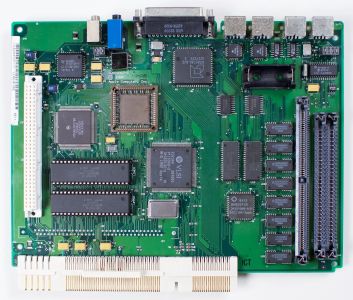 Color Classic logic board
-
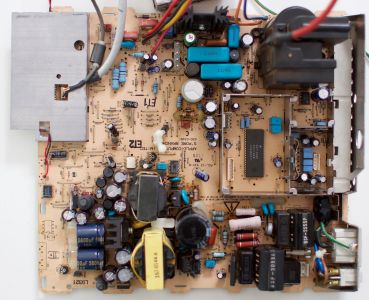 Color Classic analogue board


Maintenance, capacitors and troubleshooting
[edit | edit source]- Macintosh Color Classic General Maintenance
- Macintosh Color Classic Capacitor Replacement Guide
- Macintosh Color Classic Troubleshooting
- CRT Discharge Procedure
- Retrobrite for a yellowed case.
Apple's battery rule for this machine is replace below 3.0 V.[9] Apple describes the cell only as a long-life lithium battery;[3] Low End Mac gives a 3.6 V half-AA as the most common fit and notes that some machines use a 4.5 V Rayovac 840, so check the cell in your machine before buying a replacement.[1] Neutralise lithium-cell leakage with bicarbonate of soda, not vinegar.
Apple publishes no rail tolerance and no power-supply adjustment for the Color Classic. Its Adjustments chapter covers geometry, video, convergence, geometric distortion, yoke and light meter setup.[8]
Related pages
[edit | edit source]- Macintosh Performa 250
- Macintosh Color Classic II
- Macintosh Classic II
- Macintosh LC II
- Sad Mac Error Codes and the Sad Mac Decoder
References
[edit | edit source]- ↑ 1.0 1.1 1.2 1.3 Low End Mac, "Mac Color Classic", tech specs: dates, price, code name Slice, model M1600, System 7.1 with System Enabler 401 to 7.6.1; LC II motherboard design with a 16-bit data bus; end of the Classic line in North America; first Mac with a built-in colour monitor; no official upgrade path, though LC 550 and 575 boards have been fitted; PRAM battery "3.6V half-AA most common, although some use 4.5V Rayovac 840". Secondary source.
- ↑ Apple Computer, Macintosh Color Classic Service Source (141-page copy, File:Color classic.pdf), Take Apart, Logic Board pp. 1–4 (PDF pp. 38–41).
- ↑ 3.0 3.1 Apple, Macintosh Color Classic Service Source, Specifications pp. 1–13 (PDF pp. 5–17): Configurations, Processor, Memory, Disk Storage, I/O Interfaces, I/O Devices, Sound and Video, Electrical, Physical, Environmental.
- ↑ 4.0 4.1 4.2 4.3 Apple, Macintosh Color Classic Service Source, Upgrades pp. 1–10 (PDF pp. 82–91): VRAM Upgrade (J9), Math Coprocessor (socket U9), Memory Upgrade (J10), PDS Upgrades (J8).
- ↑ powercc.org, "Mystic": LC 550 and LC 575 logic board swaps for the Color Classic. Secondary source.
- ↑ Apple, Macintosh Color Classic Service Source, Troubleshooting, Symptom Charts p. 3 (PDF p. 21).
- ↑ Apple, Macintosh Color Classic Service Source, Exploded View (PDF p. 141).
- ↑ 8.0 8.1 Apple, Macintosh Color Classic Service Source, Adjustments, Geometry p. 2 (PDF p. 100); the caution is repeated in the Video, Convergence, Geometric Distortion and Yoke topics.
- ↑ Apple, Macintosh Color Classic Service Source, Additional Procedures, Battery Verification pp. 1–2 (PDF pp. 93–94).