

Sharp PC-G850
 | |
| A PC-G850S, the PC-G850's direct successor, in RUN mode. No freely licensed photograph of the original PC-G850 has been found. (Photo: Wonderland, CC BY-SA 3.0) | |
| Specifications | |
|---|---|
| Manufacturer | Sharp Corporation |
| Type | Pocket computer for technical education |
| Released | 1996 (Japan)[1][2] |
| CPU | Z80-compatible[1] |
| Memory | 32 KB[1] |
| Storage | — |
| Display | LCD, 24 characters × 6 lines, 144 × 48 dots[1] |
| Sound | — |
| Ports / interface | 11-pin connector; card-edge connector with the Z80 bus[1] |
| Dimensions | 196 × 95 × 20 mm (PC-G850 series)[2] |
| OS / Firmware | BASIC, C, CASL assembler, Z80 assembler and machine-code monitor in ROM[1] |
| Predecessor | Sharp PC-G815[1] |
| Successor | Sharp PC-G850S (2000)[1] |
| Model no. | PC-G850 |
The Sharp PC-G850 is a pocket computer that Sharp made for technical education in Japanese schools. It has a Z80-compatible processor, 32 KB of memory and a six-line display of 24 characters (144 × 48 dots), and it can be programmed in BASIC, C, the CASL teaching assembler and Z80 assembly language. Japanese Wikipedia dates the PC-G850 series from 1996; the PC-G850 replaced the PC-G815 and was followed by the PC-G850S in 2000.[1][2]
Background
[edit | edit source]Sharp's "G" pocket computers were made for industrial high schools, and the G800 series to which the PC-G850 belongs was sold for school use only; the PC-E200 was the one model of the series sold to the general public. The series moved to a Z80-compatible processor so that students could learn microcontroller-style programming, and every model carries BASIC, the CASL assembler used in Japan's information technology examinations, and a machine-code monitor. Sharp gave the school models a three-year warranty.[1]
Against the PC-G815 it replaced, the PC-G850 was faster, adopted structured BASIC and added an 8-bit mode for the I/O lines on the 11-pin connector, which made it easier to drive external hardware.[1]
Hardware
[edit | edit source]- Processor: Z80-compatible.[1]
- Memory: 32 KB.[1]
- Display: liquid crystal, 24 characters × 6 lines or 144 × 48 dots.[1][2]
- Connectors: Sharp's 11-pin pocket computer connector, and a card-edge connector that brings out the Z80 bus.[1]
- Sound: no buzzer is fitted. BASIC still has a BEEP command, which sounds if a buzzer is added.[1]
- Size: 196 × 95 × 20 mm for the PC-G850 series.[2]
The CE-T800 option links the G800 series to a personal computer's RS-232C port.[1] The machine also works with Sharp's common 11-pin peripherals such as the CE-126P printer and cassette interface, which Japanese Wikipedia lists as usable with the PC-G850.[3]
Later models
[edit | edit source]| Model | Year | Change |
|---|---|---|
| PC-G850 | 1996 | First of the series |
| PC-G850S | 2000 | Successor to the PC-G850 |
| PC-G850V | 2002 | Adds a PIC assembler |
| PC-G850VS | 2009 | Last model; differs from the G850V in its box and manual |
The later models are better documented than the PC-G850 itself. Jack W. Hsu's unofficial English user guide for the PC-G850V and PC-G850VS, based on a translation of Sharp's Japanese manual, says that it "should also apply for the G850 and G850S" but has not been checked on them.[4] It gives four AAA cells as the operating supply for the G850V and G850VS, with a BATT warning on the display when they run low.[4]
Documentation
[edit | edit source]Sharp sold the G models only in Japan and published no documentation for them in other languages.[4] The opened PC-G850V in the gallery shows the later model's board, with its card-edge connector and battery contacts.
Gallery
[edit | edit source]-
 PC-G850S, the PC-G850's successor (Wonderland, CC BY-SA 3.0)
-
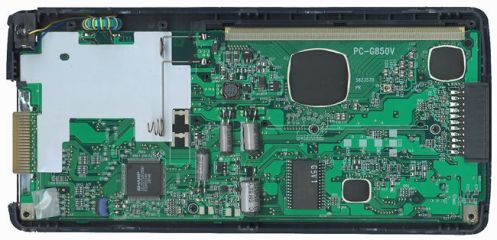 Opened PC-G850V, the third model of the series (Buschpilot, CC BY 2.0)

Related pages
[edit | edit source]References
[edit | edit source]- ↑ 1.00 1.01 1.02 1.03 1.04 1.05 1.06 1.07 1.08 1.09 1.10 1.11 1.12 1.13 1.14 1.15 1.16 1.17 ポケットコンピュータの製品一覧 (List of pocket computer products), Japanese Wikipedia—link(accessed 2026-10-21) Sections "シャープ" and "PC-G800系": G models were for industrial high schools; the G800 series uses a Z80-compatible CPU and was sold only for school education, except the PC-E200; every model has BASIC, the CASL assembler and a machine-code monitor; RAM files cannot hold machine code; no buzzer is fitted, although the BEEP command exists; the CE-T800 option gives RS-232C communication; three-year manufacturer's warranty except the PC-E200; a card-edge connector carries the Z80 bus besides the 11-pin connector. "PC-G850/G850S/G850V/G850VS": successor to the PC-G815, released in turn from 1996 to 2009; 24 characters × 6 lines (144 × 48 dots); 32 KB memory; faster, with structured BASIC; an 8-bit mode added to the 11-pin I/O; BASIC, C, CASL and Z80 assembler; PC-G850S (2000) succeeded the PC-G850; PC-G850V (2002) added a PIC assembler; the PC-G850VS (2009) was the last model.
- ↑ 2.0 2.1 2.2 2.3 2.4 ポケコンPC-G850用新作ADV「ポートアイランド連鎖殺人事件」が公開に, 4Gamer.net, 2025-01-29—link(accessed 2026-10-21) The PC-G850 series was introduced from 1996; the unit measures 196 × 95 × 20 mm; the display is 144 × 48 dots; Sharp's website describes the PC-G850VS (2009) as a pocket computer for school technical education.
- ↑ ポケットコンピュータの製品一覧, Japanese Wikipedia—link(accessed 2026-10-21) Section "PC-12xx/13xx/14xx/Exxx/Gxxx系専用" (peripherals for the 12xx to Gxxx families, including the G850): CE-126P thermal printer with cassette interface, powered by four AA cells, the EA-23E adaptor or the EA-27B battery pack; CE-124 cassette interface, usable electrically with the G800 series but only after modifying it to fit; CE-130T RS-232C level converter.
- ↑ 4.0 4.1 4.2 Jack W. Hsu, Sharp PC-G850V(S) Users Guide, version 3.0, September 2018, introduction. Internet Archive. Unofficial; not created by Sharp. Based on Jörg Wrabetz's German translation of the Japanese PC-G850V(S) manual; "This manual should also apply for the G850 and G850S, however, it has not been verified"; the G models were sold only in Japan and Sharp published no documentation in other languages. Section 1.2 gives the operating supply of the G850V(S) as four AAA batteries and describes the BATT warning.