

Sharp MZ-40K
 | |
| An assembled MZ-40K in front of its German box (photo: SharpMZ, not freely licensed; no free photograph of the kit was found) | |
| Specifications | |
|---|---|
| Manufacturer | Sharp Corporation |
| Type | 4-bit microcomputer kit |
| Released | May 1978 (Japan) |
| Intro price | 24,800 yen (Japan); DM 229 (West Germany, 1978) |
| CPU | MB8843 4-bit single-chip microcomputer, 1.7897725 MHz |
| Memory | 1 KB mask ROM and 64 × 4 bit RAM in the processor; 2 × 256 × 4 bit static RAM for tune data |
| Storage | None |
| Display | Four red 7-segment LED digits |
| Sound | Loudspeaker, one voice, 400 mW maximum |
| OS / Firmware | Fixed programs in the processor's mask ROM |
The Sharp MZ-40K is a 4-bit microcomputer kit that Sharp released in Japan in May 1978. It is the first machine to carry the MZ name. The owner assembles it from parts; once built, it plays tunes entered on its 22-key keypad, keeps time on four LED digits, and runs a set of built-in programs including an alarm, a telephone charge counter and simple games.[1]
History
[edit | edit source]Sharp sold the MZ-40K only as a kit, in Japan from May 1978 at 24,800 yen. SharpMZ's own example was bought and built in West Germany in 1978 for DM 229. Its German manual runs to 68 pages, 23 of them assembly instructions.[2] English Wikipedia's article on the MZ series traces the MZ name back to this kit and its Fujitsu MB8843 processor.[3]
Because the programs sit in the processor's mask ROM, the owner cannot program the machine in the usual sense, and Japanese Wikipedia notes that this disappointed buyers who expected a programmable microcomputer.[1] The tunes and settings entered on the keypad are lost when the power goes off.[2]
Hardware
[edit | edit source]SharpMZ's technical data for the main board:[4]
| Part | Reference | Function |
|---|---|---|
| MB8843 (Sharp X0036PAZZ) | CPU | 4-bit single-chip microcomputer with mask ROM, RAM and timer |
| MB8101 or 2101 (X0043PAZZ) | RAM1, RAM2 | 256 × 4 bit static RAM for tune data |
| 7493 | IC4 | Divides the crystal frequency for the processor clock |
| 7476 | IC3 | Divider for the timer clock |
| 74126 | IC5, IC6, IC7, IC9, IC10 | Bus buffers |
| 74157 | IC8 | Data selector |
| LM390 or LM388 | IC1 | Audio power amplifier |
| TA78005P | Regulator | 5 V regulator |
| TA60, TA76 | TA1; TA2, TA3 | Transistor arrays for the LED display |
| 3.579545 MHz | XTAL | Crystal |
Power
[edit | edit source]The MZ-40K runs from an AC adaptor, not a DC one. The board rectifies the AC with a 1B4B1 bridge, smooths it with C10 (1000 µF) and regulates 5 V with a TA78005P, while a separate path takes the raw AC through TR1 to the processor as the time base for the clock. SharpMZ gives the European adaptor as 220/240 V in, 10.5 V AC at up to 700 mA out on a 3.5 mm jack plug, and warns that a DC supply cannot be used. Japanese Wikipedia gives the adaptor output as 11 V AC.[4][1][6] The volume control carries the power switch.[4]
Options
[edit | edit source]The MZ-40K1 sensor kit adds six sensor inputs on 2.5 mm jacks, with three micro switches, a reed switch and magnet, a water-level float and a light sensor. The MZ-40K2 is a 32-key organ keyboard covering three octaves. Sharp also announced a timer kit with a replacement processor and a relay box, which was not released.[4][1]
Known faults
[edit | edit source]No fault reports for the MZ-40K were found in the sources consulted. Every machine was assembled by its first owner, and the circuit-based checks are in the Sharp MZ-40K Troubleshooting Guide.[2]
Documentation
[edit | edit source]- Sharp's schematic diagram, from SharpMZ: File:Sharp MZ-40K schematic diagram.jpg.[6]
- SharpMZ holds the German operating manual (Bedienungsanleitung), a Japanese manual, game sheets, a programming table and datasheets for the main parts.[5][7]
Related pages
[edit | edit source]- Sharp MZ-40K General Maintenance
- Sharp MZ-40K Troubleshooting Guide
- Sharp MZ-40K Capacitor Replacement Guide
- Sharp MZ-80K
Gallery
[edit | edit source]-
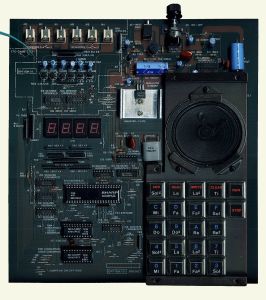 The main board with Option 1 fitted (photo: SharpMZ)
-
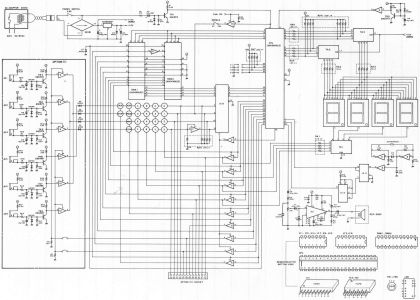 Sharp's schematic diagram


References
[edit | edit source]- ↑ 1.0 1.1 1.2 1.3 MZ-40K, Wikipedia (Japanese)—link(accessed 2026-10-21) 4-bit microcomputer kit released by Sharp in May 1978, the ancestor of the MZ series; built cheaply, closer to a children's toy; acrylic cover and base form a case, the acrylic brown so the parts cannot be seen; a full kit, unlike the semi-kit MZ-80K; after assembly it runs programs held in ROM with parameters entered from the keyboard; mask-ROM single-chip microcomputer, so in practice the user cannot program it; nickname "Maikon Hakase"; the AC adaptor has a mini plug and gives 11 V AC, rectified inside the unit, and the mains frequency is the clock source for the clock function; the volume control has a switch and doubles as the main power switch. Specifications: Fujitsu MB8843 4-bit single-chip microcomputer, 1.7897725 MHz; internal RAM 64 × 4 bits; external RAM 256 bytes, two Fujitsu MB8101 (1 Kbit, 256 × 4) SRAMs; 1 KB internal mask ROM; single-voice sound from a built-in speaker, 400 mW maximum; 22 keys (6 function keys and the hex keys, marked with notes); game switch supplied separately; four-digit 7-segment LED; list price 24,800 yen; 275 × 50 × 280 mm, 0.73 kg. Built-in programs: clock, timer, sensor, automatic performance, organ, telephone charge calculation, games (dice, roulette, big-game hunt, car race, territory game, message memo). Peripherals: MZ-40K1 sensor kit (float sensor, light sensor, reed switch, micro switches), 2,950 yen; MZ-40K2 piano-style keyboard, 4,850 yen; a timer kit with a replacement CPU and a relay box was announced but not released.
- ↑ 2.0 2.1 2.2 The MZ-40K kit– SharpMZ and Richard Cornelius, SharpMZ—link(accessed 2026-10-21) Published in the SUC magazine, November 2002, Vol. 22 No. 3, pp. 4 to 8. Bought and assembled by its previous owner in 1978 for DM 229; first sold in Japan in May 1978 for 24,800 yen; sold only as a kit in both places; the German manual has 68 pages, 23 of them assembly instructions; 4-bit technology with no expansion, no way of saving tune data to tape, and no way of learning programming; tune data is lost at power-off; up to 127 notes, each of 16 bits (8 bits of frequency, 8 of duration), 36 notes over 3 octaves; addresses 000 to 1FC; entry with F000 ADR, note data and WRITE, ended with EEEE; timer starts a tune or a 65-second buzzer; Option 1 adds sensors and a counter; 24-hour clock shown as HH.MM with the point flashing each second; telephone charge rate set by soldering four jumpers in a 1-2-4-8 code (1 to 15 units); the organ uses 20 of the 22 keys over two octaves, three octaves with Option 2's 32 keys; a game switch, one of the micro switches, provides the random values for dice, roulette and other games.
- ↑ Sharp MZ, Wikipedia—link(accessed 2026-10-21) The term MZ has its roots in the MZ-40K, a home computer kit produced by Sharp in 1978, based on Fujitsu's 4-bit MB8843 processor, with a simple hexadecimal keypad for input; followed by the MZ-80K.
- ↑ 4.0 4.1 4.2 4.3 4.4 Technical data of the MZ-40K, SharpMZ—link(accessed 2026-10-21) CPU Sharp MB8843 4-bit (part X0036PAZZ); clock 1.7897725 MHz, the 3.579545 MHz crystal divided by 2 by the 7493 (IC4); 1K × 8 bit internal mask ROM holding the operating system; 64 × 4 bit internal RAM (data memory); two external MB8101 1024-bit (256 × 4) static RAMs (program memory); four GL-8P04 red 7-segment LEDs, 10 mm, multiplexed by the CPU timer; one-voice sound through a loudspeaker, maximum 400 mW, by IC1 LM390 or LM388; volume control with combined on-off switch; 8-bit programmable timer clocked at 223.722 kHz; 24-hour clock; 22 multi-function keys (type ML-3): 16 hex keys, 20 note keys, 6 function keys (ADR, READ, WRITE, CLEAR, RUN, STOP); game switch (micro switch); telephone accounting by 4 jumpers; 2 option jumpers; power from a maximum of 10.5 V AC, 50/60 Hz, giving 5 V DC unregulated for the LEDs, 5 V DC regulated, and 5 V AC 50/60 Hz for the clock; operating temperature above 5 °C; 275 × 50 × 280 mm; 0.73 kg; accessories: operating manual, power supply, two program sheets (games), one programming card. Option 1 (MZ-40K1): six sensors (3 micro switches, a reed switch with magnet, a water-level sensor and a photo sensor) on 2.5 mm jacks. Option 2 (MZ-40K2): organ keyboard with 32 keys over 3 octaves. External power supply: 220/240 V AC, 50/60 Hz, 11 W; output 10.5 V AC, 700 mA maximum, on a 3.5 mm jack plug; the AC output is used for the clock, so no DC power supply can be used.
- ↑ 5.0 5.1 Download datasheets and manuals (MZ-40K), SharpMZ—link(accessed 2026-10-21) Parts with circuit references: 74LS04 (IC2, X0012PAZZ), 7476 (IC3, X0005PAZZ), 7493 (IC4, X0060PAZZ), 74126 (IC5, 6, 7, 9, 10, X0059PAZZ), 74157 (IC8, X0058PAZZ), 8101 or 2101 1024-bit static RAM (RAM1, RAM2, X0043PAZZ), LM390N or LM388 audio amplifier (IC1, X0062PAZZ), MB8843 NMOS single-chip 4-bit microcomputer (CPU, X0036PAZZ), TA78005P or µA7805T 5 V 1 A regulator, crystal 3.579545 MHz; transistors 2SA495 or BC556 (TR6 to TR8) and 2SC373 or BC546 (TR1 to TR5); transistor arrays TA60 (TA1) and TA76 (TA2, TA3); rectifier 1B4B1; diodes 1S1555 or 1N914 (D1 to D6); DAP601 diode array; GL-8P04 red LEDs, 10 mm; datasheets for these parts.
- ↑ 6.0 6.1 Diagram MZ-40K, SharpMZ—link(accessed 2026-10-21) Sharp's schematic diagram, also hosted as File:Sharp MZ-40K schematic diagram.jpg: AC adaptor Z0001 (100 V, 50/60 Hz); power switch S65; bridge 1B4B1; C10 1000 µF 16 V; TA78005P with C12 1000 pF and C13 1 µF 50 V; outputs +5 V unregulated and +5 V; AC through R4 (47 kΩ), C11 (4.7 µF 25 V), D1 and R5 to TR1 (2SC373), feeding the CPU; TR2 (2SC373) with C16 10 µF 16 V; IC1 audio amplifier with C1 and C9 (4.7 µF 25 V), C3 and C7 (22 µF 16 V), C4 (470 µF 16 V) to the 8 Ω speaker 8OP-30BP, volume control 10 kΩ; crystal 3.579545 MHz with C14 0.1 µF and C15 100 pF; Option 1 inputs JK1 to JK6 with C18 to C23 (10 µF 16 V), TR3 to TR5 (2SC373), TR6 to TR8 (2SA495) and DAP601 diode arrays; Option 2 socket.
- ↑ MZ-40K Manuals, SharpMZ—link(accessed 2026-10-21) German operation manual (Bedienungsanleitung); Japanese MZ-40K manual.