

Sharp MZ-3500
 | |
| An MZ-3541 with a colour display and the separate keyboard, from a Sharp German brochure | |
| Specifications | |
|---|---|
| Manufacturer | Sharp |
| Type | Business personal computer |
| Released | 1982 (Japan)[1] |
| Intro price | 320,000 yen (MZ-3531), 410,000 yen (MZ-3541)[1] |
| CPU | Two Z80A, 4 MHz[2][3] |
| Memory | 64 KB or 128 KB main RAM, expandable to 256 KB[3][2] |
| Storage | One or two built-in 5.25-inch double-sided double-density mini floppy drives, 320 KB each[2][3] |
| Display | 80 × 25 text in eight colours on up to two displays; 640 × 400 or 640 × 200 graphics with the MZ-1R03 board, in colour when the board has its full 96 KB[2][4] |
| Sound | 500 mW speaker driven by an 8253 timer[2][3] |
| ROM | 8 KB IPL ROM, 8 KB character generator ROM[2] |
| Power | Internal supply; 220 V, 50/60 Hz, 100 W maximum (export specification); separate supply units for 100 V and 200 V areas[3][5] |
| Dimensions | 471 × 145 × 375 mm (W × H × D)[3] |
| Weight | 15.3 kg with two drives[3] |
| OS / Firmware | FDOS with BASIC; CP/M[2] |
| Model no. | MZ-3530, MZ-3531, MZ-3540, MZ-3541 |
The Sharp MZ-3500 is a business personal computer with two Z80A processors that Sharp released in Japan in 1982.[1] It was sold in four versions: the MZ-3530 and MZ-3540 with 64 KB of main RAM, and the MZ-3531 and MZ-3541 with 128 KB, each with one (MZ-353X) or two (MZ-354X) built-in 5.25-inch floppy drives.[3] The main unit carries the drives, the power supply and interfaces for two displays, a printer, an RS-232C line and a light pen; the keyboard and displays are separate.[2] Sharp's service manual for the series, with its self-check tests, power circuit description, part of the circuit diagrams and the parts guide, is hosted at Sharp MZ-3500 Service Manual.
History
[edit | edit source]Japanese Wikipedia gives 1982 as the release year and places the MZ-3500 above Sharp's PC-3100S and PC-3200 business machines, with the MZ-3531 at 320,000 yen and the MZ-3541 at 410,000 yen.[1] The MZ-5500 series that followed is a 16-bit development of the MZ-3500.[1]
In the United Kingdom the machine was little known. Maurice Hawes of the Sharp Users' Club wrote in 1999 that it was not reviewed in Personal Computer World, and found it in a July 1983 advertisement at £1,795 plus VAT with 128 KB, a monochrome display, FDOS, BASIC, CP/M and PeachCalc, or £2,190 with a colour display.[6]
Hardware
[edit | edit source]The two Z80A processors divide the machine between them. At power-on the main CPU copies the initial program loader (IPL) into RAM while it holds the sub-CPU in reset, then starts the sub-CPU and loads the operating system from the system disk.[7] The service manual's self-check reflects the split: the main CPU side tests the floppy disk interface, the main RAM and the ROM, and the sub-CPU side tests its own memory, the video RAM, the display controller, the clock, the speaker and the printer, light pen and RS-232C interfaces.[8] Three Sharp custom chips handle the memory mapping (SP6102R001) and the character display (SP6102C002 and SP6102C003), a µPD7220 graphic display controller drives the screen, and a µPD765 controls the floppy drives.[2] The battery-backed µPD1990AC clock is read by the sub-CPU through an 8255.[9]

The initial program loader is in an 8 KB ROM. BASIC can run from RAM or from ROM: the manual describes four memory states (an initial state, system loading and CP/M, ROM-based BASIC and RAM-based BASIC), and the main CPU self-check tests a 16 KB ROM only on ROM-based machines.[7][8] The bottom cabinet has a lid over a ROM LSI.[5]
The power supply is a separate unit in a ventilated metal cage on the left of the case, seen from the front. It runs from a mains transformer and makes +5 V and +12 V with switching regulators and −12 V with a dropper circuit, and it sends an alarm signal to the CPU board.[10][11] The case also holds a fan.[5]
Options
[edit | edit source]- MZ-1U02 expansion unit, fitted to the back of the main unit, with four slots for 60-pin edge-connector boards such as the MZ-1R06 RAM board and RS-232C, GPIO and GPIB interfaces.[4]
- MZ-1R03 graphic board with 32 KB of RAM, expandable to 96 KB, and its own µPD7220, which goes into a slot behind a lid on the front panel.[4][5]
- Keyboards MZ-1K02 (US), MZ-1K03 (UK), MZ-1K04 (German) and MZ-1K05 (French), with an 80C49 or 8749 controller. In Japan the keyboard was an option in ASCII or JIS layout, and Ohishi Nobuaki's machine has the JIS one.[4][12]
Connections
[edit | edit source]On the back panel, every connection except the two display sockets is a card-edge connector on the CPU board, reached through square openings in the case.[12] The CPU board connector table lists the printer, RS-232C and expansion MFD edge connectors, the two 8-pin DIN display sockets CRT1 and CRT2, the keyboard and light pen sockets, and the internal connectors for the power supply, the front-panel LED and the HALT switch, volume control and speaker.[13] A block of ten DIP switches, reached through the bottom of the cabinet, selects the printer type, the display resolution, the decimal point character, RS-232C handshaking, the shift-key mode and the character set used on a 200-line display.[14]
Software
[edit | edit source]Sharp supplied FDOS with a BASIC that its service manual calls compatible with PC-3200 BASIC, and CP/M.[2] Maurice Hawes found the FDOS and BASIC much the same as on the PC-3201 and notes that Sharp's CP/M 2.2 used non-standard screen control codes.[6]
Documentation
[edit | edit source]- Sharp MZ-3500 Service Manual: Sharp's service manual, code 00ZMZ3500SM/E, with the self-check functions, the power circuit description, circuit diagrams for the main CPU, sub-CPU and CRT interface, and the parts guide. Some diagrams and parts-guide pages are not in the surviving scan.
- SharpMZ.net also offers the owner's manual, the BASIC language manual and the German operator's manual as PDFs.[15]
Repair guides
[edit | edit source]- Sharp MZ-3500 General Maintenance
- Sharp MZ-3500 Troubleshooting Guide
- Sharp MZ-3500 Capacitor Replacement Guide
Gallery
[edit | edit source]-
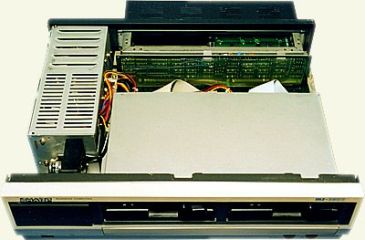 MZ-3541 opened: power supply cage on the left, MFD interface board at the back, drives under their cover (SharpMZ.net)
-
 The drives with their cover off (SharpMZ.net)
-
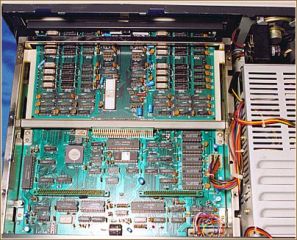 The main board with the drives and MFD interface removed (SharpMZ.net)
-
 Exploded view of the main unit from the service manual


Related pages
[edit | edit source]- Sharp MZ-2000, Sharp's 8-bit hobby machine of the same year
References
[edit | edit source]- ↑ 1.0 1.1 1.2 1.3 1.4 MZ (コンピュータ), Wikipedia (Japanese)—link(accessed 2026-10-21) MZ-3500 series released in 1982, with two Z80A processors and Japanese display; 128 KB program RAM as standard, up to 256 KB; 640 × 400 colour graphics and kanji display with options; optional keyboards in JIS or ASCII layout; a higher model than the PC-3100S and PC-3200; MZ-3531 with one 5.25-inch floppy drive at 320,000 yen and MZ-3541 with two at 410,000 yen (citing ASCII, November 1982, p. 76); the MZ-5500 series is a 16-bit development of the MZ-3500; the MZ-3500 and MZ-5500 do not use the hinged case of the earlier MZ models.
- ↑ 2.00 2.01 2.02 2.03 2.04 2.05 2.06 2.07 2.08 2.09 Sharp, Service Manual, Personal Computer Model MZ-3500, code 00ZMZ3500SM/E (File:Sharp MZ-3500 Service Manual.pdf), section 1-1, specification of the main unit, printed page 1 (PDF page 2): multi-CPU processing with two Z80A; 8 KB IPL ROM and 8 KB character generator ROM; main CPU RAM of sixteen or eight 64 Kbit DRAMs; sub-CPU RAM of four 16 Kbit static RAMs; shared RAM of one 16 Kbit static RAM; video RAM of one 16 Kbit and two 4 Kbit static RAMs; custom LSIs SP6102R001 (memory mapper) and SP6102C002 and SP6102C003 (screen controllers CSP-1 and CSP-2); µPD7220 GDC, µPD765 FDC, 8255, 8251, 8253 and µPD1990AC clock; 80 × 25, 80 × 20, 40 × 25 or 40 × 20 characters of 8 × 16 or 8 × 8 dots, eight colours, two CRT interfaces for 640 × 400 or 640 × 200 displays; MZ-353X with one and MZ-354X with two double-sided double-density mini floppy drives of 256 bytes per sector, 16 sectors per track and 80 tracks per disk; light pen, keyboard, Centronics printer and RS-232C (110 to 9600 bit/s) interfaces; 500 mW speaker, battery-backed clock, HALT switch and volume control; FDOS, BASIC and CP/M.
- ↑ 3.0 3.1 3.2 3.3 3.4 3.5 3.6 3.7 Technical data of the MZ-3500-series, SharpMZ.net—link(accessed 2026-10-21) Model MZ-3530 with one drive and 64 KB RAM, MZ-3540 with two drives and 64 KB, MZ-3531 with one drive and 128 KB, MZ-3541 with two drives and 128 KB, expandable to 256 KB; two Z80A at 4 MHz; 320 KB per mini floppy disk; sound of one voice from one of the three timers of the 8253; power 220 V, 50/60 Hz, 100 W maximum; 471 × 145 × 375 mm (W × H × D); 15.3 kg with two drives; keyboards MZ-1K02 (US), MZ-1K03 (UK), MZ-1K04 (German) and MZ-1K05 (French).
- ↑ 4.0 4.1 4.2 4.3 Sharp, MZ-3500 service manual (File:Sharp MZ-3500 Service Manual.pdf), sections 1-2 to 1-4, printed pages 2 and 3 (PDF pages 3 and 4): MZ-1K01 keyboard (MZ-1K02 US ASCII, MZ-1K03 UK ISO, MZ-1K04 German, MZ-1K05 French) with an 80C49 or 8749 controller, 98 keys, a coiled cable with an 8-pin DIN plug, four LEDs, 467 × 35 × 190 mm and about 1.5 kg; MZ-1U02 expansion unit attached to the rear of the main unit with four slots of 60-pin edge connectors; MZ-1R03 graphic board with 32 KB of RAM and a µPD7220, inserted through the slot on the front panel without the expansion unit; with 32 KB it gives two 640 × 200 or one 640 × 400 screen on a green monitor, and expanded to its 96 KB maximum it gives two 640 × 200 or one 640 × 400 screen in colour.
- ↑ 5.0 5.1 5.2 5.3 Sharp, MZ-3500 service manual (File:Sharp MZ-3500 Service Manual.pdf), parts guide, exteriors, page 2 (PDF page 110): power supply unit DUNT-1018ACZZ for the 200 V series and DUNT-1035ACZZ for the 100 V series; fan motor NFANP1001ACZZ with its fixing angle; MFD unit RMEMR1002ACZZ; lid for the graphic slot; lid for the ROM LSI in the bottom cabinet; label "POWER"; LED board with a photo transistor. PWB and fixing angles, page 4 (PDF page 112): CPU PWB units DUNTK1082ACZZ (Model 3541), DUNTK1083ACZZ (Model 3530) and DUNTK1064ACZZ (Model 3540); MFD I/F PWB unit DUNTK1060ACZZ; HALT switch; variable resistor and knob; speaker. CPU PWB, pages 6 and 7 (PDF pages 114 and 115): battery UBATN1001ACZZ; crystals of 39.32 MHz, 32 MHz, 2.45 MHz and 32 kHz; LH0080A, µPD7220, µPD1990AC, 8251, 8253, 8255, SP6102R001, SP6102C002 and SP6102C003.
- ↑ 6.0 6.1 A Brief History of the MZ-3500– Maurice Hawes, SharpMZ.net (from SUC magazine, November 1999, volume 19, number 3, p. 19)—link(accessed 2026-10-21) Not reviewed in PCW; July 1983 PCW advertisement by Bits & P.C.s: MZ-3500 with 128K RAM, mono display, FDOS, BASIC, CP/M and PeachCalc £1795, with colour display £2190, 600 × 400 high-resolution option £199, prices excluding VAT; two Z80 processors and 128K RAM expandable to 256K; FDOS and BASIC close to those of the PC-3201; Sharp's CP/M 2.2 uses non-standard screen control codes; no RESET key, so a crashed machine must be switched off and on; the HALT key works only in FDOS and BASIC; separate keyboard, built-in drives, printer and RS-232 ports and an FD expansion connector.
- ↑ 7.0 7.1 Sharp, MZ-3500 service manual (File:Sharp MZ-3500 Service Manual.pdf), section 2, software (memory) configuration, printed pages 7 to 11 (PDF pages 8 to 12): memory states SD0 (initial state, immediately after power-on), SD1 (system loading and CP/M), SD2 (ROM-based BASIC) and SD3 (RAM-based BASIC); after reset the main CPU loads the IPL into RAM at 4000H with the sub-CPU held in reset, then releases the sub-CPU, gives it the ROM IPL, sets SD1 and loads DOS from the system floppy disk; the system reset signal comes from a CR network and the power supply.
- ↑ 8.0 8.1 Sharp, MZ-3500 service manual (File:Sharp MZ-3500 Service Manual.pdf), section 11, self check functions, printed pages 94 to 98 (PDF pages 87 to 91): main CPU side tests the MFD interface, 128 KB RAM and, on ROM-based machines, the 16 KB ROM; sub-CPU side tests memory, VRAM, the GDC, clock, speaker, printer interface, light pen and RS-232C interface.
- ↑ Sharp, MZ-3500 service manual (File:Sharp MZ-3500 Service Manual.pdf), section 8-1, clock circuit, printed page 81 (PDF page 74): the µPD1990AC is connected to the sub-CPU through port B of the µPD8255, with a 32 kHz crystal; its supply pin is fed from Vcc through a diode and from a battery through a resistor.
- ↑ Sharp, MZ-3500 service manual (File:Sharp MZ-3500 Service Manual.pdf), section 9, power circuit description, printed pages 87 to 89 (PDF pages 80 to 82): mains input with fuse and noise filter; power transformer; three rectifier and smoothing circuits; +12 V and +5 V switching circuits with control and protection circuits and a shared oscillator at about 25 kHz; filter circuits; alarm circuit; −12 V dropper circuit; each switching supply has an adjusting variable resistor.
- ↑ My MZ-3541, SharpMZ.net—link(accessed 2026-10-21) Photographs of an MZ-3541 with MZ-1K04 keyboard, MZ-1D02 monitor, MZ-1U02 expansion unit and a 10 MB hard disk: rear view; opened, showing the power supply, MFD interface and covered floppy drives; floppy drives, MFD interface and power supply with the drive cover removed; floppy drives and MZ-1R03 graphic board; motherboard with the floppy drives and MFD interface removed.
- ↑ 12.0 12.1 MZ-3500– Ohishi Nobuaki, Nibbles lab. Sharp museum—link(accessed 2026-10-21) Owner's page: all internal options fitted (extra RAM, graphic RAM, kanji ROM, kanji VRAM, GP-IO, extra RS-232C, 8-inch floppy interface); the keyboard was an option in ASCII or JIS layout; every connector except the CRT sockets is a card-edge connector reached through square openings in the rear panel; FDOS is not compatible with other machines; CP/M disks have track 0 in single density, apparently for compatibility with the PC-3200, so other machines' CP/M cannot read them.
- ↑ Sharp, MZ-3500 service manual (File:Sharp MZ-3500 Service Manual.pdf), 13-15, CPU P.W.B. connector terminal table (PDF page 104): PS connector pin 1 VGG, pin 2 VDD, pins 3 and 4 VCC, pin 5 ALARM, pins 6 to 8 GND; LED connector; CRT1 and CRT2 (pins 1 GND, 2 to 4 blue, green and red, 5 VSYN, 6 HSYN, 7 VIDEO, 8 SYN); HALT-VOL-SP connector (GND, SP, GND, VOICE GND, VOICE, VOL, HLT); key and light pen sockets; printer, RS-232C and expansion MFD edge connectors.
- ↑ Sharp, MZ-3500 service manual (File:Sharp MZ-3500 Service Manual.pdf), section 8-4, system SW1 (DIP SW), printed pages 85 and 86 (PDF pages 78 and 79): SW1 and SW2 printer select (CE-332P, MZ-1P02 or a third type); SW3 high-resolution (MZ-1D02, MZ-1D03) or medium-resolution (MZ-1D01, MZ-1D06) display; SW4 period or comma as decimal point; SW5 to SW7 RS-232C ER, CD and PO handling; SW8 key shift mode; SW9 3500 or 2000 character set on a 200-line display; SW10 not connected. DIP switches (A) and (B) on the board are for servicing and for the CE-330M and CE-331M expansion drives.
- ↑ Download datasheets and manuals (MZ-3500), SharpMZ.net—link(accessed 2026-10-21) MZ-1D07 and MZ-1D13 display manuals, MZ-1E01 RS-232C manual, MZ-1E02 GP-IO service manual, BASIC Programmiersprachen Handbuch, Basic Language Manual, Bediener Handbuch, Owner's Manual, Service Manual, EOS 3 manuals.