

Sharp MZ-80K
 | |
| An MZ-80K with its built-in monitor and cassette recorder (photo: Wolfgang Stief, CC0) | |
| Specifications | |
|---|---|
| Manufacturer | Sharp Corporation |
| Type | Personal computer |
| Released | December 1978 (Japan); October 1979 (UK)[1][2] |
| Intro price | ¥198,000 (Japan); £380 to £475 plus VAT in a UK advert of October 1980, depending on memory[1][2] |
| CPU | Zilog Z80 at 2 MHz[3] |
| Memory | 20 KB RAM as standard, 48 KB maximum on the board; 1 KB video RAM[4] |
| Storage | Built-in cassette recorder, 1,200 bit/s[4] |
| Display | Built-in 10-inch monochrome CRT, 40 × 25 characters[4] |
| Sound | One channel from the 8253 timer, 400 mW speaker[4][3] |
| ROM | 4 KB monitor ROM, 2 KB character generator ROM[4] |
| Power | Internal supply; 220 V or 240 V AC 50 Hz, about 45 W (European models)[4] |
| Dimensions | 410 × 270 × 470 mm (W × H × D)[4] |
| Weight | About 13 kg[4] |
| OS / Firmware | — |
| Model no. | MZ-80K |
The Sharp MZ-80K is a personal computer made by Sharp Corporation, built around a Zilog Z80 processor, with the keyboard, a 10-inch monochrome monitor and a cassette recorder in one case.[4] It went on sale in Japan in December 1978 as a semi-kit, in which only the keyboard had to be soldered by the buyer, and was shown in the UK in October 1979.[1][2] The machine has no language in ROM. Its 4 KB monitor ROM loads BASIC or another language from tape into RAM.[1][5]
History
[edit | edit source]Sharp sold the MZ-80K in Japan from December 1978 at 198,000 yen, with 20 KB of RAM.[1] AKIBA PC Hotline! describes the launch advertising, which gave the price and called the machine a semi-kit.[6] Maurice Hawes of the Sharp Users Club records that the MZ-80K was unveiled in the UK at the Birmingham International Business Show in October 1979 and was offered with 20, 36 or 48 KB of RAM. An advertisement in October 1980 priced the three versions at £380, £423 and £475 before VAT. Hawes notes that many dealers upgraded 20K machines to 48K before selling them.[2] Phil Clark, writing in the club's magazine in 1982, said that the first MZ-80Ks imported to the UK were bright red, and that the Japanese kit machines had a reset switch fitted as standard.[7]
Sharp followed it in Japan with the Sharp MZ-80C in 1979, the Sharp MZ-80K2 in 1980 and the cheaper MZ-80K2E in 1981. In Europe the MZ-80K was replaced by the Sharp MZ-80A in 1982.[1][5]
Hardware
[edit | edit source]The MZ-80K is built from five units: the CPU board, the power supply, the display, the cassette recorder and the keyboard. Sharp gives each unit its own assembly number.[4][8]
| Unit | Sharp assembly number | Main parts |
|---|---|---|
| CPU board | DCPU-0006PAZZ | Z80 (IC46), 8255 (IC5), 8253 (IC18), monitor ROM, character generator ROM, main and video RAM |
| Power supply | DBOXD0004PAZZ (220 V); DBOXD0005PAZZ (240 V, UK) | Two SG3524 switching regulators for +12 V and +5 V, a µA78MGU regulator for −5 V |
| Display | DUTT0004PAZZ | 240NB4 10-inch tube, run from 12 V DC |
| Cassette recorder | KTRC-0004PAZZ | µPC358C amplifier, 12 V governed motor |
| Keyboard | DKEY-0005PAZZ | Mechanical key switches |
CPU board
[edit | edit source]The CPU board carries the Z80 (IC46), a µPD8255 (IC5) for the keyboard and the cassette recorder, and a µPD8253 (IC18) for the sound and the clock. The 4 KB monitor ROM is a µPD2332C in the socket marked M-ROM, and the 2 KB character generator is an HN462716 or MB8156C. Video RAM is two 2114-type chips (IC41 and IC42), and the board has an 8.00 MHz crystal.[8][9]
Standard memory is 16 KB of 4116 dynamic RAM in the first bank and 4 KB of 4027 RAM in the second. The board has room for 48 KB: the three banks of sockets are marked RAM1 to RAM3, and links on the two 16-pin headers CS1 and CS2 set the memory size.[8][10] Maurice Hawes notes that all the major chips are in sockets.[2]
Power supply
[edit | edit source]The power supply has one mains transformer. A bridge rectifier and four 2500 µF capacitors make about 23 V DC, which feeds two SG3524 switching regulators: IC2 with the transistors Q401 and Q402 for +12 V, and IC3 with Q501 and Q502 for +5 V. A separate winding, the rectifier D201 and the regulator IC1 (µA78MGU) supply −5 V. Each output has its own fuse and a 1 kΩ preset.[11] Sharp rates the outputs at 12 V 1.6 A, 5 V 1.6 A and −5 V 0.2 A, and the display takes about 1.1 A at 12 V.[4]
Display and cassette
[edit | edit source]The display uses a 240NB4 10-inch, 90-degree tube with a 12 V, 75 mA heater and about 11 kV on the anode. Its controls are volume, vertical hold, contrast, horizontal hold, brightness and focus.[4] The cassette recorder records in Sharp's PWM format at 1,200 bit/s and runs the tape at 4.75 cm/s.[4] AKIBA PC Hotline! gives 2,100 bit/s for the cassette.[6] Sharp's service manual and the Japanese Wikipedia article both give 1,200.[4][1]
Keyboard and connections
[edit | edit source]The keyboard has 78 keys in a grid, including a block of graphics keys.[4][1] Each key is a mechanical switch with a separate key top under a key cover.[8] The rear panel has the power switch, the mains connector and the expansion port; the CPU board brings the bus out on the 50-pin connector CN1.[6][8] Printers and disk drives connect through the MZ-80I/O interface unit.[1][2]
Known faults
[edit | edit source]- The power supply has four 10 µF tantalum capacitors (C401, C501, C502 and C509). Owners report them shorting, with smoke from the supply or the 500 mA fuse F101 blowing. See Sharp MZ-80K Troubleshooting Guide and Sharp MZ-80K Capacitor Replacement Guide.[12][11]
- The 4116 dynamic RAMs fail. One restorer tested all the 4116s in a machine upgraded to 48 KB and found nine faulty.[13]
- The cassette heads need cleaning, and the PRESS PLAY contact needs an occasional clean.[2]
Documentation
[edit | edit source]- Sharp MZ-80K Service Manual: Sharp's English service manual, with fault charts, schematics for every unit and the parts list.
- SharpMZ.net lists the MZ-80K user and software manuals and hosts several of them, including the SP-5010 BASIC manual and the SP-6015 and SP-6115 disk BASIC manuals.[14][15]
Repair guides
[edit | edit source]- Sharp MZ-80K General Maintenance
- Sharp MZ-80K Troubleshooting Guide
- Sharp MZ-80K Capacitor Replacement Guide
Gallery
[edit | edit source]-
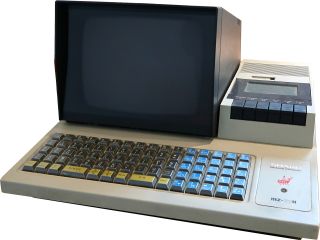 MZ-80K (Wolfgang Stief, CC0)
-
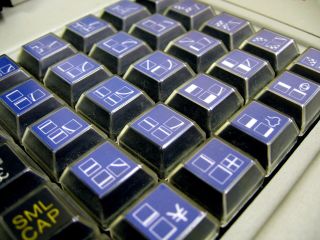 Graphics keys with their clear key covers (Marcin Wichary, CC BY 2.0)
-
 Power supply circuit from the service manual


Related pages
[edit | edit source]- Sharp MZ-80K2 and Sharp MZ-80C, the later Japanese models
- Sharp MZ-80B
References
[edit | edit source]- ↑ 1.0 1.1 1.2 1.3 1.4 1.5 1.6 1.7 1.8 MZ-80, Wikipedia (Japanese)—link(accessed 2026-10-21) MZ-80K shipped December 1978 at 198,000 yen with 20 KB RAM, sold as a semi-kit in which only the keyboard needed soldering; matrix keyboard; Z80 at 2 MHz; 40 × 25 text display; built-in cassette at 1,200 baud; MZ-80C (1979, 48 KB, typewriter keyboard, 268,000 yen), MZ-80K2 (1980, 32 KB, assembled, 198,000 yen), MZ-80K2E (1981, 148,000 yen); MZ-80I/O interface unit for up to five cards.
- ↑ 2.0 2.1 2.2 2.3 2.4 2.5 2.6 Maurice Hawes, "A Brief History of the MZ-80K", SUC Magazine (Sharp Users Club), November 1999, vol. 19 no. 3, p. 7, reproduced at A Brief History of the MZ-80K, SharpMZ.net—link(accessed 2026-10-21) Unveiled in the UK in October 1979 at the Birmingham International Business Show; 20K, 36K and 48K models; October 1980 prices; tape heads and the PRESS PLAY contact need occasional cleaning; major chips in sockets.
- ↑ 3.0 3.1 Technical data of the MZ-80K, SharpMZ.net—link(accessed 2026-10-21) CPU Z-80, clock 2 MHz; monitor ROM 4 KB; RAM 20 KB, expandable to 48 KB; CG-ROM 2 KB; V-RAM 1 KB; 10-inch CRT; 8253 used for clock and music; 78 keys.
- ↑ 4.00 4.01 4.02 4.03 4.04 4.05 4.06 4.07 4.08 4.09 4.10 4.11 4.12 4.13 4.14 4.15 Sharp Corporation, Service Manual, Personal Computer MZ-80K (File:Sharp MZ-80K Service Manual.pdf), specifications, printed pages 1 and 2 (PDF pages 3 and 4): CPU Z-80; monitor ROM 4 KB; RAM 20 KB (dynamic), extension to 48 KB; 10-inch CRT, 8 × 8 dot matrix, 1,000 characters (40 × 25); cassette at 1,200 bit/s, Sharp PWM; sound 400 mW; 78 keys; AC 220 V ±10 % 50 Hz, or AC 240 V ±10 % 50 Hz for the UK; about 45 W; 410 × 270 × 470 mm; about 13 kg; CPU board DCPU-0006PAZZ with 8 × 16K and 8 × 4K dynamic RAMs and two video RAMs; power supply DBOXD0004PAZZ (DBOXD0005PAZZ for the UK), outputs 12 V 1.6 A, 5 V 1.6 A and −5 V 0.2 A; display DUTT0004PAZZ, 240NB4 10-inch tube; cassette recorder KTRC-0004PAZZ, 4.75 cm/s, electronic governor motor (12 V). Hosted with a description at Sharp MZ-80K Service Manual.
- ↑ 5.0 5.1 Sharp MZ, Wikipedia—link(accessed 2026-10-21) MZ-80K introduced into Europe in 1979; languages had to be loaded into RAM; superseded in 1982 by the MZ-80A.
- ↑ 6.0 6.1 6.2 モニタ一体型のイカすヤツ「シャープ MZ-80K」、パソコンを身近にしてくれた人気機種, AKIBA PC Hotline! (Impress), 2020-08-25—link(accessed 2026-10-21) Released at the end of 1978 at 198,000 yen as a semi-kit; 10-inch screen with 40 × 25 characters; power switch at the left of the rear panel, with the power connector and the expansion I/O port beside it; the top opens like a car bonnet, with the display adjustment knobs at the upper left rear.
- ↑ Phil Clark, "MZ80 Series Hardware", SUC Magazine, April 1982, vol. 2 no. 1, pp. 21 to 23, reproduced at MZ80 Series Hardware, SharpMZ.net—link(accessed 2026-10-21) First MZ-80K units imported were bright red; a reset switch was fitted as standard on the Japanese kit machines; MZ-80P3 printer; MZ-80FSD single drive; Quantum Micros Hi-Res unit replaces the CPU and the 2716 character generator; Knights "Super Speed" board replaces the 2 MHz Z80 with a 4 MHz Z80A; the MZ-80A replaces the MZ-80K.
- ↑ 8.0 8.1 8.2 8.3 8.4 8.5 Sharp, MZ-80K service manual (File:Sharp MZ-80K Service Manual.pdf), replacement parts list, printed pages 43 to 48 (PDF pages 45 to 50): CPU board IC5 µPD8255C, IC18 µPD8253C, IC41 and IC42 MB8114NC or HM472114P-3, IC46 Z80CPU, monitor ROM µPD2332C, CG-ROM HN462716 or MB8156C, 16K RAM ITT4116 or MB8116, 4K RAM ITT4027 or MB8227, 8.00 MHz crystal; CN1 50-pin terminal for the bus lines, CN2 6-pin (TV), CN3 6-pin (cassette), CN4 3-pin (LED), CN5 18-pin (keyboard), CN6 4-pin (power supply); keyboard unit DKEY-0005PAZZ with mechanical key switches, key tops and key covers; power supply IC1 µA78MGU, IC2 and IC3 SG3524; fuses F101 and F201 T500 mA, F202 T315 mA, F401 and F501 T1.6 A.
- ↑ Sharp, MZ-80K service manual (File:Sharp MZ-80K Service Manual.pdf), CPU board section, printed pages 5 to 10 (PDF pages 7 to 12): display block (IC10, IC15, IC16, IC24, IC29), cassette and keyboard block (IC4, IC5, IC2, IC3, Q1, Q2, IC6), audio and clock block (IC18, IC12, IC13), memory block (ROM, IC46, IC43, IC44, IC45, IC36, IC37, IC50, IC35, IC52, IC53, IC56); RAM checker procedure: remove the monitor ROM from the socket marked "M-ROM", fit the RAM checker and switch on; RAM TEST-1 and RAM TEST-2 run from $1000 to the top of memory ($5FFF on the standard machine); RAM (I) block 16 KB, RAM (II) block 4 KB.
- ↑ MZ-80K Hints and Tips, SharpMZ.net—link(accessed 2026-10-21) Lid lugs on the cassette door; reset switch terminals on the CPU board; video signals on connector CN2 (pin 2 sync, pin 3 video); RAM sockets RAM1 to RAM3 with 4116 and 4027 chips, link headers CS1 and CS2 and the link settings for 20, 24, 36 and 48 KB; the 2332 monitor ROM can be replaced by a 2532 EPROM without modification, or by a 2732 with track changes at pins 18 and 21; the case opens after removing four screws in the base plate.
- ↑ 11.0 11.1 Sharp, MZ-80K service manual (File:Sharp MZ-80K Service Manual.pdf), power supply block diagram, printed page 12 (PDF page 14), and wiring diagrams of the power supply section, printed pages 37 (220 V) and 38 (UK) (PDF pages 39 and 40); also File:Sharp MZ-80K power supply circuit (service manual).png.
- ↑ xAD / nIGHTFALL, "Sharp MZ-80K Power Supply repair", Sharp MZ-80K Power Supply repair, nIGHTFALL Blog, 2013-01-13—link(accessed 2026-10-21) Four short-circuited tantalum capacitors in the power supply replaced with electrolytics; the author gives their value as "10uf 55v"; comments from other owners report smoke from the supply on switch-on, tantalums blowing when the supply was tested, and the F101 500 mA fuse blowing, with the advice to replace all four.
- ↑ 1980 Sharp MZ-80K Repair & Restoration– Adam Wilson, Adam's Vintage Computer Restorations, 2026-01-31—link(accessed 2026-10-21) Main board removed and cleaned, IC sockets cleaned, tantalum and aluminium electrolytic capacitors replaced; all 4116 DRAMs socketed, nine failed on a DRAM tester; power supply has a polymer X/Y capacitor soldered to the power switch, its outputs (+5 V, −5 V, +12 V) were in tolerance unloaded, and it has four 10 µF tantalum capacitors; the computer opens like a car bonnet.
- ↑ MZ-80K Manuals, SharpMZ.net—link(accessed 2026-10-21)
- ↑ MZ-80K downloads, SharpMZ.net—link(accessed 2026-10-21)