

Sharp Hotbit HB-8000
 | |
| A white HB-8000 with a cartridge in the top slot (photo: Sintegrity, CC BY-SA 4.0) | |
| Specifications | |
|---|---|
| Manufacturer | Epcom, the home computer division of Sharp's Brazilian subsidiary |
| Type | MSX home computer |
| Released | November 1985 (Brazil)[1] |
| Discontinued | 1988[2] |
| CPU | Z80A (Sharp LH0080A in the parts list), 3.58 MHz[3][4] |
| Memory | 64 KB RAM, 16 KB VRAM, 32 KB ROM[3] |
| Storage | Cassette, MSX cartridges; disk drives through the HB-3600 controller[2] |
| Display | Texas Instruments TMS9128NL[4] |
| Sound | General Instrument AY-3-8910A[4] |
| Power | Internal mains supply, 120 or 220 V, 24 W[5] |
| OS / Firmware | — |
| Model no. | HB-8000 |
The Sharp Hotbit HB-8000 is an MSX1 home computer developed and sold in Brazil by Epcom, the home computer division of Sharp's Brazilian subsidiary, and released in November 1985.[1] The service manual's cover gives the maker as Epcom and says the machine was produced in the Manaus free trade zone.[6] It is a single unit with the keyboard and the power supply in one case. The MSX Resource Center notes that the Hotbit kept closely to the MSX standard, unlike its Brazilian rival the Gradiente Expert, but lost the marketing battle; production stopped in 1988.[2]
Versions
[edit | edit source]The MSX Resource Center lists four versions, all on the same circuit board:[2]
| Case | ROM | Notes |
|---|---|---|
| White top, black base | 1.0 | No MSX logo over the DEL key. Most were brought back and fitted with the 1.1 ROM to fix accented characters, so 1.0 machines are rare. |
| White top, black base | 1.1 | MSX logo over the DEL key. Some have been found with the 1.2 ROM. |
| White, with different painting on the top | 1.2 | A small batch with the Epcom logo; rare. |
| All black, with a "64 KB" sticker | 1.2 | Smaller user manual. The case has a place for a battery holder and a covered opening for a DIN RGB connector, left over from an MSX2 version that was never released. |
[2] The 1.2 ROM counts fewer interrupt ticks than it should when timing notes, so the BASIC PLAY command plays music faster than on other MSX machines, at the right pitch.[2]
Wikipedia gives a different account of the versions, with ROM 1.2 and the black case bringing the fix for the character table.[1] The MSX Resource Center's account is used here because it describes each version separately.
Hardware
[edit | edit source]The HB-8000 is built from separate chips, with no MSX-Engine. Epcom's parts list names a Sharp LH0080A (Z80A) as the CPU, an 8255A for the keyboard, slot and cassette interface, an AY-3-8910A sound chip, the TMS9128NL video chip with two TMS4416 video RAMs, the 32 KB BASIC ROM in two 27256 EPROMs, and eight HM4864 dynamic RAMs.[4][7] On the schematic the two 74LS157s CI23 and CI24 multiplex the addresses for the main RAM.[8]
The machine has three boards:[7][9]
- The main board, with the computer, the printer, cassette and joystick interfaces and the two slot connectors.
- The RF modulator board, built around an LM1889N, which takes the luminance and colour-difference signals from the main board on connector J10 and produces the composite video and the RF output on channel 3 or 4.
- The power supply board: a linear supply with a mains transformer, an LM723 regulator for +12 V, a TIP32 pass transistor and 741C op-amp for +5 V, a 7912 for −12 V, a crowbar and fuse on +5 V, and an inhibit input.
The MSX Resource Center records three main board revisions, which differ in the audio output circuit, and two RF board revisions. Main boards 1 and 2 use a 6-pin connector to the RF board, and the first RF board takes the system clock through a shielded wire under the boards. Main board 3 and RF board 2 use a 7-pin connector with the clock on the extra pin.[2]
Three jumpers on the main board change the hardware. P1 (open) activates BUSRQ on the Z80 when closed, and P2 (open) disables the Z80's data and address buffers when closed. P3 is normally set 1-3 and 2-4; moving both links to 1-5 and 2-6 swaps the selection of slots 0 and 1, so a 32 KB ROM with a different BIOS and BASIC can be run from slot 1. Both links must be moved together, or the outputs of the 74LS139 CI14 are shorted.[2]
Connections
[edit | edit source]- Rear: printer, cassette (8-pin DIN), audio out, video out and RF out to a television, plus a switched mains outlet.[5][2]
- Two joystick ports (9-pin).[5][3]
- Two cartridge slots, one on top and one on the left side under a removable cover.[2]
- Underneath: the RF channel switch (3 or 4) and the mains voltage selector (120 or 220 V).[5]
The video output is PAL-M, the Brazilian standard.[2] Pin-outs for the slots, printer, cassette and joystick connectors are on printed page 13 of the service manual.[10]
Peripherals
[edit | edit source]Epcom sold its own peripherals, in the colours of the white Hotbit: the HB-3600 disk drive controller with the HB-6000 5¼-inch drive, the HB-4000 80-column card with a V9938, the HB-4100 64 KB RAM expansion, the HB-3000 modem, the HB-2400 tape recorder and the HB-100 joystick.[1][2] The MSX Resource Center notes that the internal power supply is not strong enough to run several devices at once.[2]
Documentation
[edit | edit source]- Sharp Hotbit HB-8000 Service Manual: Epcom's 1985 service manual in Portuguese, with circuit description, schematics, adjustments and parts lists.
- The Portuguese user manual is on the Internet Archive.[5] So are the BASIC manual and an appendix with the Hot-BASIC 1.2 changes.[11][12]
Repair guides
[edit | edit source]- Sharp Hotbit HB-8000 General Maintenance
- Sharp Hotbit HB-8000 Troubleshooting Guide
- Sharp Hotbit HB-8000 Capacitor Replacement Guide
Gallery
[edit | edit source]-
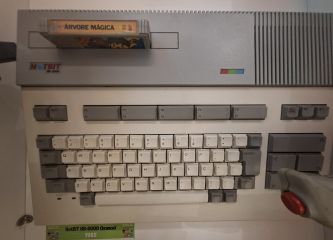 White HB-8000 (Sintegrity, CC BY-SA 4.0)
-
 Audio, video and TV sockets and the switched AC outlet (Sintegrity, CC BY-SA 4.0)
-
 Block diagram from the service manual


Related pages
[edit | edit source]- Canon V-20, whose slot and cursor key layout the MSX Resource Center compares with the Hotbit's[2]
References
[edit | edit source]- ↑ 1.0 1.1 1.2 1.3 Hotbit, Wikipedia—link(accessed 2026-10-21) Developed and sold by the Brazilian subsidiary of Sharp through its Epcom home computer division; released November 1985, discontinued 1988; peripherals HB-100 joystick, HB-2400 tape recorder, HB-3000 or HB-3001 modem, HB-3600 dual disk drive controller sold with one HB-6000 drive, HB-4000 80-column card with the V9938, HB-4100 64 KB RAM expansion, HB-6000 5¼-inch 360 KB drive.
- ↑ 2.00 2.01 2.02 2.03 2.04 2.05 2.06 2.07 2.08 2.09 2.10 2.11 2.12 2.13 Sharp HB-8000, MSX Resource Center wiki—link(accessed 2026-10-21) Description, specifications, versions, hardware and links: single unit with integrated keyboard and power supply; four case versions (ROM 1.0, 1.1 and 1.2 in white, ROM 1.2 in black); production stopped in 1988; Z80A from Zilog or SGS (Z8400A); 64 KB RAM in slot 3; 16 KB VRAM; TMS9128NL; PSG (YM2149 or AY-3-8910); QWERTY keyboard with a Ç key; switched AC outlet; reset button at the bottom left; 120/240 V selector; linear LM723 power supply with crowbar protection and a fuse on +5 V; switch on the slot 1 cover that shuts the supply down while a cartridge is inserted; second slot not protected against insertion with the power on; three main board revisions and two video/RF board revisions (LM1889N); jumpers P1 to P3.
- ↑ 3.0 3.1 3.2 Epcom, HB-8000 service manual (File:Sharp Hotbit HB-8000 Service Manual.pdf), circuit description, printed page 3 (PDF page 2): Z80-A at 3.58 MHz; 32 KB ROM with the BASIC interpreter; 64 KB dynamic RAM; 16 KB video RAM; 24 lines of 32 or 40 characters, 256 × 192 pixels, 16 colours; sound generator with 3 channels and 8 octaves; 73-key keyboard; cassette in FSK at 1200 or 2400 baud; Centronics printer interface; two 50-pin slots; RF modulator on channel 3 or 4, selected by a switch under the case, and composite video. Hosted with a description at Sharp Hotbit HB-8000 Service Manual.
- ↑ 4.0 4.1 4.2 4.3 Epcom, HB-8000 service manual (File:Sharp Hotbit HB-8000 Service Manual.pdf), parts list for the main board ("placa principal"), printed page 21 (PDF page 26): CI15 8255A, CI19 LH0080A, CI22 AY-3-8910A, CI25 and CI26 TMS4416-20NL, CI27 TMS9128NL, CI28 and CI29 27256 EPROM, CI34 to CI41 HM-4864P3; X1 crystal 10.738635 MHz; SW1 reset switch; RL1 6 V relay.
- ↑ 5.0 5.1 5.2 5.3 5.4 Manual do Usuário - Hotbit HB-8000, Internet Archive—link(accessed 2026-10-21) Epcom/Sharp user manual: description of the top, rear, sides, front and underside; channel 3/4 selector and 120/220 V selector under the case; 120 or 220 V, 24 W; connector specifications (8-pin DIN cassette, 9-pin joystick, 50-pin cartridge, 14-pin printer).
- ↑ Epcom, HB-8000 service manual (File:Sharp Hotbit HB-8000 Service Manual.pdf), cover, printed page 1: "Microcomputador HB-8000, Hotbit, Epcom Equipamentos Eletrônicos Ltda., produzido na Zona Franca de Manaus", dated November 1985.
- ↑ 7.0 7.1 Epcom, HB-8000 service manual (File:Sharp Hotbit HB-8000 Service Manual.pdf), block diagram, printed page 4 (PDF page 3): main board sections with their IC numbers; video connector J10 to the RF modulator (CI301 to CI303); power supply (CI101 to CI103) on J15; keyboard on J25; cassette on J35; printer on J20; slots J1 and J2.
- ↑ Epcom, HB-8000 service manual (File:Sharp Hotbit HB-8000 Service Manual.pdf), main board schematic, PDF pages 12 to 14: CI23 and CI24 LS157 address multiplexers for CI34 to CI41 (marked 4164); reset switch SW1 with R13, C2 (22 µF), D1, T1, CI6 and CI30; cassette motor relay RL1 driven by T4 (BC550) with D2 (1N4001) across the coil, to REM+ and REM− on J35; C9 (10 µF) to CMT OUT on J35; C1 (10 µF) from the sound input on pin 49 of J1 to the audio output stage T3 (BC550); C31 marked 4.7 µF at the Z80 reset pin; jumpers P1 (BUSRQ) and P2 (buffer enable); video connector J10 to the RF board carrying Y, R−Y, B−Y, +12 V, ground and sound.
- ↑ Epcom, HB-8000 service manual (File:Sharp Hotbit HB-8000 Service Manual.pdf), power supply schematic and layout, PDF pages 19 and 20; also File:Sharp Hotbit HB-8000 power supply circuit (service manual).png: 120/220 V 60 Hz input, SW101, F101 0.25 A, switched AC outlet, L101, C103, SW102, TR101; +5 V from bridge D101 to D104, C112 (4700 µF 25 V), TIP32 pass transistor T102 with current sensing through R101 and T101 and the 741C op-amp CI101, fuse F102, crowbar D109 (TIC106A) with zener D106 (1N754), C113 (47 µF 16 V); +12 V from D107, C114 (1000 µF 40 V), LM723 IC-102 with TIP29 pass transistor T104, VR101, C115 (47 µF 25 V); −12 V from D108, C116 (1000 µF 40 V), 7912 CI-103, C117 (47 µF 25 V); inhibit input through T105 (BC547); output wires labelled ground, −12 V, +12 V, inhibit and +5 V.
- ↑ Epcom, HB-8000 service manual (File:Sharp Hotbit HB-8000 Service Manual.pdf), connector pin-outs, printed page 13 (PDF page 11): J1/J2 slots, J20 printer, J35 cassette (pin 4 CMT OUT, pin 5 CMT IN, pins 6 and 7 REMOTE + and −), JOY A/B.
- ↑ Manual de BASIC Hotbit HB-8000, Internet Archive—link(accessed 2026-10-21)
- ↑ Apêndice Hotbit HB-8000, Internet Archive—link(accessed 2026-10-21) Appendix to the manuals supplied with the Hotbit HB-8000, with the Hot-BASIC 1.2 updates (Sharp-Epcom, 1985).
