

Daewoo CPC-400
 | |
| Daewoo CPC-400 (X-II) system unit, with the cartridge slot at the left and drive A at the right; the keyboard is separate | |
| Specifications | |
|---|---|
| Manufacturer | Daewoo Electronics |
| Type | MSX2 home computer |
| Released | 1987 (South Korea)[1] |
| CPU | Z80A (Goldstar GSS Z8400A PS) |
| Memory | 128 KB RAM (memory mapper), 128 KB VRAM |
| Storage | One or two 3.5-inch 720 KB floppy drives; MSX cartridge; cassette |
| Display | Yamaha V9938 |
| Sound | AY-3-8910A PSG, switchable stereo |
| Power | AC 220 V ±10 %, 60 Hz (MSX Resource Center); 100 V/220 V selector[2] |
| OS / Firmware | — |
| Model no. | CPC-400, CPC-400S (X-II) |
The Daewoo CPC-400 is an MSX2 computer made by Daewoo Electronics and sold in South Korea from 1987 as the X-II. It has a separate keyboard, a built-in power supply and one or two 3.5-inch floppy drives, and it was also used in Soviet administrations.[1] Like the Daewoo CPC-300 it uses Daewoo's DW64MX1 gate array for the PPI, slot select logic and memory mapper, and like the CPC-300 it has a light pen input and a SCREEN 9 Korean text mode.[1] The CPC-400S adds a superimpose and digitiser board, which the bundled Super Graphic program needs for its video functions.[3]
Specifications
[edit | edit source]| Item | Detail |
|---|---|
| CPU | Z80A, Goldstar GSS Z8400A PS[1] |
| RAM | 128 KB memory mapper in slot 0-2[1] |
| Video | Yamaha V9938 with 128 KB of VRAM[1] |
| Sound | AY-3-8910A; a rear switch selects stereo, with channel A on the left and channels B and C on the right[1] |
| Floppy disk | One or two 720 KB 3.5-inch drives,[1] WD1772 controller[4] |
| Keyboard | Separate, with a cable to a socket on the front[5] |
| Power | Built in; 100 V or 220 V by selector, set to 220 V at the factory[2] |
Connections
[edit | edit source]
The front carries the reset switch, the cartridge slot, drive A, the power switch and a door over the light pen socket and the two joystick ports; the keyboard plugs into a socket on the front.[5] The rear has the mains lead, the voltage selector, auxiliary mains outlets, the fuse, the stereo/mono switch, printer, RGB and cassette sockets, video and audio outputs, a colour/mono switch and the expansion bus. The CPC-400S adds video and audio inputs for its superimpose function.[2]
Hardware
[edit | edit source]The main board carries the DW64MX1, the Z80, the AY-3-8910A and a WD1772 floppy disk controller.[4] A separate video board sits above the main board, joined to it by cables, and carries the AA cells that back up the clock. On the CPC-400S the master crystal oscillator is on the video board; on the CPC-400 it is on the main board. Except for the disk ROM in slot 2, the system ROMs and RAM sit in the expanded slot 0; slot 1 is the cartridge slot and slot 3 goes to the rear expansion bus. RBSC's 2026 conversion project, which turns the CPC-400 and 400S into a more conventional MSX2 or MSX2+, documents these points and publishes a main board schematic supplied by Korean enthusiasts.[6]
The MSX Resource Center notes that many CPC-400 and 400S machines were not fully tested before sale, and that some SCC cartridge games behave oddly.[1]
Documentation
[edit | edit source]Daewoo's Korean user manual is hosted as Daewoo CPC-400 User Manual. No Daewoo service manual or circuit diagram for the CPC-400 has surfaced; the nearest documents are RBSC's schematic of the main board and Daewoo's own schematics for the CPC-300.[6]
Repair and maintenance
[edit | edit source]- Daewoo CPC-400 General Maintenance
- Daewoo CPC-400 Troubleshooting Guide
- Daewoo CPC-400 Capacitor Replacement Guide
Gallery
[edit | edit source]-
 Main board, with added wires
-
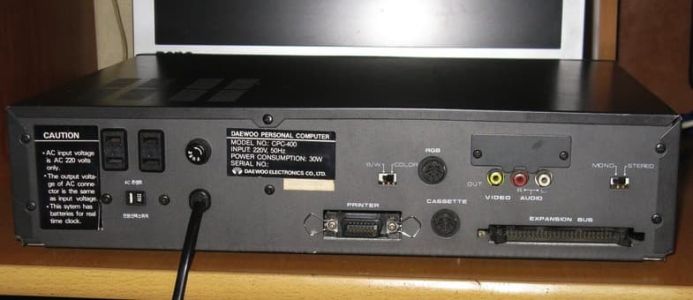 Rear panel
-
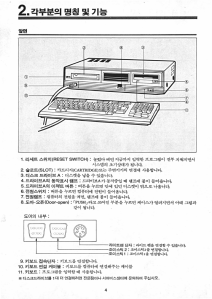 Front panel, from the manual


Related pages
[edit | edit source]References
[edit | edit source]- ↑ 1.0 1.1 1.2 1.3 1.4 1.5 1.6 1.7 1.8 Daewoo CPC-400, MSX Resource Center wiki, 20 June 2026—link(accessed 2026-10-21) Community specification page: also called the X-II; made and sold by Daewoo in Korea from 1987 and also used in the USSR; separate Korean keyboard; black or dark silver; power supply built in; light pen handled by the V9938; SCREEN 9 Korean text mode; rear switch for stereo PSG sound (channel A left, B and C right); odd behaviour noted with SCC cartridges; many CPC-400 and 400S machines not fully tested before sale; 128 KB of RAM in slot 0-2, 128 KB of VRAM; one or two 720 KB 3.5-inch drives; Yamaha V9938; AY-3-8910A; DW64MX1 gate array; Goldstar Z8400A PS CPU; reset button; I/O port F7h controls mixing of external sound; power plug for AC 220 V ±10 %, 60 Hz and two outlets for a monitor and another device.
- ↑ 2.0 2.1 2.2 Daewoo, X-II (CPC-400/400S) user manual, printed page 5, rear panel: 1 power cord; 2 power selector switch, 100 V or 220 V, set to 220 V at first; 3 auxiliary power outlets supplying the incoming mains; 4 fuse, which blows to protect the computer from excessive current; 5 stereo/mono switch; 6 printer port (MSX standard, semi-Centronics); 7 analogue RGB output; 8 cassette; 9 video input for the superimpose and digitise functions; 10 video output; 11 to 14 audio inputs and outputs, right and left; 15 colour/mono switch; 16 expansion bus; machines without the superimpose function have no sockets 9, 11 and 13. Hosted as File:Daewoo CPC-400 User Manual (Korean).pdf; see Daewoo CPC-400 User Manual.
- ↑ Daewoo, X-II (CPC-400/400S) user manual, printed page 186: Super Graphic is graphics software for the CPC-400S with its built-in SD (superimpose and digitise) board; without the SD board the external video functions do not work. See Daewoo CPC-400 User Manual.
- ↑ 4.0 4.1 Photograph of the CPC-400 main board, uploaded to the MSX Resource Center wiki by Gdx on 28 June 2016 (File:Daewoo CPC-400 main board.jpg): board marked DAEWOO CPC-400; DW64MX1 gate array, Goldstar Z8400A, AY-3-8910A, a WD1772-PH floppy disk controller and a finned heatsink.
- ↑ 5.0 5.1 Daewoo, X-II (CPC-400/400S) user manual, printed page 4, front panel: 1 reset switch; 2 cartridge slot; 3 disk drive A; 4 drive A lamp; 5 eject button; 6 power switch; 7 power lamp; 8 door, opened by pressing PUSH, behind which are the light pen socket and joystick ports 2 and 1; 9 keyboard socket; 10 keyboard cable; 11 keyboard. See Daewoo CPC-400 User Manual.
- ↑ 6.0 6.1 Daewoo CPC-400/400S MSX2/MSX2+ Conversion Project, RBSC, 2026—link(accessed 2026-10-21) Project description (Docs/Daewoo_CPC400_Upgrade_Project_English.pdf, pages 3 and 4): everything except the disk ROM is in expanded slot 0, the disk ROM in non-expanded slot 2, slot 1 free for the user and slot 3 routed to the back panel; the clock batteries are removable AA cells on the video board, which sits above the main board on cables; leaking cells destroyed video boards and ran down the cables to corrode the main board, so cables, the battery holder, IC sockets and connectors had to be replaced; on the 400S the master crystal oscillator is on the video board and on the 400 on the main board; the board used had an unstable oscillator, at least two faulty 74LS367 buffers and a 74LS157 that stopped the clock IC holding data; the board schematic lists some capacitor values incorrectly. Mainboard/Schematics/X2PCB_Schematics.pdf: one-sheet main board schematic and PAL dumps for U33 and U46, provided by Peter Yoo.