

Sony HB-75
 | |
| Sony HB-75P, the European version of the HB-75 | |
| Specifications | |
|---|---|
| Manufacturer | Sony |
| Type | MSX home computer |
| Released | 1984[1] |
| Intro price | ¥69,800 (Japan); £299 (UK)[1] |
| CPU | Z80A, 3.579545 MHz |
| Memory | 64 KB RAM, 16 KB VRAM |
| Storage | Cartridge slots; cassette interface |
| Display | TMS9918ANL (HB-75); TMS9929ANL (European models) |
| Sound | PSG (AY-3-8910A or YM2149F) |
| Power | 220 V (HB-75P) or 240 V (HB-75B), 50/60 Hz, 24 W; 100 V (HB-75) |
| Dimensions | 405 × 67 × 245 mm (HB-75P/75B) |
| Weight | About 3.5 kg (HB-75P/75B) |
| OS / Firmware | — |
| Model no. | HB-75, HB-75AS, HB-75B, HB-75D, HB-75F, HB-75P |
The Sony HB-75 is an MSX computer that Sony launched in 1984 as a larger companion to its HB-55, with more RAM and a better keyboard. It starts into Sony's built-in Personal Data Bank program for addresses, a diary and memos.[1] Sony sold it in Japan as the HB-75 and in Europe and Australia as the HB-75P and several national versions.[1]
Versions
[edit | edit source]| Model | Market | Mains | Keyboard | Video outputs | Slots |
|---|---|---|---|---|---|
| HB-75 | Japan | 100 V | QWERTY, kana | RF, composite | One cartridge slot and an expansion bus |
| HB-75AS | Australia | 240 V | QWERTY with £ | RF, RGB SCART, composite DIN | Two cartridge slots |
| HB-75B | UK | 240 V | QWERTY with £ | RF, RGB SCART, composite DIN | Two cartridge slots |
| HB-75D | Germany | 220 V | QWERTZ | RF, RGB SCART, composite DIN | Two cartridge slots |
| HB-75F | France | 220 V | AZERTY | RGB SCART | Two cartridge slots |
| HB-75P | Europe | 220 V | QWERTY with £ | RF, RGB SCART, composite DIN | Two cartridge slots |
The Japanese HB-75 came with an HBI-55 data cartridge. Its built-in program asks for the machine to be switched off and the cartridge fitted if any of its options is chosen without it.[2]
Specifications
[edit | edit source]Sony's service manual for the European models gives:[3]
| Item | Figure |
|---|---|
| CPU | Z80A, 3.579545 MHz, one wait state in each M1 cycle |
| RAM | 64 KB (3764 DRAMs) |
| ROM | 48 KB: MSX-BASIC 32 KB and the utility program 16 KB |
| Video | TMS9929ANL; PAL composite 1 V p-p; analogue RGB 0 to 0.7 V; RF on UHF channel 36 |
| Sound | PSG, 8 octaves, three tones and one noise channel |
| Interfaces | Cassette (8-pin DIN, 1200 or 2400 baud), printer (14-pin), two joystick ports (9-pin), two cartridge slots |
| Keyboard | 74 keys |
| Power | 220 V ±10 % (HB-75P) or 240 V ±10 % (HB-75B), 50/60 Hz, 24 W |
| Size and weight | About 405 × 67 × 245 mm and 3.5 kg |
The 3764 DRAMs are named in the manual's theory chapter, which also places the 64 KB of RAM in slot 2.[4]
Hardware
[edit | edit source]The power supply sits on its own boards inside the case. A mains transformer with a thermal fuse in its primary feeds three linear regulators: an SI-3052V for +5 V and an SI-3122V for +12 V, each on a small board of its own, and an NJM79L12A for −12 V. The power board also carries the RF modulator and the 6-pin audio and video socket.[5] On the main board, IC41 is the CPU, IC16 the PPI, IC6 the video processor and IC48 the PSG; the MSX-BASIC ROM is at IC42 and IC43 (or one 32 KB mask ROM at IC42), and the Personal Data Bank is in IC44.[6][4] At switch-on the firmware loads the settings for the PAL colour subcarrier into the PLL chip IC31 before BASIC starts.[4]
Known faults
[edit | edit source]The MSX Resource Center lists the HB-75P among MSX machines with failure-prone capacitors, noting that the affected capacitors are on separate small boards, which makes the damage less serious.[7] One owner found the electrolytics on both regulator boards of an HB-75P had burst.[8] The values and replacement procedure are in the Sony HB-75 Capacitor Replacement Guide, fault-finding in the Sony HB-75 Troubleshooting Guide, and routine work in the Sony HB-75 General Maintenance guide.
Documentation
[edit | edit source]Sony's service manual for the HB-55P, HB-75P and HB-75B is hosted here as the Sony HB-55P, HB-75P and HB-75B Service Manual. It covers the European models only.[3]
Gallery
[edit | edit source]-
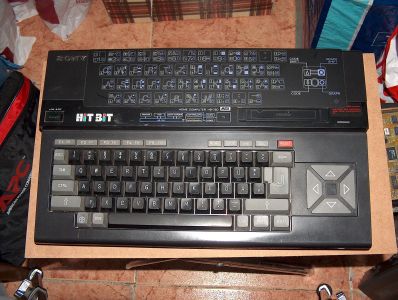 HB-75D, the German version, from above

Related pages
[edit | edit source]- Sony HB-75 General Maintenance
- Sony HB-75 Troubleshooting Guide
- Sony HB-75 Capacitor Replacement Guide
- Sony HB-55P, HB-75P and HB-75B Service Manual
- Sony HB-701
References
[edit | edit source]- ↑ 1.0 1.1 1.2 1.3 1.4 Category:Sony HB-75, MSX Resource Center wiki—link(accessed 2026-10-21) The HB-75 series: HB-75 (Japan, 100 V, one cartridge slot plus an expansion bus, RF and composite outputs, black or white, ¥69,800), HB-75AS (Australia, 240 V), HB-75B (UK, 240 V, £299), HB-75D (Germany, 220 V, QWERTZ), HB-75F (France, 220 V, AZERTY, RGB SCART only) and HB-75P (Europe, 220 V); the export models have two cartridge slots, RGB on SCART and composite video and audio on a 6-pin DIN; 1984; 64 KB RAM in slot 2, 16 KB VRAM; TMS9918ANL (HB-75) or TMS9929A (others); PSG AY-3-8910A or YM2149F; NEC D780C-1 Z80A; built-in Personal Databank; the Japanese HB-75 came with the HBI-55 data cartridge; links to Sony's HB-55P/75P/75B service manual on the MSX Archive.
- ↑ Sony HB-75, MSX Resource Center wiki—link(accessed 2026-10-21) The Japanese HB-75 at ¥69,800, supplied with the HBI-55 cartridge; its built-in program offers Address, Schedule, Memo, Copy, BASIC + Data Cartridge and BASIC, and choosing an option without the HBI-55 fitted brings a message asking for the machine to be switched off and the cartridge inserted.
- ↑ 3.0 3.1 Sony, HB-55P/75P/75B Service Manual, PDF page 3 (printed pages 1-1 and 1-2), features and specifications: Z80A at 3.579545 MHz with one wait state in each M1 cycle; HB-75P/75B 64 KB RAM, HB-55P 16 KB; 48 KB ROM (MSX-BASIC 32 KB, utility program 16 KB); TMS9929ANL video; PAL composite video 1 V p-p, analogue RGB 0 to 0.7 V on the HB-75P/75B, RF on UHF channel 36; audio −5 dBs; 74 keys on the HB-75P/75B; cassette 1200/2400 baud; 14-pin printer port; two 9-pin joystick ports; two MSX cartridge slots; 220 V ±10 %, 50/60 Hz (HB-55P/75P) or 240 V ±10 %, 50/60 Hz (HB-75B); 24 W; about 405 × 67 × 245 mm and 3.5 kg. Hosted here as Sony HB-55P, HB-75P and HB-75B Service Manual.
- ↑ 4.0 4.1 4.2 Sony, HB-55P/75P/75B Service Manual, PDF pages 13 and 14 (sections 3-2 and 3-3), theory of operation: at switch-on R106 and C49 hold pin 3 of IC26, a Schmitt-trigger inverter, low for several hundred milliseconds to reset the PPI (IC16) and the CPU (IC41); the firmware ROM (IC44) then sends PLL setting data to IC31, which starts the 4.43 MHz PAL subcarrier, before BASIC (IC42 and IC43) starts; slot 0 holds the ROMs, slot 1 is the top cartridge slot, slot 3 the rear cartridge slot, and on the HB-75 the 64 KB main RAM is in slot 2. The contents list (PDF page 2) gives section 3-5-3 as "Dynamic RAM (3764) (HB-75P/75B)" and the HB-55P's as the 4116. Hosted here as Sony HB-55P, HB-75P and HB-75B Service Manual.
- ↑ Sony, HB-55P/75P/75B Service Manual, PDF pages 54 and 55 (printed 5-23 and 5-24), schematic of the fuse, LED, power, transformer, +5 V and +12 V boards: mains through fuse F401 (T160mA) and power switch S401, with C9 (4700 pF) across the switch, to transformer T401, which has a thermal fuse in its primary and taps for 220 V (AE) and 240 V (UK); +5 V from bridge D6 (RB-402), reservoir C1 (10,000 µF 16 V) and regulator IC1 (SI-3052V) on the +5 V board with C10 (0.33 µF) and C6 (47 µF 16 V), then L1 (22 µH) and C4 (47 µF 16 V); +12 V from D1 and D2 (10E-2), C2 (3300 µF 25 V) and IC2 (SI-3122V) on the +12 V board with C11 (0.33 µF) and C7 (47 µF 16 V); −12 V from D3 and D4 (10E-2), C3 (330 µF 35 V) and IC3 (NJM79L12) with C5 (0.33 µF) and C8 (47 µF 16 V); +5 V, +12 V and −12 V go to main board connector CN10; the power board also carries the RF unit and the 6-pin audio/video DIN socket. Hosted here as Sony HB-55P, HB-75P and HB-75B Service Manual.
- ↑ Sony, HB-55P/75P/75B Service Manual, PDF pages 9 and 10 (printed 2-1 to 2-3): upper cabinet removal (three screws in the lower cabinet; unplug CN11 (13-pin) and CN12 (9-pin) on the main board and CN2 (2-pin) on the power board; release three hooks); main board removal (four heat sink screws, three main board screws, two screws in the blind plate, unplug CN10 (8-pin)); on the HB-75P/75B the function and cursor keytops are not locked in, so take the keyboard out and tape them before handling it; the BASIC ROM can be a single MSM38256-70RS mask ROM at IC42 with jumpers JW5 and JW7 to JW10 set to MASK and IC43 removed; the firmware ROM IC44 is an MSM38128A-77RS, with JW6 removed for an EPROM; parts marked with a warning triangle are safety-critical. Hosted here as Sony HB-55P, HB-75P and HB-75B Service Manual.
- ↑ Vulnerable MSX hardware, MSX Resource Center wiki—link(accessed 2026-10-21) All MSX2 and later machines have a battery for the real-time clock; drained batteries, alkaline ones especially, leak; take removable batteries out before storage; lithium AA cells as an alternative. Lists the Sony HB-75P ("not as serious, as the problem caps are on separate small PCBs"), HB-F1II, HB-F1XD, HB-F1XDJ ("the ELNA caps are risky, the Nichicon ones are ok"), HB-F1XDmk2 and HB-F1XV among models with leaky capacitors. Fractured solder joints on DIN, RCA and DE-9 connectors cause flickering video and crackling sound; reflow them.
- ↑ Photograph posted to msx.pics on 25 March 2019 (https://www.msx.pics/image/Ud0TS), linked from the MSX Resource Center's vulnerable hardware page: "These capacitors had exploded on the Sony HB-75P when I got it", showing two small regulator boards marked RE-19 (1-615-726-11) and RE-20 (1-615-727-11) with replacement electrolytics and film capacitors marked 330nK beside each regulator.