

Sony HB-F1XDJ
 | |
| Sony HB-F1XDJ, with the floppy drive panel at the right of the top cover | |
| Specifications | |
|---|---|
| Manufacturer | Sony |
| Type | MSX2+ home computer |
| Released | 21 October 1988 (Japan)[1] |
| Intro price | ¥69,800[2] |
| CPU | Zilog Z80A (Z0840004SPC), 3.58 MHz |
| Memory | 64 KB RAM, 16 KB SRAM for MSX-JE, 128 KB VRAM |
| Storage | Built-in 3.5-inch floppy drive (720 KB), two cartridge slots |
| Display | Yamaha V9958 |
| Sound | PSG in the Yamaha S1985 MSX-Engine; Yamaha YM2413 (MSX-MUSIC) |
| Power | AC 100 V, 50/60 Hz, 31 W[3] |
| OS / Firmware | — |
| Successor | Sony HB-F1XV |
| Model no. | HB-F1XDJ |
The Sony HB-F1XDJ is an MSX2+ computer that Sony released in Japan on 21 October 1988. It uses the case of Sony's MSX2 HB-F1XD series and adds MSX-JE Japanese text conversion, and it came with a game programming tool disk.[1] The machine has a built-in 3.5-inch floppy drive, the Yamaha V9958 video chip and the YM2413 FM sound chip. It has a pause key, a speed controller slider and a Ren-Sha Turbo autofire slider.[2] The HB-F1XV replaced it a year later.
History
[edit | edit source]Sony sold the HB-F1XDJ at ¥69,800. It was sold only in Japan, like all MSX2+ machines.[2] The HB-F1XV that followed on 21 October 1989 kept the hardware and changed the colouring and the bundled software.[4][1][5]
Specifications
[edit | edit source]| Item | Figure |
|---|---|
| Standard | MSX2+ |
| CPU | Zilog Z0840004SPC (Z80A), 3.58 MHz, one wait state in each M1 cycle[2][5] |
| MSX-Engine | Yamaha S1985, with the PSG |
| RAM | 64 KB in slot 3-0, plus 16 KB SRAM used by MSX-JE |
| Video | Yamaha V9958, 128 KB VRAM |
| FM sound | Yamaha YM2413 (MSX-MUSIC) |
| Floppy drive | Mitsumi D357B, 3.5-inch, 720 KB; controller MB89311[2][5] |
| Cartridge slots | Two: one on top, one at the back |
| Rear connectors | RF (channel 1 or 2), composite video, mono audio, RGB (8-pin DIN), cassette (8-pin DIN), printer (14-pin)[5] |
| Joystick ports | Two, on the right-hand side[5] |
| Power | AC 100 V, 50/60 Hz, 31 W[3] |
Hardware
[edit | edit source]The main board is printed "MSX2+SYSTEM". The mains transformer and the large reservoir capacitor sit at its left-hand end, the HIC-1 module stands upright near the rear connectors at the right, and a CR2032 cell marked BATT1 is soldered to the board at the right. Near the front right corner is a blue trimmer beside a test point marked TP1 (ALM); on the HB-F1XV board the trimmer is marked CV2.[6][7] On the HB-F1XD, Sony's service guide uses CV2 and TP1 to set the clock chip's timer frequency.[8]
The HIC-1 is a Mitsumi hybrid module, EMC-NX0039, that Sony and Panasonic used in several MSX2 and MSX2+ machines. It encodes RGB to composite video with a Sony CXA1145M, mixes and amplifies the sound from the PSG, the 1-bit sound port and the two cartridge slots, mutes the sound at reset and pause, and drives the cassette interface and its relay. It carries three electrolytic capacitors, two of 10 µF and one of 100 µF, which are known to leak.[9]
Two backup supplies are fitted. The calendar clock runs from two AA cells. The kanji conversion dictionary of MSX-JE is held in SRAM backed by a CR2032 lithium cell soldered to the main board under the keyboard; when that cell is flat the dictionary is cleared at every switch-on.[5]
Known faults
[edit | edit source]- Leaking electrolytic capacitors on the HIC-1 module. Owners on the MSX Resource Center forum report that the first sign is usually lower sound volume; the module also encodes the composite video, while RGB passes through it unchanged.[10][11]
- Leaking ELNA electrolytics on the main board, with intermittent starting, instability and wrong key presses.[10]
- Quiet FM sound. Sony's own remedy was to replace a capacitor; owners replace C99, a 1 µF 50 V electrolytic near the YM2413.[1][5]
- A stretched or melted floppy drive belt.[5][2]
- Dead keys from corroded traces on the keyboard film.[1][5]
The checks, part values and procedures are in the Sony HB-F1XDJ Troubleshooting Guide, Sony HB-F1XDJ General Maintenance and Sony HB-F1XDJ Capacitor Replacement Guide.
Documentation
[edit | edit source]No service manual for the HB-F1XDJ has been found. Sony's service guide for the MSX2 HB-F1XD, which uses the same case and the same HIC-1 module, is hosted here as the Sony HB-F1XD Service Guide; its board, supply and parts numbering belong to the HB-F1XD.[8][1] A schematic of the HIC-1 module, redrawn from a module by the author of the ジャンカーのブログ blog, is linked from the blog post.[9]
Gallery
[edit | edit source]-
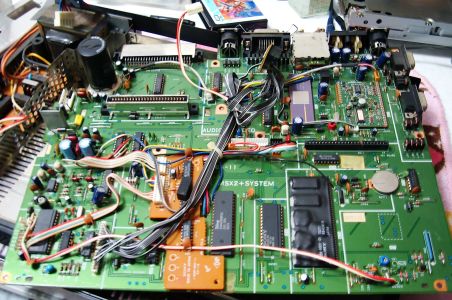 HB-F1XDJ main board, with the HIC-1 module at the rear right and the CR2032 at the right
-
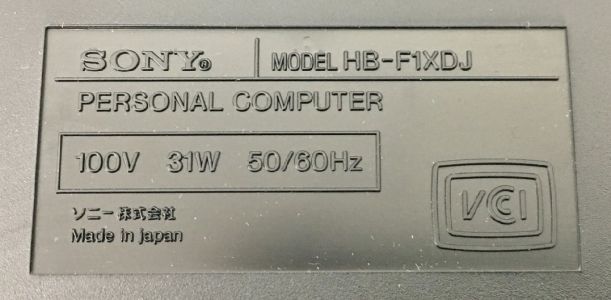 Rating label: 100 V, 31 W, 50/60 Hz


Related pages
[edit | edit source]- Sony HB-F1XDJ General Maintenance
- Sony HB-F1XDJ Troubleshooting Guide
- Sony HB-F1XDJ Capacitor Replacement Guide
- Sony HB-F1XV
- Sony HB-F1XD Service Guide
References
[edit | edit source]- ↑ 1.0 1.1 1.2 1.3 1.4 1.5 MSX2+, Japanese Wikipedia—link(accessed 2026-10-21) In Japanese. The HB-F1XDJ was released on 21 October 1988 with a game development tool disk; its case was carried over from the MSX2 HB-F1XD series; MSX-JE built in. After about a year of use the FM sound on the HB-F1XDJ became quieter because of a circuit fault, which Sony dealt with by replacing a capacitor. The keyboards of the series suffer broken traces on the film when dirt gets in between the keys. The HB-F1XV changed the colouring and expanded the bundled software.
- ↑ 2.0 2.1 2.2 2.3 2.4 2.5 2.6 Sony HB-F1XDJ, MSX Resource Center wiki—link(accessed 2026-10-21) Community specification page: MSX2+, released 1988-10-21 in Japan at ¥69,800; 64 KB RAM in slot 3-0 plus 16 KB SRAM; 128 KB VRAM; Yamaha V9958; PSG (YM2149) in the Yamaha S1985 MSX-Engine; MSX-MUSIC (YM2413); 720 KB 3.5-inch floppy drive; reset and pause buttons, speed controller, Ren-Sha Turbo; Kanji ROM levels 1 and 2, MSX-JE; Zilog Z0840004SPC CPU; MB89311 floppy disk controller; two cartridge slots, one at the top and one at the back; RF, composite video and audio, RGB (8-pin DIN), cassette, printer and two general-purpose ports; mains plug for AC 100 V ±10 %, 50/60 Hz; replaced by the HB-F1XV. Maintenance notes: drive belt 59 mm in diameter, 186 mm long, 2.8 mm wide and 0.4 mm thick; HIC-1 daughterboard with three SMD electrolytic capacitors that leak; ELNA capacitors on the system board that leak; FM crackle fix (C99 replaced by a wire, C20 by a non-polarised capacitor of the same value, after Niga); lithium or Eneloop cells recommended, alkaline cells advised against.
- ↑ 3.0 3.1 Rating label of the HB-F1XDJ, photographed for the MSX Resource Center wiki (File:Sony HB-F1XDJ rating label.jpg, uploaded by Mars2000you, 18 January 2023): "MODEL HB-F1XDJ PERSONAL COMPUTER 100V 31W 50/60Hz", ソニー株式会社, Made in Japan.
- ↑ Sony HB-F1XV, MSX Resource Center wiki—link(accessed 2026-10-21) Community specification page: released 1989-10-21 in Japan at ¥69,800; the last MSX made and sold by Sony.
- ↑ 5.0 5.1 5.2 5.3 5.4 5.5 5.6 5.7 5.8 8ビットパソコン HB-F1XDJ (MSX2+) ネタ, 25 October 2016—link(accessed 2026-10-21) In Japanese. An owner's notes on the HB-F1XDJ: successor to the HB-F1XD mk2 at ¥69,800; the HB-F1XV is almost identical apart from the bundled software and the colour of the drive panel, and its hardware is the same; Z80A-equivalent CPU at 3.58 MHz with one wait state in the M1 cycle; kanji dictionary SRAM backed by a soldered Sony CR2032 lithium cell on the main board, under the keyboard; calendar and clock backed by two AA dry cells; Mitsumi D357B 720 KB drive without VFO, with a rubber drive belt; floppy drive powered by +5 V only, 34-pin signal connector; AC 100 V present at the left-hand side of the case; RGB 8-pin DIN pin-out; disassembly sequence; some production lots lose FM volume, cured by replacing C99, a 50 V 1 µF electrolytic in the YM2413 block on the left of the main board; quaternary-salt electrolytic capacitors used in places; keyboard film traces corroded by spilled liquid.
- ↑ File:Sony HB-F1XDJ main board.jpg, photograph of an HB-F1XDJ main board uploaded to the MSX Resource Center wiki by Gdx on 4 April 2016. Read from it: "MSX2+SYSTEM" on the board; transformer and large reservoir capacitor at the left; HIC-1 module upright at the rear right; coin cell marked BATT1 at the right; blue trimmer beside test point TP1 marked ALM near the front right; Zilog Z80 CPU and Sony ROM at the centre.
- ↑ File:Sony HB-F1XV main board.jpg, photograph of an HB-F1XV main board uploaded to the MSX Resource Center wiki by Gdx on 4 April 2016: the same layout as the HB-F1XDJ board, with a trimmer marked CV2 beside test point TP1 near the front right.
- ↑ 8.0 8.1 Sony, HB-F1XD サービスガイド (Japanese), PDF page 6 (printed page 5), adjustments: CPU clock at TP2 with CV1; timer clock at TP1 with CV2; floppy controller VCO at TP5 with RV1; read pulse at TP3 with RV2; all on the PU-14 board. Hosted here as Sony HB-F1XD Service Guide.
- ↑ 9.0 9.1 MSX2以降用ハイブリッドIC「EMC-NX0039」の回路図, 19 May 2020—link(accessed 2026-10-21) In Japanese, with the author's redrawn schematic as a PDF. Mitsumi hybrid IC EMC-NX0039 (HIC-1): RGB to NTSC encoder (CXA1145M), sound output amplifier mixing the PSG, the 1-bit sound port and the audio from slots 1 and 2, external audio input (unused), reset and pause muting, cassette interface amplifiers and relay control. Used in the Sony HB-F1II, HB-F1XD, HB-F1XDmk2, HB-F1XDJ and HB-F1XV and the Panasonic FS-A1mkII and FS-A1F. Sony part number 1-464-877-11, Panasonic DAMCNX0039XT. Two 10 µF and one 100 µF electrolytic capacitors, all known to leak; the author replaced them with tantalum capacitors and advises fused types, because tantalums fail short. R32 and R33, which mix the slot audio, are 220 kΩ on Sony modules and 150 kΩ on Panasonic ones.
- ↑ 10.0 10.1 Sony HB-F1XDJ capacitor leakage repair guide, 21 December 2017—link(accessed 2026-10-21) Repair report by Omega: an HB-F1XDJ that sometimes would not start, was unstable when it did, and produced wrong key presses (EF for E). Electrolyte had leaked round the HIC module and from through-hole capacitors on the main board; all four ELNA 47 µF capacitors (corrected in a later post to 6.3 V) had leaked and lost their capacitance. He desoldered the SMD capacitors with hot air, cleaned with isopropyl alcohol, neutralised with vinegar, scraped the pads and fitted Panasonic parts, replaced every ELNA electrolytic on the board, left the Nichicon ones, and removed the flat CR2032. He found that the capacitors on the HIC module served only the RGB to composite circuit, and that RGB output passes through the module unaffected. Some copper was corroded but no traces needed repair; the machine then started every time and the keyboard worked. Grauw's reply links the MSX wiki page on vulnerable hardware. Reply by Wierzbowsky, 7 January 2018, on an HB-F1XV: replaced the three capacitors on the daughterboard with 10 µF 16 V size B and 100 µF 16 V size D tantalums, and replaced the soldered cell, which he calls the clock battery, with a socket for a CR2032.
- ↑ Urgent alert to MSX2/2+ owners: suicide capacitors on HIC-1 daughterboard, July 2015 onwards—link(accessed 2026-10-21) Opening post by sd_snatcher, 19 July 2015: the HIC-1 (EMC-NX0039) module in the Sony HB-F1XV, HB-F1XDJ, HB-F1XDmkII and HB-F1XD and the Panasonic FS-A1, FS-A1mkII and FS-A1F carries three SMD aluminium electrolytics that leak and damage the board: C10 10 µF 16 V, C14 10 µF 16 V and C22 100 µF 16 V, C22 being the worst; ceramic or tantalum replacements in 3216 (10 µF) and 4532 or 6032 (100 µF) sizes, rated 16 V or more. Reply by gdx: the FS-A1's daughterboard is a different one. Reply by jltursan: two HB-F1XD and one HB-F1XV affected, the first symptom usually lower sound volume. Reply by dublevay, 5 September 2020, on an HB-F1XV: the original 100 µF part was a 6.3 V type marked 6A and the 10 µF parts were 16 V; after replacement there was no composite or RF picture until the 22 µH inductor below the lower 10 µF capacitor, which had a bad joint, was reflowed; hot air blew three small resistors (820 Ω, 1 kΩ and 0 Ω) off the module.
