

Philips NMS 8280
 | |
| NMS 8280 with a Philips CM 8852 monitor | |
| Specifications | |
|---|---|
| Manufacturer | Sanyo, for Philips |
| Type | MSX2 home computer with video digitiser |
| Released | 1 April 1987 |
| Intro price | ƒ2995 (Netherlands), 2300 DM (Germany) |
| CPU | Z80A |
| Memory | 128 KB RAM, 128 KB video RAM, 48 KB ROM, 16 KB disk ROM |
| Storage | Two built-in 3.5-inch drives (one on the first batch) |
| Display | Yamaha V9938 |
| Sound | PSG (YM2149) inside the Yamaha S-3527 MSX-Engine |
| Power | 220 V ±10 %, 50 Hz |
| OS / Firmware | — |
| Model no. | NMS 8280/00, /02, /09, /16, /19 |
The Philips NMS 8280 is an MSX2 desktop computer with a built-in video digitiser and superimpose, released by Philips on 1 April 1987. It was made by Sanyo and based on the Sanyo MPC-27. It looks much like the Philips NMS 8250 and Philips NMS 8255, but adds a colour data bus, a control register and an independent CPU clock for the video functions, and front-panel sliders for the video, audio mix and digitise levels with a button to select the input source.[1] Most were sold with two drives; the first batch had one. Four disks came with it: MSX-DOS 1, the Home Office 2 suite, the Video Graphics drawing program, which can superimpose and digitise, and a demo disk. An SBC 3810 mouse was included.[1]
The "256K RAM" printed on the case includes the 128 KB of video RAM; the machine has 128 KB of user RAM.[1][2]
Versions
[edit | edit source]| Version | Market | Keyboard |
|---|---|---|
| /00 | Netherlands, Belgium | QWERTY |
| /02, /09 | Germany | QWERTZ |
| /16 | Spain | QWERTY with ñ |
| /19 | France | AZERTY |
The Philips service manual covers the /00 and /16.[2] The MSX Resource Center records five board variants, identified by the first three digits of the serial number, and differences between power supplies.[1]
| Prefix | Notes |
|---|---|
| 005 | Extra board; main board differs from the 006 and 007 |
| 006 | No extra board |
| 007 | Extra board |
| 017 | Double-sided board, fewer cables |
| 027 | As 017, with a newer model of drive |
Philips's parts list gives the analogue unit in two forms, the original with a separate sub analogue unit and a modified one into which the sub analogue unit is integrated.[3]
Hardware
[edit | edit source]| Position | Part | Function |
|---|---|---|
| IC145 | Z80A | CPU |
| IC101 | S-3527 | MSX-Engine, including the PSG |
| IC106 | V9938 | Video processor |
| IC102 to IC105 | 81464-12 | Video RAM |
| IC133 to IC136 | 81464-12 | User RAM |
| IC153 | WD2793A | Floppy disk controller |
| IC162 | RP5C01 | Real-time clock |
| IC301 to IC304 | V7010, V7020, V7030, V7040 | Video chips on the analogue unit |
| X101, X102, X103 | 7.159 MHz, 32.768 kHz, 4 MHz | Main board crystals |
| X301, X302 | 3.55 MHz, 4.43 MHz | Analogue unit crystals |
The video functions are on the analogue unit and on the control unit behind the front sliders. The control unit carries three variable resistors (VR501 1 kΩ, VR502 10 kΩ, VR503 50 kΩ), the source select switch SW501, the reset switch SW502, three green LEDs and one orange LED.[4][5]
Power supply
[edit | edit source]The supply board is similar in layout to the NMS 8250's but not the same: the +5 V regulator is an STR9005 (IC1053), the bridge rectifiers are C01-02F types for +5 V and DSF10C for ±12 V, and C1053 is 470 µF where the NMS 8250 has 220 µF.[5][6] The rectifiers are the part owners most often replace; see Philips NMS 8280 Troubleshooting Guide.
Known problems
[edit | edit source]- Failing rectifier diodes in the power supply. A forum member who repairs these machines calls a dead diode, which leaves one half-wave missing, a classic fault of the NMS 8280 supply.[7]
- Poor mixing of SCC and other sound cartridges with the internal sound.[1]
- A brittle front panel.[1]
Documentation
[edit | edit source]The service manual is hosted and described on Philips NMS 8280 Documentation.
Maintenance and repair
[edit | edit source]- Philips NMS 8280 General Maintenance
- Philips NMS 8280 Troubleshooting Guide
- Philips NMS 8280 Capacitor Replacement Guide
Gallery
[edit | edit source]-
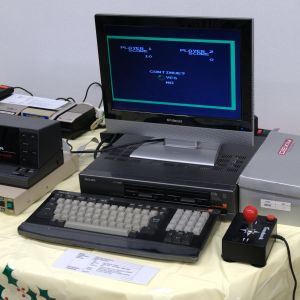 NMS 8280 at Retrosystems 2010
-
 Inside the NMS 8280
-
 Power supply circuit (service manual)


Related pages
[edit | edit source]References
[edit | edit source]- ↑ 1.0 1.1 1.2 1.3 1.4 1.5 1.6 1.7 Philips NMS 8280, MSX Resource Center wiki—link(accessed 2026-10-21) Community page: made by Sanyo for Philips, based on the design of the Sanyo MPC-27; released by Philips on 1 April 1987; looks like the NMS 8250 and 8255 but is a very different machine, with a video digitiser and superimpose; a colour data bus, a control register and an independent CPU clock added for these functions; front sliders for the video, audio mix and digitise levels and a button to select the input source; most have two drives, the first batch only one; 128 KB RAM, not the 256 KB on the machine and box, which adds the video RAM; versions /00 (Netherlands and Belgium, QWERTY), /02 and /09 (Germany, QWERTZ), /16 (Spain, QWERTY with ñ), /19 (France, AZERTY); sold in Italy as the Phonola NMS 8280; a rare white version, the HCS 280; SBC 3810 mouse included; launch prices 2300 DM and ƒ2995; RAM in slot 3-2; V9938; PSG (YM2149) integrated in the S3527 MSX-Engine; Z80A from NEC (D780C-1); four disks supplied: MSX-DOS 1, Home Office 2, Video Graphics (with superimpose and digitise support) and a demo disk; board differences by the first three digits of the serial number (005, 006, 007, 017, 027) and differences in the power supply; SCC mixing problems; fragile front panel; connections listed.
- ↑ 2.0 2.1 Philips, Service Manual, Home computer NMS8280/00/16, 4822 727 15939, PDF page 1: specification. Z80A; 48k ROM, 16k disk ROM, 128k video RAM, 128k user RAM; V9938 video processor; S-3527 MSX controller; floppy disk drives 2 × 3.5-inch, 1 MB; RF output (UHF channel E36), video/audio output, video/audio input, SCART, cassette recorder, two joysticks, printer, two cartridge slots; QWERTY keyboard /00 and /16; 220 V ±10 %, 50 Hz. Hosted as File:Philips NMS 8280 Service Manual 4822 727 15939.pdf.
- ↑ Philips, Service Manual NMS8280, PDF page 18, mechanical parts list: front panel 4822 432 10613; slide knob; keyboard /00 4822 273 20259 and /16 4822 693 91125; caps LED unit; floppy drives 4822 693 91114; source select knob; mains switch; control unit 4822 219 81061; transformer 4822 148 80768; analog unit 4822 219 81057, or analog unit (modified) 4822 219 81072, with the sub analog unit integrated in it; sub analog unit 4822 219 81063; power supply 4822 219 81055; main panel /00 4822 219 81056 and /16 4822 219 81062; modulator 4822 212 10215; audio and video input and output connectors. Hosted as File:Philips NMS 8280 Service Manual 4822 727 15939.pdf.
- ↑ 4.0 4.1 Philips, Service Manual NMS8280, PDF page 45, main printed board parts list: IC101 S-3527, IC102 to IC105 and IC133 to IC136 81464-12, IC106 V9938, IC145 Z80A, IC153 WD2793A, IC162 RP5C01, IC173 AN1431T, X101 7.159 MHz, X102 32.768 kHz, X103 4 MHz, RL101 relay, Ni-Cd accumulator 4822 138 10213, SW101 service switch, VR102 50 kΩ, VR104 10 kΩ. PDF page 46, analog unit U103: IC301 V7010, IC302 V7020, IC303 V7030, IC304 V7040, IC305 4053BP, DL301 to DL303, X301 3.55 MHz, X302 4.43 MHz, T302 4.43 MHz band-pass filter, T303, VC301 and VC302, VR302 to VR310, C333 0.47 µF 35 V tantalum. PDF page 47: power supply, floppy drive and control unit. Hosted as File:Philips NMS 8280 Service Manual 4822 727 15939.pdf.
- ↑ 5.0 5.1 Philips, Service Manual NMS8280, PDF page 47: power supply U101 4822 219 81055 with IC1051 L7812-RA, IC1052 AN79M12, IC1053 STR9005, D1050 to D1053 C01-02F, D1054 to D1057 DSF10C and R1050 fusible resistor; floppy drives U106 and U107 4822 693 91114, alignment disk 4822 395 30274; control unit U105 4822 219 81061 with D501 to D503 green LED, D504 orange LED, VR501 1 kΩ, VR502 10 kΩ, VR503 50 kΩ, SW501 source select switch, SW502 reset switch. PDF page 21 (sheet CS 9 271): power supply circuit. Hosted as File:Philips NMS 8280 Service Manual 4822 727 15939.pdf; the supply diagram is reproduced as File:Philips NMS 8280 power supply circuit (service manual).png.
- ↑ Philips, Service Manual NMS8250/NMS8255, PDF page 20: NMS 8250/8255 supply with IC1050 SI-3052V, D1050 to D1053 DSB15C and C1053 220 µF. Hosted as File:Philips NMS 8250 and NMS 8255 Service Manual.pdf.
- ↑ PHILIPS 8280 bad picture quality...., September 2014—link(accessed 2026-10-21) japanretroCT: an NMS 8280 unused for ten years showed vertical shaking of the picture, worst with FM-PAC or SCC games, fading after about twenty minutes; all PSU capacitors and regulators already changed. edoz: replaced the complete PSU for similar issues. Jipe: change the four big diodes on the power supply; often one no longer rectifies and a half-wave is missing, a classic fault of the 8280 supply; he fitted an industrial bridge rectifier. japanretroCT: new 6 A 1000 V diodes cured it for about twenty minutes, then the diodes ran very hot and ripple returned; a small fan above the diodes fixed it. Jipe: try 10 A or 15 A; 1000 V is not a good choice for 5 V, try 100 V.