

Philips CDI 210
 | |
| A CDI 210/45, the UK version with the Mono III mainboard | |
| Specifications | |
|---|---|
| Manufacturer | Philips |
| Type | Compact Disc Interactive (CD-i) player |
| CPU | Philips SCC68070[1][2] |
| Memory | 8 KB battery-backed NVRAM (ICDIA)[3] |
| Storage | CD tray with a CDM 9, CDM 12.4 or CDM 12.1 mechanism, depending on version[3] |
| Display | — |
| Sound | — |
| Ports / interface | Composite video, SCART (Euroconnector), stereo audio, headphones, two 8-pin mini-DIN input ports on early versions, RF modulator on some versions[4][5] |
| Power | 220-230 V 50 Hz (Europe) or 240 V 50 Hz (UK); 35 W with the 22ER9141 cartridge (210/00, Europe)[4] |
| Dimensions | 420 × 90 × 286 mm[4][5] |
| Weight | 5.2 kg (210/00); 3.75 kg with and 3.5 kg without the video cartridge (210/40)[4][5] |
| OS / Firmware | — |
| Model no. | 210/00, /05; /20, /25; /40, /41, /45; /60, /65[6] |
The Philips CDI 210 is a consumer Compact Disc Interactive (CD-i) player made by Philips. ICDIA describes it as a stripped-down Philips CDI 220: it has no door in front of the disc tray and a simpler front display.[7] In the United States the same player was sold under the Magnavox name as the CDI 200.[3] Like the 220, the 210 kept its model number through four hardware revisions, each on a different mainboard, so the number after the slash on the type plate decides which manual and which parts apply.[3][6]
History
[edit | edit source]The 210 belongs to Philips's 200 series of consumer CD-i players, with the Philips CDI 205 and the CDI 220.[8] retrostuff notes that the 220 came out first, on an earlier hardware generation, so a 210 carries a version number 20 lower than the 220 built on the same mainboard: the 210/00 has the Mono I board of the 220/20, and the 210/20 the Mono II board of the 220/40.[9] ICDIA lists special versions of the 210 adapted for Grolier (/48, /68), Planeta (/56, /76) and Radiola (/78).[3]
Versions
[edit | edit source]| Version | Mainboard | CD mechanism | Digital Video cartridge | Service manual |
|---|---|---|---|---|
| 210/00, /05 | Mono I | CDM 9 | 22ER9141 | 4822 725 24696 |
| 210/20, /25 | Mono II | CDM 9 | 22ER9141 | 4822 725 24715 |
| 210/40, /41, /45 | Mono III | CDM 12.4 | 22ER9956 | 4822 725 24753 |
| 210/60, /65 | Mono IV | CDM 12.1 | Built in | 4822 725 24775 |
Region codes follow Philips's usual scheme: /00 continental Europe, /05 UK, /17 USA, with 20 added for each hardware revision.[10] The first two revisions take the 22ER9141 Digital Video cartridge, which feeds its picture into the player in analogue form; the 210/40 takes the later 22ER9956, which has a digital connection; the 210/60 has digital video built in.[3]
Hardware
[edit | edit source]The four 210 boards are the same Mono I to Mono IV boards that Philips used in the 220, and the 210 manuals list the same electrolytic capacitors, position for position, as the 220 manuals for the same board.[6] The main ICs are the same too: on the 210/00 the parts list names an SCC68070CCA84 processor (7201), two TMS45165-70 DRAMs (7110, 7118), an MK48T08B-15 Timekeeper NVRAM (7224), the IMS66490 CDIC (7301) and a CXA1145M video encoder (7609); on the 210/60 it names an SCC68070 (7210), the IKAT (7201), the CIAP1.5 (7331) and an M48T08-150PC1 NVRAM (7241).[1][2]
ICDIA lists 8 KB of NVRAM for every 210 version.[3] The parts list in Philips's 210/40 manual instead gives an "ASSY NVRAM 32k x8" and an "IKAT CDI220/PH.IV" at the positions that the 220/60 list uses, so that list appears to have been copied from the 220; check the board itself before ordering a replacement.[11] retrostuff gives the NVRAM size on Mono III boards as set by resistors: 8 KB with a 4.7 kΩ resistor at 3241, 32 KB with 0 Ω resistors at 3244 and 3246.[12]
The 210/00 to 210/25 have a mains transformer wound for one region, on the same power supply board as the 220/20 to 220/57; the 210/40 and later have multi-voltage switch-mode supplies.[9] Philips quotes 35 W with and 22 W without the 22ER9141 cartridge for a European 210/00 (34 W and 21 W for the UK version), and 22 W with and 17 W without the 22ER9956 cartridge for a European 210/40 (23 W and 18 W for the UK).[4][5]
The 210/40 has a single input port at the rear, an 8-pin mini-DIN carrying RXD, TXD, CTS and RTS.[5] ICDIA's I/O code for the 210/40 and 210/60 means the front port takes one pointing device (two through a splitter) and the rear port RS-232 devices only, while on the 210/00 and 210/20 the rear port takes either.[3] The 210/45 in Matthew Paul Argall's photograph has a rear extension slot labelled for the 22ER9956 cartridge, an Input 2 socket, audio and video outputs, an A/V Euroconnector and an RF modulator.[13]
Known faults
[edit | edit source]- The NVRAM battery runs flat and the player forgets its settings or stops with a "memory full" error. See Philips CDI 210 Troubleshooting Guide.[14]
- A 210/00 to 210/25 runs only on the mains voltage it was built for; a European or UK player on 120 V gives a dim display and erratic behaviour.[9]
- On a 210/40 (Mono III) a blown −5 V fuse, 3274, gives a rolling picture, a tray that opens by itself and a spindle that keeps turning.[15]
Documentation
[edit | edit source]Philips published one service manual per hardware revision. All four are hosted here and described on Philips CDI 210 Service Manuals.
- File:Philips CDI 210-00 Service Manual.pdf – 210/00, /05 (Mono I)
- File:Philips CDI 210-20 Service Manual.pdf – 210/20, /25 (Mono II)
- File:Philips CDI 210-40 Service Manual.pdf – 210/40, /41, /45 (Mono III)
- File:Philips CDI 210-60 Service Manual.pdf – 210/60, /65 (Mono IV)
Gallery
[edit | edit source]-
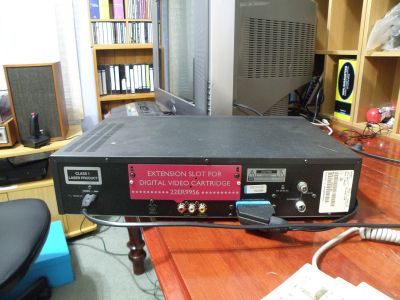 Rear of a CDI 210/45

Related pages
[edit | edit source]- Philips CDI 210 General Maintenance
- Philips CDI 210 Troubleshooting Guide
- Philips CDI 210 Capacitor Replacement Guide
- Philips CDI 210 Service Manuals
- Philips CDI 220
- Philips CDI 205
References
[edit | edit source]- ↑ 1.0 1.1 Philips, Service Manual CDI 210/00/05 (4822 725 24696), PDF pp. 53-54, section 8.4 (parts list of the monoboard): 7110, 7118, 7201, 7224, 7301, 7609. Hosted as File:Philips CDI 210-00 Service Manual.pdf.
- ↑ 2.0 2.1 Philips Interactive Media Systems, Service Manual: Compact disc interactive player CDI 210/60/65, part number 4822 725 24775, PDF p. 42, parts list of the main panel: 7201 IKAT, 7210 SCC68070CCA84, 7241 M48T08-150PC1, 7331 CIAP1.5. Hosted as File:Philips CDI 210-60 Service Manual.pdf.
- ↑ 3.0 3.1 3.2 3.3 3.4 3.5 3.6 3.7 3.8 ICDIA, "Comparison table of all Philips and Philips-build consumer CD-i players" (retrieved 2026-10-20): NV-RAM, DVC, I/O, CDM and PCB for CDI 210/00, /20, /40 and /60; CDI 200/xx as the Magnavox version of the 210; special versions for Grolier, Planeta and Radiola.
- ↑ 4.0 4.1 4.2 4.3 4.4 Philips Interactive Media Systems, Service Manual: Compact disc interactive player CDI 210/00/05, part number 4822 725 24696, PDF p. 3, section 2.1 (technical specification): mains voltage, power consumption with and without the 22ER9141, 5.2 kg, 420 × 90 × 286 mm, two 8-pin mini-DIN input ports. Hosted as File:Philips CDI 210-00 Service Manual.pdf.
- ↑ 5.0 5.1 5.2 5.3 5.4 Philips Interactive Media Systems, Service Manual: Compact disc interactive player CDI 210/40/41/45, part number 4822 725 24753, PDF p. 3 (technical specification): power consumption with and without the 22ER9956, 3.750 kg with and 3.500 kg without DVC, 420 × 90 × 286 mm, one rear 8-pin mini-DIN input (pins include RXD, TXD, CTS and RTS). Hosted as File:Philips CDI 210-40 Service Manual.pdf.
- ↑ 6.0 6.1 6.2 6.3 Cover pages of the four Philips CDI 210 service manuals: 210/00/05 (4822 725 24696, P.S. 0793), 210/20/25 (4822 725 24715, P.S. 1093; /20/25 PAL players with the CDM9), 210/40/41/45 (4822 725 24753, P.S. 1094; CDM12.4), 210/60/65 (4822 725 24775, P.S. 0995; CDM12.1); compared with the parts lists of the CDI 220/20, /40, /60 and /80 manuals. See Philips CDI 210 Service Manuals.
- ↑ ICDIA, "Philips consumer CD-i players" (retrieved 2026-10-20): the CDI 210 as a stripped-down CDI 220 without the door in front of the tray and with a less sophisticated display.
- ↑ Wikipedia, "CD-i" (retrieved 2026-10-21): the 200 series (205, 210, 220).
- ↑ 9.0 9.1 9.2 retrostuff, "Philips CD-i Power Supply Units" (retrieved 2026-10-20): the 210 and 220 version numbering; Mono I/II transformer supplies and the effect of a wrong mains voltage; switch-mode supplies from Mono III.
- ↑ ICDIA, "Philips' version indication method" (retrieved 2026-10-20).
- ↑ Philips, Service Manual CDI 210/40/41/45 (4822 725 24753), PDF p. 42, parts list of the mainboard: 7201 "IKAT CDI220/PH.IV", 7241 "ASSY NVRAM 32k x8". Hosted as File:Philips CDI 210-40 Service Manual.pdf.
- ↑ retrostuff, "Modifications for Philips CD-i Players" (retrieved 2026-10-20): Mono III NVRAM resistor options.
- ↑ Matthew Paul Argall, photographs of a CDI 210/45, Wikimedia Commons, hosted as File:Philips CDI 210-45 front.jpg (CC0) and File:Philips CDI 210-45 rear.jpg (public domain).
- ↑ retrostuff, "NVRAM+RTC Solutions for Philips CD-i Players" (retrieved 2026-10-20).
- ↑ retrostuff, "Philips CD-i Mono III / IV Fuses" (retrieved 2026-10-20); the author checked the fuses on his own 210/40.