

Philips Odyssey 2000
 | |
| A Philips Odyssey 2000, with the VISITING TEAM knob on the left and HOME TEAM on the right | |
| Specifications | |
|---|---|
| Manufacturer | Philips |
| Type | Dedicated home video game console |
| Released | 1977[1][2] |
| CPU | None; game chip General Instrument AY-3-8500 (IC1)[3] |
| Memory | — |
| Storage | — |
| Display | Black and white, RF output for PAL televisions[4][2] |
| Sound | Built-in speaker[2] |
| Power | Six C cells; no adaptor socket[2] |
| OS / Firmware | — |
| Model no. | G 7509/00[5][2] |
The Philips Odyssey 2000 (type G 7509/00) is the European version of the Magnavox Odyssey 2000, a dedicated home video game console sold by Philips from 1977. It has the Magnavox console's case, games and main board, with a PAL version of the General Instrument game chip, an aerial lead for European televisions and Philips labels.[4][2][3] Unlike the Magnavox console it has no socket for a mains adaptor and runs from its six C cells only.[2]
The circuit, games and controls are described in full on Magnavox Odyssey 2000.
History
[edit | edit source]Pong-Story describes the first two Philips Odyssey consoles, the Odyssey 200 and the Odyssey 2000, as direct copies of their American equivalents with a PAL game chip, a European television cable and a Philips label, and dates the 2000 to "1977 or 1978". Wikipedia gives 1977, and says the Philips Odyssey 2000 replaced the Philips Odyssey 200 and was itself followed by the Philips Odyssey 2001 the same year.[4][1] The two later Philips consoles, the Odyssey 2001 and the Philips Odyssey 2100, had no American equivalent.[4]
An owner's console bought in Italy has the type label G 7509/00 and "MADE IN U.S.A." moulded into the bottom case.[2][5]
Differences from the Magnavox Odyssey 2000
[edit | edit source]| Feature | Philips (G 7509/00) | Magnavox (BH7510) |
|---|---|---|
| Game chip | AY-3-8500, the PAL version | Magnavox part 612114-1 |
| Power | Six C cells only; the moulded opening for the adaptor socket is unused | Six C cells or a 9 V adaptor in socket J1 |
| RF output | Aerial lead for European televisions; channel switch marked CH 4 and CH 3 | Channel 3 or 4, chosen with a switch on the RF module |
| Labels | PHILIPS ODYSSEY 2000 panel; type label G 7509/00, 8622 275 09009 | Magnavox |
| Main board | 703837 | 703837 |
General Instrument made most of its game chips in a PAL version and an NTSC version with a -1 suffix; the AY-3-8500 is the PAL part and the AY-3-8500-1 the NTSC part.[10] The Philips board photographed carries an AY-3-8500.[3]
Controls
[edit | edit source]The centre panel has the GAME switch with three game symbols, the SKILL switch (AM, PRO, PRACTICE) and the OFF-ON/RESET switch, under the PHILIPS ODYSSEY 2000 legend. The player knobs are marked VISITING TEAM on the left and HOME TEAM on the right.[6][11] The games and skill settings are those of the Magnavox console: Smash, Tennis and Hockey for two players and a one-player Practice game.[2][7]
Power
[edit | edit source]The cells sit in a holder inside the case, reached only by removing the bottom case. With no adaptor socket, the battery's red lead is soldered directly to the board terminal W9, which Magnavox's board drawing labels "FROM BATTERY (+)".[2][3][9]
Maintenance and repair
[edit | edit source]The main board is Magnavox's 703837, the board of the Odyssey 2000 BH7510, so Magnavox's Service Manual No. 6507 covers it and the Magnavox guides apply:[3][9]
- Magnavox Odyssey 2000 General Maintenance: opening the case, the battery holder, the switches and the oscillator and channel adjustments.
- Magnavox Odyssey 2000 Troubleshooting Guide: symptoms, the IC1 voltage chart and transistor voltages.
- Magnavox Odyssey 2000 Capacitor Replacement Guide: the three 470 µF 16 V electrolytics C1, C2 and C9.
Points that apply to the Philips unit only:
- Ignore the adaptor checks in the Magnavox guides: there is no J1, and the battery supply goes straight to W9.[2][3]
- To change the cells or the channel, remove the bottom case: turn the central screw and lift the case off. The board and battery holder stay in the top case, and the CH 4 and CH 3 channel switch is beside the modulator.[2]
- If IC1 has to be replaced, fit an AY-3-8500 (PAL). An AY-3-8500-1 is the NTSC part.[10][3]
- Magnavox's oscillator and channel adjustments in Service Manual No. 6507 are written for the American BH7510.[7]
- As on the Magnavox console, the SKILL and GAME SELECT legends on the board are the other way round from the switches on the case; follow the schematic.[2][9]
Documentation
[edit | edit source]Magnavox's Service Manual No. 6507 for the BH7510 and the Odyssey 2000 instruction booklet IB 3270-1 are hosted on Magnavox Odyssey 2000 Documentation.[7]
Gallery
[edit | edit source]-
 Centre panel: GAME, SKILL and OFF-ON/RESET switches
-
 Underside, with the type label G 7509/00 and "MADE IN U.S.A." moulded into the case
-
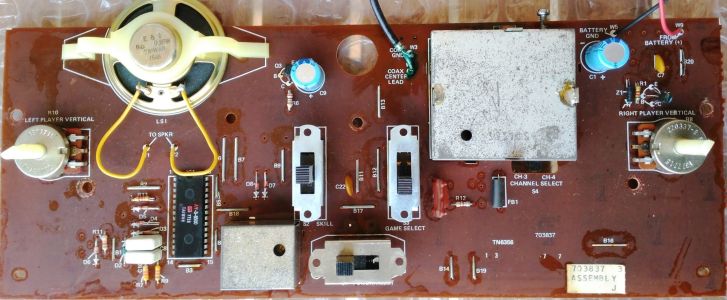 Main board 703837, component side, with IC1 marked AY-3-8500
-
 Bottom case removed: the board, the RF module and the battery holder


Related pages
[edit | edit source]- Magnavox Odyssey 2000
- Magnavox Odyssey 2000 General Maintenance
- Magnavox Odyssey 2000 Troubleshooting Guide
- Magnavox Odyssey 2000 Capacitor Replacement Guide
- Magnavox Odyssey 2000 Documentation
- Philips Odyssey 2100
References
[edit | edit source]- ↑ 1.0 1.1 Wikipedia, "Odyssey series" (retrieved 2026-10-20), section "Philips Odyssey 2000": released across Europe in 1977, replacing the Philips Odyssey 200, and replaced by the Philips Odyssey 2001 in 1977.
- ↑ 2.00 2.01 2.02 2.03 2.04 2.05 2.06 2.07 2.08 2.09 2.10 2.11 2.12 2.13 José Antonio Ortigueira Amor, Retro Ordenadores Orty, "Consolas Magnavox, Philips y Phonola", section "Philips Odyssey 2000 (modelo G 7509/00) (versión PAL) (1977)", in Spanish (retrieved 2026-10-20): the owner's console, bought in Italy, serial 017836, made in the USA; the same case and games as the Magnavox Odyssey 2000; the AY-3-8500 with Tennis, Hockey, Smash and a practice game; black and white picture and internal sound; no socket for an external power supply, with the unused "AC ADAPTER" opening at the back; six 1.5 V C cells in an internal compartment; the bottom case removed by turning the central screw, with the board and battery compartment fixed to the top case; the CH 4/CH 3 channel switch beside the modulator; the SKILL and GAME SELECT board legends the other way round from the case. Owner's hands-on description.
- ↑ 3.0 3.1 3.2 3.3 3.4 3.5 3.6 3.7 José Antonio Ortigueira Amor, photograph of the main board of a Philips Odyssey 2000, 26 November 2020, on Wikimedia Commons as File:Philips Odyssey 2000 placa 2a.jpg (CC BY 4.0): board 703837 with the label "703837 3 ASSEMBLY J", IC1 marked AY-3-8500, the red battery lead soldered to W9. Hosted as File:Philips Odyssey 2000 main board.jpg.
- ↑ 4.0 4.1 4.2 4.3 4.4 David Winter, Pong-Story, "Other Magnavox Odyssey systems", section "Philips Odyssey in Europe" (retrieved 2026-10-20): the Philips Odyssey 200 (1976) and Odyssey 2000 ("1977 or 1978") as direct copies of their US equivalents with a PAL game chip, a European TV cable and a Philips label; the Odyssey 2001 and 2100 without US equivalents.
- ↑ 5.0 5.1 5.2 José Antonio Ortigueira Amor, photograph of the underside of a Philips Odyssey 2000, 26 November 2020, on Wikimedia Commons as File:Philips Odyssey 2000 Back.jpg (CC BY 4.0): type label G 7509/00, 8622 275 09009, serial 017836; "MADE IN U.S.A." moulded into the case. Hosted as File:Philips Odyssey 2000 underside.jpg.
- ↑ 6.0 6.1 José Antonio Ortigueira Amor, photograph of the centre panel of a Philips Odyssey 2000, 26 November 2020, on Wikimedia Commons as File:Philips Odyssey 2000 centro.jpg (CC BY 4.0): GAME, SKILL (AM, PRO, PRACTICE) and OFF-ON/RESET switches and the PHILIPS ODYSSEY 2000 legend. Hosted as File:Philips Odyssey 2000 control panel.jpg.
- ↑ 7.0 7.1 7.2 7.3 Magnavox Consumer Electronics Company, Service Manual No. 6507: BH7510 Odyssey, first issue, October 1977, p. 6507-1: six C cells or an optional 9 V adaptor; Smash, Tennis, Hockey and Practice; the 2 MHz and channel 3 and 4 adjustments. Hosted as File:Magnavox Odyssey 2000 Service Manual 6507.pdf.
- ↑ Magnavox, Service Manual No. 6507, October 1977, p. 6507-2: BH7510 parts list, with IC1 as part 612114-1. Hosted as File:Magnavox Odyssey 2000 Service Manual 6507.pdf.
- ↑ 9.0 9.1 9.2 9.3 Magnavox, Service Manual No. 6507, October 1977, pp. 6507-5 and 6507-6: main board viewed from the component side, marked 703837, with W9 labelled "FROM BATTERY (+)" and the note that the screening is reversed for S2 and S3. Hosted as File:Magnavox Odyssey 2000 Service Manual 6507.pdf.
- ↑ 10.0 10.1 David Winter, Pong-Story, "The General Instruments chips and others" (retrieved 2026-10-20): most GI chips made in PAL (625-line, 50 Hz) and NTSC (525-line, 60 Hz) versions, the NTSC versions with a -1 suffix; the AY-3-8500 (PAL) released in NTSC as the AY-3-8500-1.
- ↑ José Antonio Ortigueira Amor, photograph of a Philips Odyssey 2000 from above, 26 November 2020, on Wikimedia Commons as File:Philips Odyssey 2000 (2).jpg (CC BY 4.0): VISITING TEAM on the left knob panel and HOME TEAM on the right. Hosted as File:Philips Odyssey 2000 console.jpg.