

Sanyo PHC-70FD Wavy
 | |
| The PHC-70FD, sold in Japan as the Wavy70FD | |
| Specifications | |
|---|---|
| Manufacturer | Sanyo Electric Co., Ltd. |
| Type | MSX2+ home computer |
| Released | 4 November 1988 (Japan)[1][2] |
| Intro price | ¥64,800[1] |
| CPU | Z80A inside a Toshiba T9769 MSX-Engine, 3.57 MHz[1][3] |
| Memory | 64 KB RAM, 128 KB video RAM[1] |
| Storage | One 3.5-inch 2DD drive (720 KB)[1] |
| Display | Yamaha V9958[1] |
| Sound | PSG and MSX-MUSIC (YM2413)[1][3] |
| Power | 100 V AC, 50/60 Hz, 18 W[4] |
| OS / Firmware | MSX-BASIC 3.0 and Disk BASIC 1.0 in ROM, with a BASIC compiler; MSX-DOS 1 on the supplied disk[3][1] |
| Successor | PHC-70FD2 |
| Model no. | PHC-70FD (Wavy70FD); also labelled PHC-70FDA[1] |
The Sanyo PHC-70FD is an MSX2+ computer that Sanyo released in Japan on 4 November 1988 and sold as the Wavy70FD. It has one 3.5-inch drive facing the user, MSX-MUSIC, a "Rensha" autofire control and a pause button, and a BASIC compiler built into its firmware.[1][2] Sanyo's other MSX2+ machines were the two-drive PHC-70FD2 and the drive-less PHC-35J.[2]
The navbox entry "Sanyo Wavy 70" refers to this machine. Sanyo's MSX lists on the MSX Resource Center and on Japanese Wikipedia contain no model called simply Wavy 70; the names used are Wavy70FD and Wavy70FD2.[5][2]
Specifications
[edit | edit source]| Item | Figure |
|---|---|
| CPU | Z80A, 3.57 MHz, inside a Toshiba T9769 MSX-Engine |
| Memory | 64 KB RAM (memory mapper); 128 KB video RAM |
| Video | Yamaha V9958 |
| Sound | PSG; MSX-MUSIC (YM2413) |
| Storage | One 3.5-inch 2DD drive, 720 KB; Toshiba TC8566AF controller |
| ROM | MSX-BASIC 3.0, Disk BASIC 1.0, Kanji ROM level 1, MSX-MUSIC BASIC, BASIC compiler (MSX-BASIC KUN 2.0) |
| Slots | Two cartridge slots |
| Power | 100 V AC, 50/60 Hz, 18 W |
Hardware
[edit | edit source]The two cartridge slots are on the left of the top surface, with the power, kana and caps lamps beside them. The drive faces the user on the right, just above the keyboard, with the Rensha controller slider and the pause button to its left.[6] The joystick ports, the reset button and the cassette socket are on the right-hand side, and the printer port, RGB output, RF channel switch and outputs, mains lead and power switch are at the back.[3] A label beside the slots asks for the power to be switched off before a cartridge goes in or comes out.[6]
The power supply is on the main board, not on a separate board, and a metal shield plate covers the board under the top cover.[7][8][9] The board has places for two more DRAM chips, and fitting them raises the main memory from 64 KB to 128 KB.[7][1]
The firmware contains a modified MSX-BASIC KUN 2.0 compiler. Type CALL BC before using its commands, such as CALL RUN and CALL TURBO ON.[1] Some machines carry the label PHC-70FDA, which the MSX Resource Center takes to be a revision that fixed a hardware fault.[1]
Variants
[edit | edit source]- The PHC-70FD2 (Wavy70FD2) was released on 21 October 1989 at ¥87,800. A second drive takes the place of the autofire slider and pause button, and the kanji ROM covers JIS levels 1 and 2.[10] USB Secret Base found only small board differences: the autofire connector and the resistors round it are left off, the two drives share a two-way cable, and the kanji ROM is larger.[3]
- The Sakhr AX-370 is the PHC-70FD adapted by Al Alamiah for Arabic markets, with 128 KB RAM and an Arabic keyboard. The autofire, pause key and BASIC compiler were removed and the MSX2+ BIOS was replaced with MSX2 ROMs, but it keeps the V9958.[11]
Power supply
[edit | edit source]The supply runs from 100 V mains and draws 18 W.[4] On the main board, the fuse F501 sits beside the mains input, followed by a bridge rectifier and a primary reservoir capacitor, C502, rated 330 µF at 160 V.[9][12] Repair-Bas gives the fuse as 1.6 A at 120 V, and the board is printed "AC 125V 1.6A" beside it.[9][12]
Two AA (SUM-3) cells in a compartment underneath keep the real-time clock running. Sanyo's label beside the compartment asks for them to be replaced about once a year.[13]
Known faults
[edit | edit source]- Dead or unreliable floppy drives. The original TEAC drives are direct-drive units powered through the 34-way drive cable, and some have been revived by replacing an electrolytic capacitor on the drive.[14][15]
- SCC and other sound cartridges sound muted, and the mix of PSG, MSX-MUSIC and cartridge sound is unbalanced. A community modification recalibrates the audio circuit.[16]
- Alkaline clock cells leak in time. The MSX Resource Center recommends lithium or Eneloop cells instead.[1]
See the Sanyo PHC-70FD Wavy Troubleshooting Guide.
Documentation
[edit | edit source]No service manual or schematic for the PHC-70FD is held in the MSX Archive's collection of service manuals.[17] Sanyo's MSX2+ 拡張 BASIC 説明書 (MSX2+ extended BASIC manual) for the Wavy series, which covers MSX-MUSIC, the BASIC compiler and the kanji modes, is on the Internet Archive.[18] A copy is at Sanyo MSX2+ Extended BASIC Manual (Wavy series).
Repair guides
[edit | edit source]- Sanyo PHC-70FD Wavy General Maintenance
- Sanyo PHC-70FD Wavy Troubleshooting Guide
- Sanyo PHC-70FD Wavy Capacitor Replacement Guide
Gallery
[edit | edit source]-
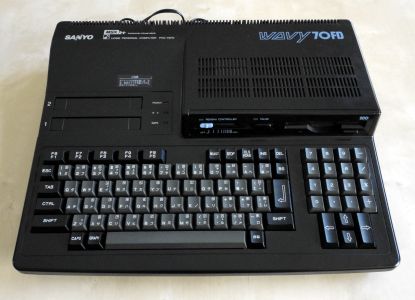 PHC-70FD, top view
-
 Underside, with the battery compartment
-
 Rating label
-
 The 100 V supply on the main board
-
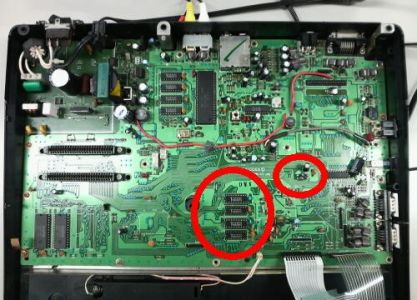 Main board with the shield plate removed


Related pages
[edit | edit source]References
[edit | edit source]- ↑ 1.00 1.01 1.02 1.03 1.04 1.05 1.06 1.07 1.08 1.09 1.10 1.11 1.12 1.13 1.14 Sanyo PHC-70FD, MSX Resource Center wiki—link(accessed 2026-10-21) Community specification page: Japanese market, usually called Wavy70FD; drive facing the user, Ren-Sha Turbo (autofire) slider to its left; not intended to take a second drive, though the board has room for a second drive connector; some units are labelled PHC-70FDA, probably a revision to fix a hardware issue; adapted for Arabic countries as the Sakhr AX-370 with more RAM and an MSX2 BIOS; released 4 November 1988 at ¥64,800; 64 KB RAM in slot 3-0, 128 KB VRAM, Yamaha V9958, PSG and MSX-MUSIC, Toshiba T9769 (A or B) MSX-Engine containing the Z80A, Toshiba TC8566AF floppy controller; QWERTY/JIS keyboard with numeric keypad; 720 KB 3.5-inch drive, reset and pause buttons, Kanji ROM level 1, Kanji BASIC, MSX-MUSIC BASIC, X-BASIC (MSX-BASIC KUN) 2.0 in firmware, enabled with CALL BC; MSX-DOS 1 disk and a demo disk; connections: RF, audio and composite video, RGB (8-pin DIN), data recorder, Centronics printer port, two general-purpose ports, two cartridge slots, and a mains plug for AC 100 V ±10 %, 50/60 Hz; batteries: lithium or Eneloop cells recommended, alkaline cells advised against because they leak.
- ↑ 2.0 2.1 2.2 2.3 MSX2+, Japanese Wikipedia—link(accessed 2026-10-21) In Japanese. Sanyo's MSX2+ models were the WAVY70FD, WAVY70FD2 and WAVY35; the WAVY70FD has a built-in BASIC compiler equivalent to "MSX Bēshikkun plus", single-kanji conversion and no MSX-JE; it was released on 4 November 1988 with one floppy drive; the WAVY70FD2 dropped the autofire control and has two drives.
- ↑ 3.0 3.1 3.2 3.3 3.4 3.5 PHC-70FD/PHC-70FD2, USB Secret Base—link(accessed 2026-10-21) In Japanese. Specification of the WAVY70FD: Z80A at 3.57 MHz; 64 KB main RAM, expandable to 128 KB by a fairly simple modification; 128 KB VRAM with the V9958; Kanji ROM level 1; no MSX-JE; PSG and FM (YM2413, MSX-MUSIC); one 3.5-inch 2DD drive; two slots; MSX-BASIC 3.0 and Disk BASIC 1.0; BASIC compiler; autofire. Side, from the left: joystick ports 1 and 2, reset button, cassette interface. Rear, from the left: printer port, RGB output, RF channel switch, RF output, audio output, video output, mains lead, power switch. The PHC-70FD2 replaces the autofire control and pause button with a second drive, joined by a two-way cable, and has a larger Kanji ROM with level 2.
- ↑ 4.0 4.1 4.2 File:Sanyo PHC-70FD rating label.jpg, rating label photographed for the MSX Resource Center wiki by Mars2000you: PHC-70FD, AC 100 V, 50/60 Hz, 18 W, Sanyo Electric Co., Ltd.
- ↑ Category:Sanyo, MSX Resource Center wiki—link(accessed 2026-10-21) Table of Sanyo MSX computers: MSX2+ models PHC-35J (Wavy35), PHC-70FD (Wavy70FD) and PHC-70FD2 (Wavy70FD2); no model named Wavy 70 without a suffix.
- ↑ 6.0 6.1 File:Sanyo PHC-70FD Wavy.jpg, photograph uploaded to the MSX Resource Center wiki by Jorito: two cartridge slots at the left with Sanyo's label "ご注意: カートリッジの抜き差しは、必ず、電源スイッチを切ってから行なってください" (always switch the power off before inserting or removing a cartridge); power, kana and caps lamps; "Rensha controller" slider and pause button beside the drive marked "2DD".
- ↑ 7.0 7.1 PHC-70FD/PHC-70FD2 メインRAM増設, USB Secret Base—link(accessed 2026-10-21) In Japanese. Main RAM expansion from 64 KB to 128 KB: remove the top cover and the shield plate and free the board from the case; fit two 64K × 4-bit DRAMs (Toshiba TMM41464AP, NEC D41464C, Fujitsu MB81464 or similar) in the empty positions, with 0.1 µF ceramic bypass capacitors, and move the jumper; the start-up screen then shows 128 KB.
- ↑ Sanyo WAVY PHC-70FD2 needs repair, November 2010—link(accessed 2026-10-21) Thread about a PHC-70FD2. Reply by RetroTechie on the Repair-Bas 230 V conversion: 350 V is a bit tight for the replacement reservoir, 400 or 450 V is better, and for the same stored energy it should be at least 68 µF (he used 150 µF 400 V); the fuse should be rated for 230 V AC at about 0.5 to 0.6 times the original current; the small yellow capacitors in the mains section must be checked as suitable for 230 V AC because they are safety-critical; the bridge rectifier is worth replacing too; as far as he knows there is only one board in the machine, the main board, and the owner agrees that the Wavy has no separate power board.
- ↑ 9.0 9.1 9.2 Repair-Bas, Ombouw Sanyo Wavy PHC-70FD(2) naar 230 Volt (3-page PDF, in Dutch), https://repairbas.file-hunter.com/docs/other/Sanyo%20Wavy%20-%20230%20Volt%20ombouw.pdf, retrieved 2026-10-21. The PHC-70FD runs on 100 V AC because it was made only for the Japanese market; the simplest way to run it on 230 V is a step-down transformer; the alternative conversion replaces electrolytic C502 (330 µF 160 V) with 47 µF 350 V (a higher voltage is allowed), glass fuse F501 (1.6 A 120 V) with 1.6 A 250 V, and the mains lead and plug. Photographs of the 100 V supply before and after the change.
- ↑ Sanyo PHC-70FD2, MSX Resource Center wiki—link(accessed 2026-10-21) Community specification page: Japanese market, usually called Wavy70FD2; compared with the PHC-70FD, the Ren-Sha Turbo and pause keys were replaced with a second floppy drive, and the kanji ROM supports JIS levels 1 and 2; released 21 October 1989 at ¥87,800; 64 KB RAM, 128 KB VRAM, V9958, PSG and MSX-MUSIC, Toshiba T9769 MSX-Engine; two 720 KB drives; BASIC compiler built in.
- ↑ Sakhr AX-370, MSX Resource Center wiki—link(accessed 2026-10-21) The AX-370 is the downgraded Sanyo PHC-70FD localised by Al Alamiah, with 128 KB RAM; the Rensha controller, pause key and X-BASIC were removed and the MSX2+ BIOS ROMs replaced by MSX2 ROMs, but the V9958 remains; Arabic QWERTY keyboard; Toshiba T9769B MSX-Engine; 720 KB drive.
- ↑ 12.0 12.1 File:Sanyo PHC-70FD power supply (100 V).jpg, from the Repair-Bas conversion document: fuse F501 with the board printed "AC 125V 1.6A" beside it; bridge D501; primary capacitor a Rubycon CE, 160 V, 330 µF, 85 °C; transformer T501 marked AE0130; Y capacitors C510 and C513; the large secondary capacitor C551.
- ↑ File:Sanyo PHC-70FD underside.jpg, photograph uploaded to the MSX Resource Center wiki by Mars2000you: battery compartment for two SUM-3, AA, R6 1.5 V cells, with Sanyo's label "電池(SUM-3タイプ2個)は、約一年で交換してください" (replace the two SUM-3 cells after about one year) and boxes for the year and month of replacement.
- ↑ PHC-70FDシリーズのFDD交換, USB Secret Base—link(accessed 2026-10-21) In Japanese. The WAVY70FD drives are direct-drive, unlike the belt-driven drives of Panasonic's A1 series, so a failure is more serious; replacing the drive's electrolytic capacitors has fixed some, but not all; the drive is a TEAC FD-235F (some machines have an FD-235GF, whose 4-pin power connector is not used), powered through the 34-pin connector; a Y-E Data YD-702B-6036B D (the final "D" matters), reportedly the drive used in the FM Towns, also takes its power through the 34-pin connector and fits as a direct replacement after trimming the front panel: shave 2 to 3 mm off the disk slot and cut the eject button opening; its access lamp may not light, which is not a fault.
- ↑ Fix for broken Sany Wavy 70 FD / FD2 drives, June 2013 to April 2017—link(accessed 2026-10-21) msxholder: replacing "the 10V 4.7 mF capacitor" fixed all his non-working drives from a Wavy55FD2, 70FD and 70FD2, and the capacitor is on the drive; another member found a 4.7 µF 25 V part on his drive.
- ↑ MSX hardware fixes and enhancements, FRS' MSX Page—link(accessed 2026-10-21) Section 2.1, Sanyo PHC-70FD and PHC-70FD2: the fix cures SCC and other cartridges being muted because of wrong impedance matching (some machines had a Sanyo service fix, which still left other cartridges muted), sets the mixer levels to those of Panasonic and Sony MSX2+ machines, boosts the OPLL bass and recalibrates the OPLL low-pass filter. Parts: R229 and R230 47 kΩ, R227 27 kΩ, R125 33 kΩ, R115 200 kΩ, R120 47 kΩ (metal film); C177 and C178 1.8 nF polypropylene or polystyrene; remove R228; replace C183 with a 0 Ω link; C181 360 pF; 18 pF in parallel with R221; cut the track between pins 1 and 2 of op-amp IC117 and add 10 kΩ from IC117 pin 2 to the negative pin of C184 and 2.2 kΩ from IC117 pin 2 to the positive pin of C115. Credited to work by Fábio Belavenuto and Sturaro.
- ↑ Index of /pub/msx/docs/service_manuals, MSX Archive—link(accessed 2026-10-21) Directory of MSX service manuals; none for any Sanyo machine.
- ↑ MSX2+ 拡張 BASIC 説明書 SANYO WAVYシリーズ, Internet Archive—link(accessed 2026-10-21) Item dated 1988 in the manuals_sanyo collection: the parts of BASIC extended from MSX2 to MSX2+, and the BASIC compiler (MSX Bēshikkun); MSX-MUSIC, kanji mode and the colour modes.