

Sanyo PHC-35J Wavy
 | |
| The PHC-35J (Wavy35), Sanyo's MSX2+ without a disk drive | |
| Specifications | |
|---|---|
| Manufacturer | Sanyo Electric Co., Ltd. |
| Type | MSX2+ home computer |
| Released | 1989 (Japan)[1] |
| CPU | Z80A inside a Toshiba T9769 MSX-Engine, 3.57 MHz[1][2] |
| Memory | 64 KB RAM, 128 KB video RAM[1] |
| Storage | None built in; cassette recorder interface[2] |
| Display | Yamaha V9958[1] |
| Sound | PSG only; no MSX-MUSIC[1][2] |
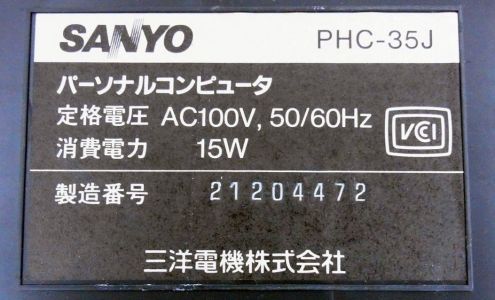
| Power | 100 V AC, 50/60 Hz, 15 W[3] |
| OS / Firmware | MSX-BASIC 3.0 and Kanji BASIC in ROM[2][1] |
| Model no. | PHC-35J (Wavy35); sold in the PHC-35JN package[1] |
The Sanyo PHC-35J, also called the Wavy35, is an MSX2+ computer that Sanyo made in 1989 for an educational package; it was not sold to the general public. It has no disk drive and no MSX-MUSIC, and it was the only MSX2+ model without a drive.[1][4] The Japan Management Association sold it with a course on cassette tape.[4] Its sister models were the one-drive PHC-70FD and the two-drive PHC-70FD2.[1]
Specifications
[edit | edit source]| Item | Figure |
|---|---|
| CPU | Z80A, 3.57 MHz, inside a Toshiba T9769 MSX-Engine |
| Memory | 64 KB RAM (memory mapper); 128 KB video RAM |
| Video | Yamaha V9958 |
| Sound | PSG (AY-3-8910 equivalent); no FM sound |
| Storage | None built in; data recorder socket |
| ROM | MSX-BASIC 3.0, Kanji ROM level 1, Kanji BASIC; no BASIC compiler |
| Slots | Two cartridge slots |
| Power | 100 V AC, 50/60 Hz, 15 W |
Hardware
[edit | edit source]The two cartridge slots are on the left of the top surface, with Sanyo's label asking for the power to be switched off before a cartridge goes in or comes out. The power, caps and kana lamps, the pause button and the "Rensha controller" autofire slider are along the top right.[5] The joystick ports, reset button and data recorder socket are on the right-hand side. The printer port, RGB output, RF channel switch and outputs, mains lead and power switch are at the back.[2]
The power supply is on the main board, in its top left corner. The board is marked 2CA4B10202, 2CA0U20391 and CMK-54X.[6] The V9958 sits at IC104 with four HM50464P-12 video RAM chips, IC105 to IC108, and the main RAM is two more HM50464P-12 chips at IC111 and IC112.[6] The MSX-Engine and a CMOS gate array are on the solder side.[2]
Power supply
[edit | edit source]The supply runs from 100 V mains and draws 15 W.[3] It is a switch-mode supply on the main board: fuse F501, a mains filter and film capacitor C501, bridge D501, a large primary electrolytic, IC501 under a metal cover, and transformer T501 labelled 0027A. On the secondary side are diodes D551 to D556, IC552, IC553 and electrolytics numbered C551 to C557.[7] The PHC-70FD's supply uses the same designators for its fuse, bridge and transformer, but a different transformer, and Repair-Bas's 230 V conversion was written for the 70FD.[8][7] No conversion for the PHC-35J has been published, so run it from a step-down transformer with a 100 V output.
Two AA (SUM-3) cells in a compartment underneath keep the real-time clock running, and Sanyo's label asks for them to be replaced about once a year.[9] The machine works without them, but forgets the time and some start-up settings.[10]
Known faults
[edit | edit source]- Black screen. One owner's PHC-35J stopped giving a picture, and another owner who had the same fault on the same model says replacing RAM cured it.[11]
- Corrupted backgrounds in some MSX2 games, with MSX1 games and memory tests passing. In one machine the SCREEN 8 test pattern was corrupt while SCREEN 5 was clean, and the cause turned out to be a solder bridge between two pins, left from the factory.[12]
- Alkaline clock cells leak in time. The MSX Resource Center recommends lithium or Eneloop cells instead.[1]
See the Sanyo PHC-35J Wavy Troubleshooting Guide.
Documentation
[edit | edit source]No service manual or schematic for the PHC-35J has been published, and the MSX Archive's collection of service manuals has none for any Sanyo machine.[13] Sanyo's MSX2+ 拡張 BASIC 説明書 (MSX2+ extended BASIC manual) for the Wavy series is on the Internet Archive.[14] A copy is at Sanyo MSX2+ Extended BASIC Manual (Wavy series). Parts of it, such as MSX-MUSIC and the BASIC compiler, do not apply to the PHC-35J.[2]
Repair guides
[edit | edit source]- Sanyo PHC-35J Wavy General Maintenance
- Sanyo PHC-35J Wavy Troubleshooting Guide
- Sanyo PHC-35J Wavy Capacitor Replacement Guide
Gallery
[edit | edit source]-
 PHC-35J, top view
-
 Clock battery compartment underneath
-
 Rating label
-
 Main board, component side
-
 The 100 V supply on the main board


Related pages
[edit | edit source]References
[edit | edit source]- ↑ 1.00 1.01 1.02 1.03 1.04 1.05 1.06 1.07 1.08 1.09 1.10 Sanyo PHC-35J, MSX Resource Center wiki—link(accessed 2026-10-21) Community specification page: released in Japan in 1989; not advertised in computer magazines, because it was part of an educational package for a correspondence course, reference PHC-35JN on the box, made with the Japan Management Association (JMA) to promote computer use in schools, administrations and companies; the package held the computer, cables, the RF converter, three Sanyo manuals, further manuals and an educational cassette; the only MSX2+ model without a disk drive, and one of two MSX2+ machines without built-in MSX-MUSIC (the other is the Panasonic FS-A1FX); also known as the Wavy35; 64 KB RAM in slot 3-0, 128 KB VRAM, Yamaha V9958, PSG, Toshiba T9769 (A or B) MSX-Engine containing the Z80A; QWERTY/JIS keyboard with numeric keypad; reset button, pause button, Ren-Sha Turbo (autofire) slider, Kanji ROM level 1, Kanji BASIC; connections: RF, audio and composite video, RGB (8-pin DIN), data recorder, Centronics printer port, two general-purpose ports, two cartridge slots, mains plug for AC 100 V ±10 %, 50/60 Hz; batteries: lithium or Eneloop recommended, alkaline advised against because they leak.
- ↑ 2.0 2.1 2.2 2.3 2.4 2.5 2.6 2.7 PHC-35J, USB Secret Base—link(accessed 2026-10-21) In Japanese. Specification of the WAVY35: Z80A at 3.57 MHz; 64 KB main RAM; 128 KB VRAM with the V9958; Kanji ROM level 1; no MSX-JE; PSG (AY-3-8910 equivalent); no floppy drive; two slots; MSX-BASIC 3.0; autofire; "no FM sound or Bēshikkun [BASIC compiler]". Right side: joystick ports 1 and 2, reset button, data recorder socket. Back panel: printer connector, RGB output, RF channel switch, RF output, audio output, video output, mains lead, power switch. Indicators: power, caps, kana, pause lamp and button, autofire lamp and controller. Photographs of the main board, component and solder sides, with close-ups of the power supply, the VRAM and V9958, the NTSC decoder, the slots and ROM, the DRAM, the MSX-Engine (on the solder side) and a CMOS gate array.
- ↑ 3.0 3.1 3.2 File:Sanyo PHC-35J rating label.jpg, rating label photographed for the MSX Resource Center wiki by Mars2000you: PHC-35J, AC 100 V, 50/60 Hz, 15 W, Sanyo Electric Co., Ltd.
- ↑ 4.0 4.1 MSX2+, Japanese Wikipedia—link(accessed 2026-10-21) In Japanese. Sanyo's MSX2+ models were the WAVY70FD, WAVY70FD2 and WAVY35; the WAVY35 (PHC-35J) was not a model for the general Japanese market and has no floppy drive; the WAVY35 (PHC-35JN) was sold by the Japan Management Association as teaching material, also without a drive, with a course called "パソコン入門" (introduction to the personal computer) supplied on cassette tape.
- ↑ File:Sanyo PHC-35J Wavy.jpg, photograph uploaded to the MSX Resource Center wiki by Jorito: "MSX2+ RAM64KB/VRAM128KB, Home Personal Computer System PHC-35J"; cartridge slots 1 and 2 with Sanyo's label "ご注意: カートリッジの抜き差しは、必ず、電源スイッチを切ってから行なってください" (always switch the power off before inserting or removing a cartridge); power, caps and kana lamps; pause button with lamp; "Rensha controller" slider from OFF to MAX; "Wavy 35" logo.
- ↑ 6.0 6.1 File:Sanyo PHC-35J main board.jpg, photograph of the component side from USB Secret Base: board marked 2CA4B10202, 2CA0U20391 and CMK-54X; the switch-mode supply at the top left; V9958 (IC104) with four HM50464P-12 video RAMs (IC105 to IC108); two HM50464P-12 main RAMs (IC111, IC112); an NEC D23C2001C ROM (IC109) with an empty 32-pin position (IC110) beside it; the two cartridge connectors at the left; a red wire across the board, glued down over the V9958.
- ↑ 7.0 7.1 File:Sanyo PHC-35J power supply section.jpg, from USB Secret Base: fuse F501; the large primary electrolytic beside it (its designator and value cannot be read); green film capacitor C501 and the mains filter (LQ0011 ABA); bridge D501; a 3 W 3.3 Ω resistor; IC501 under a metal cover; transformer T501 labelled 0027A; yellow capacitors C505 and C507; on the secondary side D551, D552, D553, D555 and D556, IC552, IC553, and electrolytics C551, C553, C554, C556 and C557. D554 and C552 appear at the edge of USB Secret Base's close-up of the VRAM area.
- ↑ Repair-Bas, Ombouw Sanyo Wavy PHC-70FD(2) naar 230 Volt (3-page PDF, in Dutch), https://repairbas.file-hunter.com/docs/other/Sanyo%20Wavy%20-%20230%20Volt%20ombouw.pdf, retrieved 2026-10-21. Conversion of the PHC-70FD and PHC-70FD2 from 100 V to 230 V; the photographs show fuse F501, bridge D501, C502 and transformer T501 marked AE0130.
- ↑ File:Sanyo PHC-35J battery compartment.jpg, photograph uploaded to the MSX Resource Center wiki by Mars2000you: compartment for two SUM-3, AA, R6 1.5 V cells, with Sanyo's label asking for them to be replaced after about a year and boxes for the year and month.
- ↑ SANYO WAVY 35 - batteries, May 2022—link(accessed 2026-10-21) An owner asks what the two AA batteries in his PHC-35J are for; sdsnatcher73 replies that the batteries in all MSX2 models are for the real-time clock, which keeps the time and some settings such as the screen and width the machine starts in, and are not needed for normal operation.
- ↑ [WTS] MSX2+ SANYO PHC35-J "Wavy 35" BLACK SCREEN, November 2023—link(accessed 2026-10-21) The seller's PHC-35J, working in July, showed a black screen; a reply says the writer had the same issue with the same machine from Japan and that replacing RAM helps.
- ↑ Possible VDP issue with Sanyo Wavy 35 (Sanyo PHC-35J), October to November 2024—link(accessed 2026-10-21) Two pages. The owner sees graphical corruption in the backgrounds of some games (Aleste, 1942, Gradius) on his PHC-35J while MSX1 games run, and Test RAM 2.0 and MSXDiag find no fault; sdsnatcher73 suspects the second 64 KB of VRAM, since MSX1 games use only 16 KB and many MSX2 games only 64 KB; Jipe advises checking +5 V, +12 V and −12 V before replacing any chip; mcolom notes that a chip can pass simple pattern tests and still be faulty; retrocanada76 gives a BASIC test drawing lines in SCREEN 8 and SCREEN 5, saying that if SCREEN 8 is bad but SCREEN 5 fine the upper 64 KB is at fault; the SCREEN 8 picture was corrupt; in the end a repair technician found that two pins on the board had an unintended solder bridge from the factory, and removing it cleared all the problems.
- ↑ Index of /pub/msx/docs/service_manuals, MSX Archive—link(accessed 2026-10-21) Directory of MSX service manuals; none for any Sanyo machine.
- ↑ MSX2+ 拡張 BASIC 説明書 SANYO WAVYシリーズ, Internet Archive—link(accessed 2026-10-21) Item dated 1988 in the manuals_sanyo collection: the parts of BASIC extended from MSX2 to MSX2+, and the BASIC compiler; MSX-MUSIC, kanji mode and the colour modes.