

Sanyo MPC-200
 | |
| Sanyo's photograph of the MPC-200 on the cover of its Spanish operating instructions. A recent photograph is in the gallery below. | |
| Specifications | |
|---|---|
| Manufacturer | Sanyo Electric Co., Ltd. |
| Type | MSX home computer |
| Released | 1985 (Spain)[1] |
| CPU | Z80A-compatible, inside a Toshiba T7775 MSX-Engine[2][3] |
| Memory | 64 KB RAM, 32 KB ROM, 16 KB video RAM[2][1] |
| Storage | Cassette, FSK at 1200 or 2400 baud[2] |
| Display | Toshiba T6950 (TMS9929A-compatible); 256 × 192 pixels, 16 colours[1][2] |
| Sound | AY-3-8910-compatible PSG, three channels, eight octaves[2] |
| Power | 220 V AC, 50 Hz, 6 W[4] |
| Dimensions | 415 × 266 × 63 mm[2] |
| Weight | About 2.3 kg[2] |
| OS / Firmware | — |
| Model no. | MPC-200(SP) (service reference MPC-200(SP)-00)[4] |
The Sanyo MPC-200 is an MSX1 home computer that Sanyo sold in Spain in 1985. It is the Spanish version of Sanyo's Japanese MPC-2, with a Spanish keyboard that includes an Ñ key, two cartridge slots and the power supply inside the case.[1] The MPC-2 was first shown at the Japan Electronics Show in October 1985, and the same design was also sold as the Sakhr AX-170 and AX-230 in Arabic-speaking countries and as the Fenner FPC-500 in Italy.[5]
Specifications
[edit | edit source]| Item | Figure |
|---|---|
| CPU | Z-80A (equivalent) |
| Memory | 32 KB ROM (MSX BASIC), 64 KB RAM |
| Keyboard | Four cursor keys, ten function keys |
| Display | TMS-9929A (equivalent); text 40 × 24 or 32 × 24; graphics 256 × 192, 16 colours; sprites; PAL video and RF outputs |
| Sound | AY-3-8910 (equivalent), 8 octaves, 3 channels; one audio output |
| Interfaces | Two joystick ports; cassette (FSK, 1200 or 2400 baud); parallel printer, TTL level (Centronics type); two cartridge slots |
| Power | Local mains voltage, 50/60 Hz, 6 W |
| Size and weight | 415 × 266 × 63 mm; about 2.3 kg |
Hardware
[edit | edit source]The top of the case carries the two cartridge slots, labelled "Double slot system", the power lamp and the reset button; the cassette socket and the two joystick ports are on the right-hand side; the printer connector, power switch, mains lead and the RF, video and audio outputs are at the rear.[6][7] A label beside the slots tells the user to switch the computer off before inserting a cartridge.[7]
The CPU is inside a Toshiba T7775 MSX-Engine, a surface-mounted chip on the underside of the main board that combines a Z80-compatible CPU with the other MSX1 functions apart from video and sound.[3][8] The video chip is a Toshiba T6950, which Sanyo's manual calls a TMS-9929A equivalent.[1][2] Inside the case the mains transformer, labelled PT0129, sits at the back left beside a fuse marked F101, T1A 250V. The main board is marked UF063481 and MCL437F, and a separate board marked SANYO EB1402 sits behind the cartridge connectors.[9]
The T6950 video chip
[edit | edit source]The T6950 supports all the documented screen modes of the TMS9918 family but not the undocumented "mirrored" modes, so a few games and demos that use them do not display correctly. Its colour palette is also slightly different from the Texas Instruments chips.[10] Neither is a fault in the machine.
Power supply
[edit | edit source]The MPC-200 has its supply inside the case and is rated at 220 V, 50 Hz and 6 W. The Spanish label on the base says not to open the computer without first disconnecting it from the mains.[4] A photograph of an opened machine shows a mains transformer with a fuse beside it, and two large electrolytic capacitors next to a part on a heatsink.[9] The mains lead has a two-pin European plug.[11]
Documentation
[edit | edit source]Sanyo's Spanish operating instructions are hosted here as Sanyo MPC-200 Operating Instructions. They give the specification, a list of precautions and a table of problems and checks, but no circuit diagram or pin assignments. No service manual for the MPC-200 or the MPC-2 is held in the MSX Archive's collection of service manuals or on the Internet Archive.[12]
Repair guides
[edit | edit source]- Sanyo MPC-200 General Maintenance
- Sanyo MPC-200 Troubleshooting Guide
- Sanyo MPC-200 Capacitor Replacement Guide
Gallery
[edit | edit source]-
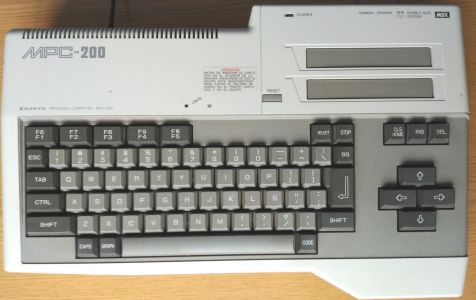 MPC-200, top view
-
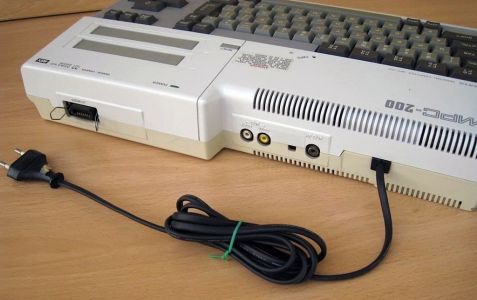 Rear
-
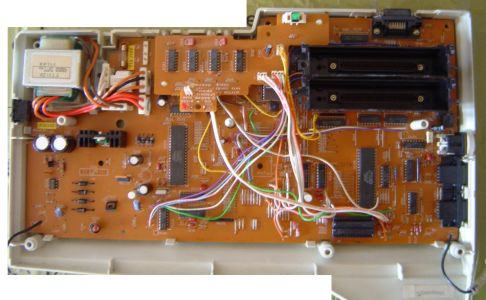 Inside, with the transformer at the top left
-
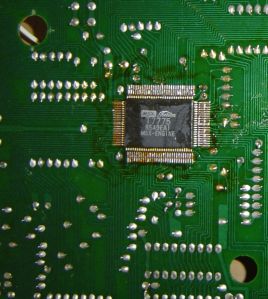 T7775 MSX-Engine on the underside of the main board
-
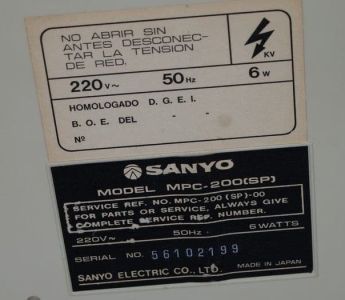 Labels on the base


Related pages
[edit | edit source]- Sanyo MPC-100, Sanyo's British MSX1
- Sanyo MPC-25FD
- Capacitor Failure Symptoms
References
[edit | edit source]- ↑ 1.0 1.1 1.2 1.3 1.4 Sanyo MPC-200, MSX Resource Center wiki—link(accessed 2026-10-21) Community specification page: the MPC-2 localised for the Spanish market, 1985; internal power supply; Z80A, 64 KB RAM in slot 3, Toshiba T6950 VDP with 16 KB VRAM, AY-3-8910 PSG, Toshiba T7775 MSX-Engine; QWERTY keyboard with an Ñ key; reset button; two cartridge slots, RF, composite video and audio (PAL), data recorder, Centronics printer port and two joystick ports. The T6950 does not support some undocumented features of the Texas Instruments TMS9918, TMS9928 and TMS9929.
- ↑ 2.0 2.1 2.2 2.3 2.4 2.5 2.6 2.7 2.8 Sanyo, Ordenador personal MSX: Instrucciones para el funcionamiento (MPC-200), part number 3P05386 (Y3BL), page 14, "Especificaciones". In Spanish. Hosted here as Sanyo MPC-200 Operating Instructions.
- ↑ 3.0 3.1 Toshiba T7775, MSX Resource Center wiki—link(accessed 2026-10-21) The T7775 MSX-Engine contains a Toshiba TMPZ84C00A Z80-compatible CPU at 3.58 MHz and the MSX1 functions, probably including the PPI, but not the VDP or the sound chip; used in the Fenner FPC-500 and the Sanyo MPC-1, MPC-2 and MPC-200.
- ↑ 4.0 4.1 4.2 File:Sanyo MPC-200 rating label.jpg, labels photographed for the MSX Resource Center wiki by Mars2000you: "Model MPC-200(SP)", "Service Ref. No. MPC-200(SP)-00", 220 V, 50 Hz, 6 watts, Sanyo Electric Co., Ltd., made in Japan; Spanish label "No abrir sin antes desconectar la tensión de red", 220 V, 50 Hz, 6 W, "Homologado D.G.E.I.".
- ↑ Sanyo MPC-2, MSX Resource Center wiki—link(accessed 2026-10-21) The MPC-2 (Wavy2) was a low-cost MSX for Japan with an internal power supply, in black or white, first shown at the Japan Electronics Show '85 (17 to 22 October); localised as the Sakhr AX-170 and AX-230 (Arabic countries), the Fenner FPC-500 (Italy), the Sanyo MPC-200 (Spain) and the Sakhr AX-170 for Thailand.
- ↑ Sanyo, Instrucciones para el funcionamiento (MPC-200), page 1, "Nombres de los componentes": top view with power indicator, cartridge slots and reset button; right-hand side with cassette terminal and joystick ports 2 and 1; rear view with printer terminal, power switch (OFF/ON), mains cable, RF, video and audio terminals. See Sanyo MPC-200 Operating Instructions.
- ↑ 7.0 7.1 File:Sanyo MPC-200.jpg, photograph uploaded to the MSX Resource Center wiki by Mars2000you: "RAM64K/VRAM16K", "Double slot system", power and caps lamps, reset button, Spanish keyboard with Ñ, and Sanyo's "Atención" label: before inserting a cartridge, make sure the equipment is switched off, to avoid damage to the cartridge and the computer.
- ↑ File:Sanyo MPC-200 T7775 MSX-Engine.jpg, photograph of the underside of the MPC-200 main board uploaded to the MSX Resource Center wiki by Rderooy: surface-mounted chip marked "MSX Toshiba T7775 8549EA1 MSX-ENGINE".
- ↑ 9.0 9.1 File:Sanyo MPC-200 inside.jpg, photograph of an opened MPC-200 uploaded to the MSX Resource Center wiki by Rderooy. Read from it: mains transformer labelled PT0129 at the back left; fuse holder F101 marked "T1A 250V"; two large electrolytic capacitors side by side next to a part on a black heatsink; a column of four diodes below them; main board labelled UF063481 and marked MCL437F; a board marked SANYO EB1402 behind the two cartridge connectors.
- ↑ Toshiba T6950, MSX Resource Center wiki—link(accessed 2026-10-21) The T6950 is a clone of the TMS9918 family and supports all documented screen modes; the first revision does not support the undocumented modes, in particular the mirrored VDP modes, which makes a few games and demos incompatible; its colour palette is slightly different from the Texas Instruments implementation.
- ↑ File:Sanyo MPC-200 rear.jpg, photograph uploaded to the MSX Resource Center wiki by Gdx: printer connector below the slots, audio and video phono sockets, a small switch, RF output and a fixed mains lead with a two-pin European plug.
- ↑ Index of /pub/msx/docs/service_manuals, MSX Archive—link(accessed 2026-10-21) Directory of MSX service manuals for Goldstar, Panasonic, Philips, Pioneer, Sony, Toshiba and Yamaha machines; none for Sanyo.