

Mitsubishi ML-F80
 | |
| Mitsubishi ML-F80, photographed for the MSX Resource Center | |
| Specifications | |
|---|---|
| Manufacturer | Mitsubishi Electric |
| Type | MSX1 home computer |
| Released | 1984 (United Kingdom, France)[1] |
| Intro price | £299 (UK)[1] |
| CPU | NEC D780C-1 (Z80A)[1] |
| Memory | 64 KB RAM, 16 KB video RAM[1] |
| Storage | Cassette, MSX cartridges |
| Display | Texas Instruments TMS9929A[1] |
| Sound | General Instrument AY-3-8910A[1] |
| Power | 220 to 240 V AC, 50/60 Hz, 27 W[2] |
| OS / Firmware | — |
| Model no. | ML-F80 |
The Mitsubishi ML-F80 is an MSX1 home computer from Mitsubishi Electric, sold in the United Kingdom and France from 1984. It has the case of the smaller ML-F48 with 64 KB of RAM, a keyboard and power supply in one unit, and two cartridge slots, one on top and one at the rear.[1] The Centre for Computing History dates it to 1983.[3]
Versions
[edit | edit source]The British version has a QWERTY keyboard with a £ key and gives PAL composite video and RF. The French version has an AZERTY keyboard and an RGB output on a DIN socket in place of them.[1] On the MSX Resource Center forum, owners of the British version who want RGB are pointed at replacing the video chip with a TMS-RGB board, since the British board has no RGB socket.[4] Both were sold with a demonstration tape that also held two games.[1]
Specifications
[edit | edit source]| Item | Figure |
|---|---|
| Processor | NEC D780C-1 (Z80A) |
| RAM | 64 KB main, 16 KB video |
| Video | TMS9929A; composite and RF (UK) or RGB (France) |
| Sound | AY-3-8910A, mono output |
| Slots | Two: one on top, one at the rear |
| Ports | Cassette, Centronics-compatible printer, two joystick ports |
| Power | 220 to 240 V AC, 50/60 Hz, 27 W |
Hardware
[edit | edit source]A photograph of an ML-F80 main board, marked J0510425K, shows a separate video and RF board (marked 55-4007D) at one corner, an NEC D780C-1 processor, an HN613256P mask ROM, eight M5K4164ANP DRAMs, eight NEC D416C-2 video RAMs next to a copper shield, an M5L8255AP-5 PPI and the AY-3-8910A. The board is marked "STATIC PREVENT DISCHARGE".[5] The D416 video RAM is the µPD416 type, which runs from +5 V, +12 V and −5 V.[6]
Documentation
[edit | edit source]Mitsubishi's Operating Instruction Manual and BASIC Language Handbook covers the ML-F80 and ML-F48.[7] No scan of it, and no service manual or circuit diagram for the ML-F80, has been found online.
Repair guides
[edit | edit source]- Mitsubishi ML-F80 General Maintenance
- Mitsubishi ML-F80 Troubleshooting Guide
- Mitsubishi ML-F80 Capacitor Replacement Guide
See also Capacitor Failure Symptoms.
Gallery
[edit | edit source]-
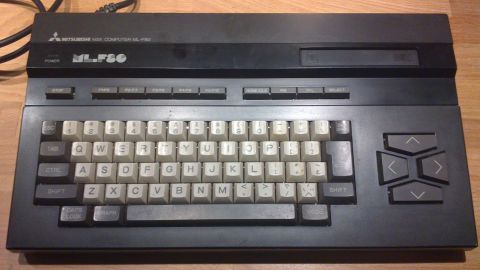 The ML-F80
-
 Main board J0510425K
-
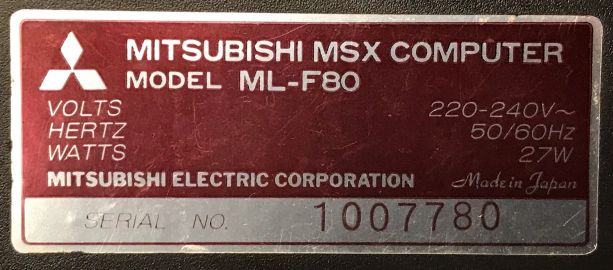 Rating label: 220 to 240 V, 27 W


Related pages
[edit | edit source]References
[edit | edit source]- ↑ 1.00 1.01 1.02 1.03 1.04 1.05 1.06 1.07 1.08 1.09 Mitsubishi ML-F80, MSX Resource Center wiki, 7 March 2026—link(accessed 2026-10-21) Same design as the ML-F48 with more RAM; a French version with an AZERTY keyboard and an RGB DIN video output and a UK version with a QWERTY keyboard (£ key) and PAL RF and composite video; sold with a tape holding a system demo and two games by Knights Computers; 1984; UK launch price £299; 64 KB RAM; 16 KB VRAM; TMS9929A; AY-3-8910A; separate ICs, no MSX-Engine; NEC D780C-1; two cartridge slots, top and rear; connections: RF and composite video (PAL version), RGB (French version), mono sound, data recorder, Centronics-compatible printer port, two general ports, two cartridge slots.
- ↑ 2.0 2.1 File:Mitsubishi ML-F80 rating label.jpg, rating label photographed for the MSX Resource Center wiki (uploaded by Mars2000you, 2 February 2023): "Mitsubishi MSX Computer, Model ML-F80, Volts 220-240V~, Hertz 50/60Hz, Watts 27W, Mitsubishi Electric Corporation, Made in Japan".
- ↑ Mitsubishi ML-F80 MSX computer, Centre for Computing History—link(accessed 2026-10-21) Manufacturer Mitsubishi; date 1983; 64K RAM.
- ↑ Mitsubishi ML-F80, September 2022—link(accessed 2026-10-21) thecaver99: the PAL ML-F80 has only composite output where the French version has RGB. sdsnatcher73: adding RGB is not easy but not impossible, see TMS-RGB. gdx: if there is no space under the RF converter for an RGB connector, the only solution is to replace the VDP with the TMS-RGB and find a way to fit an RGB connector.
- ↑ File:Mitsubishi ML-F80 main board.jpg, photograph of an ML-F80 main board uploaded to the MSX Resource Center wiki by Mars2000you on 7 April 2020. Read from it: board marking J0510425K; video and RF board 55-4007D with its own RF modulator can; composite video and sound RCA sockets; printer connector CON-PR; cartridge connectors CN1 and CN2; NEC D780C-1; HN613256P; M5K4164ANP (eight); NEC D416C-2 (eight); M5L8255AP-5; GI AY-3-8910A; crystal oscillator CXO-043B marked 21.3750 MHz; a copper shield above the video RAMs; a relay RL beside the cassette and joystick sockets; components on the board are located by a grid of letters and numbers, such as IC5D and IC7A.
- ↑ Matsushita, Service Manual: Personal Computer CF-2700 (IED84113035C2), printed page 9, Fig. 7: µPD416C video RAMs with +5 V on pin 9, +12 V on pin 8, −5 V on pin 1 and ground on pin 16. See Panasonic CF-2700 Service Manual.
- ↑ MSX Resource Center wiki, File:Ml-f48f.jpg, photograph of the manual cover shown on the Mitsubishi ML-F80 page: "Operating Instruction Manual and BASIC Language Handbook, Models ML-F80/F48, Mitsubishi MSX Computers".
