

Sanyo MPC-25FD
 | |
| The MPC-25FD main unit. The keyboard is separate. | |
| Specifications | |
|---|---|
| Manufacturer | Sanyo Electric Co., Ltd. |
| Type | MSX2 home computer |
| Released | December 1985 (Japan)[1] |
| Intro price | ¥135,000[1] |
| CPU | NEC D780C-1 (Z80A)[1] |
| Memory | 64 KB RAM, 128 KB video RAM[1] |
| Storage | 3.5-inch 2DD drive (720 KB)[1] |
| Display | Yamaha V9938[1] |
| Sound | PSG (YM2149) inside a Yamaha S3527 MSX-Engine[1] |
| Power | 100 V AC[1][2] |
| OS / Firmware | — |
| Model no. | MPC-25FD (Wavy25)[1] |
The Sanyo MPC-25FD is an MSX2 computer that Sanyo sold in Japan from December 1985 under the name Wavy25. It is a desktop unit with a 3.5-inch drive in the front, a separate keyboard and a single cartridge slot on the right-hand side. Sanyo first showed the MPC-25 range at the Japan Electronics Show in October 1985.[1]
Versions
[edit | edit source]| Model | Video RAM | Drive | Other |
|---|---|---|---|
| MPC-25F | 64 KB | 1DD (360 KB) | Kanji word processor on disk |
| MPC-25FD | 128 KB | 2DD (720 KB) | Kanji word processor on disk |
| MPC-25FK | 128 KB | 2DD | Kanji ROM, address book software, connector for a second external drive |
| MPC-25FS | 128 KB | 1DD | Kanji word processor on disk, probably |
[1] Each model formats only the disk type of its own drive, because of the way its disk ROM is written.[1]
Hardware
[edit | edit source]The front of the main unit carries the reset button, the drive, marked "2DD", and the power button.[3] The rear has RF, composite video and audio outputs, a Japanese RGB21 connector, the keyboard socket, the cassette and printer connectors and two joystick ports, and a 100 V outlet for a monitor; the cartridge slot is on the right-hand side.[1] The keyboard uses the 26-pin connector shared with Philips's NMS 8250, NMS 8255 and NMS 8280.[4]
Inside there are two stacked boards and a separate power supply board at the left. The upper board carries a Sanyo Cadnica backup cell soldered in place, and the drive sits under a metal shield. The lower board carries the NEC D780C-1 CPU and the Yamaha V9938.[5] An owner who opened an MPC-25FD in 2009 described single-sided boards with many wire links, a WD2793 disk controller and a clock chip near the battery, and a switch-mode supply; tests on that machine found the 64 KB of RAM in slot 3-2 with no memory mapper, and the external cartridge slot as slot 1.[2]
Relation to the Philips NMS 8250
[edit | edit source]Sanyo built the Philips NMS 8250 for Philips, and the MSX Resource Center describes the 8250 as essentially the MPC-25FD rebranded for Europe, with more RAM and a second cartridge slot.[1][6] The case frames look alike, but one forum member who compared them described the 8250's internals as very different.[2] The NMS 8250's supply board in its service manual is a Philips design, 41 674 B12, with capacitors numbered C1050 to C1054, while the MPC-25FD's supply board is marked UF0673 and numbers its capacitors from C005.[7][5] The Philips manual is therefore no guide to the MPC-25FD's supply.
Power supply
[edit | edit source]The MPC-25FD runs from Japanese 100 V mains and has a 100 V outlet on the back for a monitor.[1] Its supply is on its own board at the left of the case, with a TDK transformer marked AE0081.[5] No rating label for the MPC-25FD has been photographed, so its power consumption is not known.
Known issues
[edit | edit source]- The original drive. One owner replaced a failed Mitsumi D357 drive with a standard PC drive and said he had collected a pile of faulty D357s.[2]
- The Cadnica backup cell on the upper board. Cadnica is Sanyo's trade name for nickel-cadmium cells, whose electrolyte is potassium hydroxide.[8] See Battery Explosion, Capacitor or Corrosion Damage.
- Not faults: the keyboard has no protection against ghosting, and the RGB21 connector does not take a European SCART cable.[2]
Details are in the Sanyo MPC-25FD Troubleshooting Guide.
Documentation
[edit | edit source]No service manual, schematic or user manual for the MPC-25FD is held in the MSX Archive's collection of service manuals or on the Internet Archive.[9]
Repair guides
[edit | edit source]- Sanyo MPC-25FD General Maintenance
- Sanyo MPC-25FD Troubleshooting Guide
- Sanyo MPC-25FD Capacitor Replacement Guide
Gallery
[edit | edit source]-
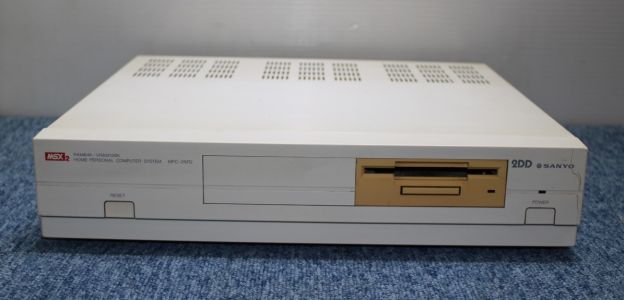 Front of the main unit
-
 Inside: upper board with the Cadnica cell
-
 Lower board with the upper board removed
-
 Supply board


Related pages
[edit | edit source]- Philips NMS 8250
- Sanyo PHC-70FD Wavy, Sanyo's MSX2+ desktop
- Sanyo MPC-100
References
[edit | edit source]- ↑ 1.00 1.01 1.02 1.03 1.04 1.05 1.06 1.07 1.08 1.09 1.10 1.11 1.12 1.13 1.14 Sanyo MPC-25FD, MSX Resource Center wiki—link(accessed 2026-10-21) Community specification page: the MPC-25 (Wavy25), first shown at the Japan Electronics Show '85 (17 to 22 October); a precursor of the Philips NMS 8250 with 64 KB instead of 128 KB of RAM and one cartridge slot; separate keyboard; four versions (MPC-25F 64 KB VRAM and 1DD drive, MPC-25FD 128 KB VRAM and 2DD, MPC-25FK 128 KB VRAM, 2DD, Kanji ROM, address book software and a connector for a second external drive, MPC-25FS 128 KB VRAM and 1DD), each able to format only its own disk format because of its disk ROM; the space that looks meant for a second drive cannot take one; localised for Europe as the Philips NMS 8250 and NMS 8255 and the Fenner FPC-900; MPC-25FD released December 1985 in Japan at ¥135,000, 64 KB RAM in slot 3-2, 128 KB VRAM, Yamaha V9938, PSG (YM2149) in a Yamaha S3527 MSX-Engine, NEC D780C-1, QWERTY/JIS keyboard with numeric keypad, 720 KB 3.5-inch drive, reset button, a Kanji word processor on disk; connections: RF, audio and composite video, RGB21, keyboard connector, data recorder, Centronics printer port, two general-purpose ports, one cartridge slot on the right-hand side, and a 100 V AC outlet for a monitor.
- ↑ 2.0 2.1 2.2 2.3 2.4 MSX junk sale, November 2008 to June 2009—link(accessed 2026-10-21) Pages 2 and 3. The buyer of an MPC-25FD sold with a dead drive replaced the broken Mitsumi D357 drive with a standard PC drive; replies described single-sided boards with many wire links, video RAM at IC120 to IC123 and main RAM at IC109 and IC110, a switching power supply apparently taking 100 to 110 V AC, a WD2793 disk controller, a clock chip and a ROM near the battery; one member said the Philips 8250 is very different inside, another that the case frame looks very like the NMS 8250/55/80. Test results posted by the owner: MSX2 BIOS in slot 0-0, extended BIOS in slot 2-3, disk ROM in slot 3-1, 64 KB RAM without mapper in slot 3-2, external cartridge slot 1-0; JIS keyboard without ghosting protection; RGB connector not compatible with a European SCART cable.
- ↑ File:Sanyo MPC-25FD.jpg, photograph uploaded to the MSX Resource Center wiki by Mars2000you: front panel marked "MSX2 RAM64K/VRAM128K Home personal computer system MPC-25FD", reset button at the left, drive marked "2DD", power button at the right.
- ↑ 26-pin keyboard connector, MSX Resource Center wiki—link(accessed 2026-10-21) "Sanyo/Philips connector pinout (type 2)", used on the Sanyo MPC-25F, MPC-25FD, MPC-25FK, MPC-25FS, MPC-27, MPC-2500FD and PHC-50FD2, the Philips HCS 280, NMS 8250, NMS 8255, NMS 8260 and NMS 8280 and the Fenner FPC-900: pins 1 to 11 Y10 to Y0 (outputs), 12 to 19 X7 to X0 (inputs, active low), 20 KANA or CODE lamp, 21 CAPS lamp, 22 not connected, 23 +5 V, 24 to 26 ground.
- ↑ 5.0 5.1 5.2 File:Sanyo MPC-25FD inside, upper board.jpg and File:Sanyo MPC-25FD main board.jpg, photographs uploaded to the MSX Resource Center wiki by Mars2000you as "Sanyo MPC-25FD inside" and "MPC-25FD mainboard" (the MSX Resource Center's MPC-25FS page uses the same two photographs). Read from them: an upper board with a Sanyo Cadnica backup cell soldered to it and the drive under a metal shield; a lower board with the NEC D780C-1 and the Yamaha V9938; a separate supply board at the left marked UF0673, with a TDK transformer marked AE0081.
- ↑ Philips NMS 8250, MSX Resource Center wiki—link(accessed 2026-10-21) "The NMS 8250 is a professional computer made by Sanyo for the Dutch company Philips. The machine itself is basically the MPC-25FD rebranded and localised for the European market"; brand Philips, manufacturer Sanyo.
- ↑ Philips NMS 8250 Capacitor Replacement Guide, citing Philips's Service Manual NMS8250/NMS8255 (PDF page 32): power supply board layout 41 674 B12 with C1050 to C1054 and F1001 (250 V T 2 A).
- ↑ ニッケル・カドミウム蓄電池, Japanese Wikipedia—link(accessed 2026-10-21) In Japanese. Nickel-cadmium cells use an aqueous potassium hydroxide electrolyte; "Cadnica" (カドニカ電池) is Sanyo Electric's registered trade mark for them.
- ↑ Index of /pub/msx/docs/service_manuals, MSX Archive—link(accessed 2026-10-21) Directory of MSX service manuals; none for any Sanyo machine.