

Panasonic FS-A1
 | |
| A red Panasonic FS-A1. The cartridge slot cover is at the top right. | |
| Specifications | |
|---|---|
| Manufacturer | Matsushita Electric Industrial (Panasonic) |
| Type | MSX2 home computer |
| Released | 1986 (Japan) |
| Intro price | ¥29,800 |
| CPU | Z80A (ROHM BU18400A-PS) |
| Memory | 64 KB RAM, 128 KB video RAM |
| Storage | MSX cartridges, cassette |
| Display | Yamaha V9938 |
| Sound | PSG in the Yamaha S1985 MSX-Engine |
| Power | External adapter FS-AA51: DC 9 V 1.2 A and AC 18 V 170 mA |
| Dimensions | 380 × 230 × 63 mm |
| Weight | 1.6 kg (adapter 580 g) |
| OS / Firmware | — |
| Successor | Panasonic FS-A1MK2 |
| Model no. | FS-A1 |
The Panasonic FS-A1 is an MSX2 computer made by Matsushita Electric Industrial and sold in Japan under the Panasonic brand from 1986, at ¥29,800. It was made in black and in red, and has a pause key and Panasonic's DESKPAC software in ROM.[1] A white version was sold in Italy as the Toshiba FS-TM1.[1] The Panasonic FS-A1MK2 followed in 1987 on a new main board.[1][2]
Specifications
[edit | edit source]| Ref | Part | Function |
|---|---|---|
| IC12 | Z80 | CPU |
| IC14 | Yamaha S1985 | MSX-SYSTEM II |
| IC8 | Yamaha V9938 | VDP |
| IC4 to IC7 | MB81464-12 | Video RAM |
| IC10, IC11 | MB81464-12 | Main RAM |
| IC13 | Mitsubishi M60002A-0108FP | Gate array |
| IC3 | 1 Mbit mask ROM | System ROM and DESKPAC |
| IC1 | BX7396WB | Hybrid board: RGB to video encoder, cassette interface, audio amplifier |
| IC18, IC16, IC17 | M5236L, 78L12, 79L12 | +5 V, +12 V and −12 V regulators |
| IC19 | MN1280-R | Reset IC |
[3] The board traced for the community schematic is marked DFUP0110ZAP2. Four main board versions are known, DFUP0110ZAP and ZAP1 to ZAP3; on ZAP1 the system ROM sits on a small sub-board (DFUP0136ZAP).[1][3] The crystals are 21.47727 MHz for the video and 32.768 kHz for the clock.[3]
Connections
[edit | edit source]The FS-A1 has two cartridge slots, one on top under a flap and one at the rear, two joystick ports, a printer port, an 8-pin RGB socket, composite video and audio outputs, an RF output and a cassette socket.[1]
Power
[edit | edit source]The FS-A1 has no mains supply of its own. It runs from the FS-AA51 adapter, which supplies DC 9 V at 1.2 A and AC 18 V at 170 mA through a three-pin connector, as printed on the machine's label.[4][5] Inside, the 9 V feeds a regulator for +5 V, and the 18 V AC is rectified for the +12 V and −12 V regulators.[3] The ±12 V rails feed the cartridge slots and the hybrid board that produces the video and audio, so the FS-A1 gives no picture without them.[6]
The clock and its settings are kept by two 1.5 V cells in a compartment in the base.[3]
Documentation
[edit | edit source]- Panasonic FS-A1 Schematic: the community schematic and parts list of the DFUP0110ZAP2 main board. No Panasonic service manual for the FS-A1 has been found.
Repair guides
[edit | edit source]- Panasonic FS-A1 General Maintenance
- Panasonic FS-A1 Troubleshooting Guide
- Panasonic FS-A1 Capacitor Replacement Guide
Gallery
[edit | edit source]-
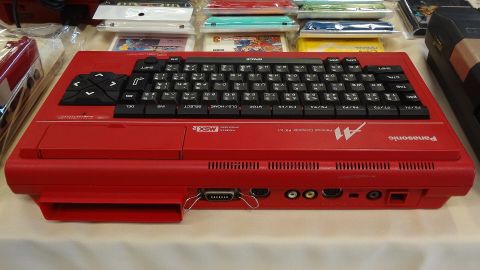 Rear panel of a red FS-A1
-
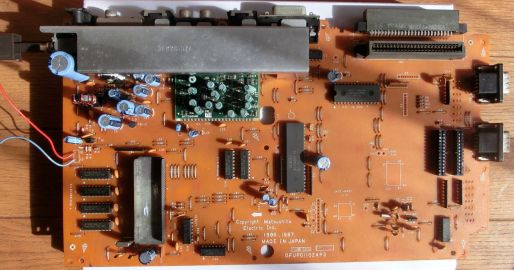 Main board DFUP0110ZAP3 with the BX7396WB hybrid board
-
 Rating label: DC 9 V 1.2 A and AC 18 V 170 mA


Related pages
[edit | edit source]References
[edit | edit source]- ↑ 1.0 1.1 1.2 1.3 1.4 Panasonic FS-A1, MSX Resource Center wiki, 7 March 2026—link(accessed 2026-10-21) Community page: 1986, Japan, ¥29,800; black and red versions; white version sold in Italy as the Toshiba FS-TM1; pause button; FS-AA51 power adapter, specification the same as the Sony AC-HB3; 380 (W) × 63 (H) × 230 (L) mm, 1,600 g plus 580 g for the adapter; 64 KB RAM in slot 3-0, 128 KB VRAM, Yamaha V9938, PSG in the S1985 MSX-Engine, ROHM BU18400A-PS Z80A; 1 Mbit of ROM; DESKPAC firmware bypassed by holding DEL at start-up; two cartridge slots (top and rear); RF, composite video and audio, RGB, cassette, printer and two joystick ports; four main board versions DFUP0110ZAP, ZAP1, ZAP2 and ZAP3, with the ROMs on a separate board on ZAP1; the daughterboard is not a HIC-1 board; slot instability with some FPGA cartridges cured by cutting C24 and C25 beside the slot; lithium or Eneloop backup cells recommended, alkaline advised against.
- ↑ FS-A1Mk2のメモリ512kB増設– niga2—link(accessed 2026-10-21) In Japanese. The FS-A1mkII differs from the FS-A1 in its numeric keypad and its kana, CAPS and PAUSE lamps; the case is greyer and the main board was redesigned; the original FS-A1 board is single-sided with many jumper wires on the component side; both use the M60002A-0108F gate array; the mkII has a Zilog Z80 where the author's FS-A1 has a ROHM part; the mkII's video hybrid board uses a Sony CXA1145 and surface-mount electrolytic capacitors.
- ↑ 3.0 3.1 3.2 3.3 3.4 BABAX, Panasonic MSX2 FS-A1 board (PWB) Rev.02 schematic, PWB DFUP0110ZAP2, revision 01a, 14 April 2015, with parts list. Hosted as File:Panasonic FS-A1 schematic and parts list (BABAX, Rev 01a).pdf; see Panasonic FS-A1 Schematic. A community reverse-engineered drawing. Page 1: power circuit (CN3 input rated DC 9 V 1.2 A and AC 18 V 170 mA, power switch SW1, choke L4; +5 V from IC18 M5236L with pass transistor Q3 2SB941-Q and feedback resistors R33 13 kΩ and R34 4.3 kΩ; +12 V from IC16 78L12 via D2, −12 V from IC17 79L12 via D3); backup battery 1.5 V × 2; reset IC IC19 MN1280-R, output low when the supply falls below 4.0 to 4.3 V; crystals X1 21.47727 MHz and X2 32.768 kHz. Page 2: the ROM sub-board DFUP0136ZAP fitted to DFUP0110ZAP1 boards and not to DFUP0110ZAP2. Pages 3 to 7: parts list, noting that part numbers may differ between production lots.
- ↑ Rating label on the underside of an FS-A1: "電源入力 DC 9V 1.2A AC 18V 170mA", Matsushita Electric Industrial, Made in Japan. File:Panasonic FS-A1 rating label.jpg, from the MSX Resource Center wiki (uploaded by Mars2000you, 15 September 2020).
- ↑ Panasonic FS-AA51, MSX Resource Center wiki, 17 September 2025—link(accessed 2026-10-21) Adapter supplied with the FS-A1 and FS-A1mkII; input AC 100 V 50/60 Hz 23 VA; output DC 9 V 1.2 A and AC 18 V 170 mA; same specification, connector and pin-out as the Sony AC-HB3; not interchangeable with the Sony AC-HB1 series or AC-HB2P; the connector shape is also used on the Neo Geo CD and some HP supplies such as the SDD018-1000, whose voltages are not compatible.
- ↑ 初代 FS-A1の改造– niga2—link(accessed 2026-10-21) In Japanese. The FS-A1's adapter connector is a special three-pin type; the same adapter is used by the FS-A1mk2 and the Sony HB-F1; the AC 18 V is rectified by diodes inside the FS-A1 and regulated to ±12 V, which feeds the cartridge slots and the hybrid IC that processes the video and audio signals, so without it there is no picture; inside the adapter, the AC 18 V comes straight from the transformer and the DC 9 V is rectified and smoothed; the adapter's large capacitor is old enough to be a concern; the Panasonic adapter is closed with ordinary screws.