

Casio PV-16
 | |
| Black Casio PV-16 (TYPE B) | |
| Specifications | |
|---|---|
| Manufacturer | Casio |
| Type | MSX1 home computer |
| Released | 1985 (Japan) |
| Intro price | ¥29,800 |
| CPU | NEC µPD780C-1 (Z80A) |
| Memory | 16 KB RAM, 16 KB VRAM |
| Storage | One MSX cartridge slot; data recorder socket |
| Display | Texas Instruments TMS9118NL |
| Sound | General Instrument AY-3-8910A |
| ROM | MSX BASIC (HN613256P D19) |
| Power | 10 V DC, 8 W, from the AC adaptor AD-4110 or the KB-7 |
| OS / Firmware | — |
| Model no. | PV-16BK (black), PV-16 RD (red) |
The Casio PV-16 is an MSX1 computer that Casio sold in Japan from 1985 as an improved Casio PV-7. It has 16 KB of RAM in place of the PV-7's 8 KB, a standard data recorder socket and a new main board, but keeps the PV-7's chiclet keyboard, single cartridge slot and JOY PAD 1 cluster with TR1 and TR2 keys, which act as a joystick in port 1. It has no printer port. It was made in black and red and cost ¥29,800, with the KB-7 expansion unit at ¥14,800.[1]
Hardware
[edit | edit source]| Item | Detail |
|---|---|
| CPU board (C2305-1) | NEC µPD780C-1, BASIC ROM HN613256P D19, two NEC µPD4168C-20 RAMs (16 KB) |
| Main board | TMS9118NL video chip, AY-3-8910A sound chip, Fujitsu MB64H131 gate array, µPC7805H 5 V regulator, RF modulator |
| Slots | One cartridge slot without ±12 V; KB-7 expansion bus |
| Ports | RF, composite video and mono audio outputs, data recorder socket, two general-purpose ports |
| Power | 10 V DC, 8 W, from the AD-4110 adaptor or the KB-7 |
The CPU, ROM and RAM sit on a small CPU board mounted on the main board. One owner who tried to lift it off found it soldered in place.[5]
Power
[edit | edit source]The PV-16 has no internal mains supply. Its AD-4110 adaptor takes 100 V AC and gives unregulated 10 V DC at up to 800 mA, centre negative; the KB-7 expansion unit can power it instead.[1][4] +5 V comes from a µPC7805H regulator beside the power jack.[3] More detail is in the Casio PV-16 General Maintenance guide.
Expansion
[edit | edit source]The KB-7 adds two cartridge slots and a printer port and has its own power supply.[1] One owner reports that the KB-7's connector fits the PV-7 directly, while the PV-16's expansion connector faces the back of the case in place of the underside.[6] Raising the RAM beyond 16 KB is not a simple chip swap: on one PV-16, a 32 KB static RAM fitted in place of the two 8 KB chips still showed only 16 KB, and owners who have expanded the PV-16 put the extra RAM in slot 2, which leaves the KB-7 unusable.[7]
Related models
[edit | edit source]- Casio PV-7: the earlier model, with 8 KB of RAM and a non-standard cassette socket.[1]
- Sanno sold a special version as the SPCmk-III.[1]
Documentation
[edit | edit source]No service manual or circuit diagram has been published; an owner who asked for a PV-16 schematic on the MSX Resource Center forum in 2023 did not get one.[6] The cover of Casio's owner's manual for the PV-16 (操作マニュアル) is photographed on the MSX Resource Center wiki, but no scan of its pages has been found.[8] The Casio PV-7 Instruction Manual covers the earlier model.
Repair and maintenance
[edit | edit source]- Casio PV-16 General Maintenance
- Casio PV-16 Troubleshooting Guide
- Casio PV-16 Capacitor Replacement Guide
See also Capacitor Failure Symptoms.
Gallery
[edit | edit source]-
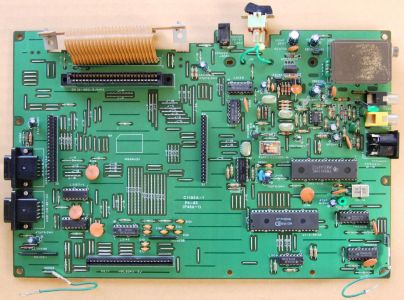 Main board with the CPU board removed
-
 CPU board, both sides
-
 Data recorder, video, audio and TV sockets
-
 Rating label: 10 V DC, 8 W


References
[edit | edit source]- ↑ 1.0 1.1 1.2 1.3 1.4 1.5 Casio PV-16, 24 July 2026—link(accessed 2026-10-21) Improved version of the PV-7 with more RAM, a standard tape connector and a better mainboard; 16 KB RAM, one cartridge slot, no printer port; chiclet keyboard; cursor keys in a circle labelled Joypad 1 which, with the TR1 and TR2 keys, emulate a joystick in port 1; the KB-7 expansion unit adds two cartridge slots and the printer port; the AC power adaptor AD-4110 is required without the KB-7, which has its own power supply; black (BK) and red (RD); special version Sanno SPCmk-III; official price ¥29,800 for the computer and ¥14,800 for the expansion unit; year 1985; RAM 16 KB in slot 0 with or without the KB-7; VRAM 16 KB; video TMS9118NL; audio PSG AY-3-8910A; chipset: separate ICs with a Fujitsu MB64H131 gate array; Z80A from NEC (D780C-1); cartridge connector pins SW1, SW2, −12 V and +12 V not connected; power adapter input AC 100 V, 50/60 Hz, 14 VA, output up to 800 mA, unregulated DC 10 V, centre negative.
- ↑ Photograph of the PV-16 CPU board, both sides (File:Casio PV-16 CPU board.jpg), uploaded to the MSX Resource Center wiki by Gdx on 15 February 2016: board C2305-1 with µPD780C-1, HN613256PD19 and two µPD4168C-20.
- ↑ 3.0 3.1 Photograph of the PV-16 main board (File:Casio PV-16 main board.jpg), uploaded to the MSX Resource Center wiki by Gdx on 15 February 2016: power jack HEC0470-01-230 and power switch at the top edge, µPC7805H regulator, RF modulator, video, audio and data recorder sockets, TMS9118NL and AY-3-8910A.
- ↑ 4.0 4.1 Moulded rating label of a black PV-16 (File:Casio PV-16 rating label.jpg), uploaded to the MSX Resource Center wiki by Mars2000you on 17 October 2016: "PV-16BK, RATING: DC 10V, 8 W; use AC ADAPTOR AD-4110 or KB-7".
- ↑ Black Screen, March 2018—link(accessed 2026-10-21) cobracon2, 13 March 2018: tried to remove the CPU board of a PV-16 but it would not move; it appears to be soldered. Grauw: the RAM is the two µPD4168C-20 on the CPU board; the ROM is the HN613256PD19 next to it.
- ↑ 6.0 6.1 Casio PV-16 upgrade to 32kb on slot 0 won't work, November 2023 to February 2024—link(accessed 2026-10-21) lmanes, 6 February 2024: his three KB-7 units fit the PV-7 but not the PV-16 or the MX line; the connectors are the same but the orientation differs, the PV-16 and MX connectors facing back and the PV-7's facing down. gdx: a small extension cable should solve it.
- ↑ Casio PV-16 upgrade to 32kb on slot 0 won't work, November and December 2023—link(accessed 2026-10-21) lmanes, 26 November 2023: replaced the two 8 KB chips with one 32 KB chip in slot 0 and wired A13 and A14, but BASIC still showed the same free memory as before. gdx, 4 December 2023: the MB64H131 seems to filter /SLTSL0 for the page 3 RAM only; the known 64 KB upgrades wire the RAM to /SLTSL2 of the MB64H131, and the KB-7 dock can no longer be used after such an upgrade.
- ↑ Photographs of the PV-16 box contents and of the cover of the PV-16 操作マニュアル (files Pv16o.jpg and Pv16p.jpg), uploaded to the MSX Resource Center wiki by Mars2000you on 2 August 2016, https://www.msx.org/wiki/Casio_PV-16. Retrieved 2026-10-21.