

Sony HB-F1
 | |
| Sony HB-F1 in the black and red finish | |
| Specifications | |
|---|---|
| Manufacturer | Sony |
| Type | MSX2 home computer |
| Released | Autumn 1986 (Japan)[1] |
| Intro price | ¥32,800[1] |
| CPU | Z80A (a Sharp LH0080A on the board photographed)[2] |
| Memory | 64 KB RAM, 128 KB VRAM |
| Storage | Two cartridge slots; cassette interface |
| Display | Yamaha V9938 |
| Sound | PSG in the Yamaha S1985 MSX-Engine |
| Power | External AC-HB3 adapter: DC 9 V 1.2 A and AC 18 V 170 mA[3] |
| OS / Firmware | — |
| Successor | Sony HB-F1II |
| Model no. | HB-F1 |
The Sony HB-F1 is an MSX2 computer that Sony released in Japan in the autumn of 1986 at ¥32,800. Matsushita released its FS-A1 at ¥29,800 in the same season; both were low-priced machines with the keyboard and computer in one case.[1] It has two cartridge slots, a pause button and a speed controller slider, but no reset button and no built-in disk drive, and it runs from an external adapter.[4] Sony replaced it with the HB-F1II at the end of 1987.[4]
Specifications
[edit | edit source]| Item | Figure |
|---|---|
| Standard | MSX2 |
| CPU | Z80A; a Sharp LH0080A on the board photographed[2] |
| MSX-Engine | Yamaha S1985 |
| RAM | 64 KB in slot 3-3 |
| Video | Yamaha V9938, 128 KB VRAM |
| Sound | PSG |
| Cartridge slots | Two: one on top, one at the back |
| Connectors | RF, composite video and audio, RGB (8-pin DIN), cassette, printer, two joystick ports |
| Power input | DC 9 V 1.2 A and AC 18 V 170 mA from the AC-HB3 adapter[3] |
The HB-F1 starts into Sony's built-in Personal Databank software, which holds addresses, a schedule and memos and can save them to cassette, to the HBI-55 data cartridge or to a disk drive. Holding DEL during start-up goes straight to BASIC.[4]
Hardware
[edit | edit source]The main board is printed "MSX2SYSTEM". Four large electrolytic capacitors stand at the rear left beside an aluminium heat sink, and a small daughterboard marked EX-1 sits at the centre. The S1985 MSX-Engine has a crystal and a trimmer marked TIMER beside it.[2] The board has two +5 V regulators and a 12 V regulator, and the main ROM is a single Fujitsu MB831124 mask ROM (IC14).[5] The clock chip is built into the S1985 and is backed by AA cells.[5]
The HB-F1 does not have the HIC-1 video and audio module that Sony fitted to the later HB-F1XD and HB-F1XDJ. Its EX-1 daughterboard carries a single ceramic capacitor.[5][6]
Power adapter
[edit | edit source]The HB-F1 came with the AC-HB3 adapter, which takes AC 100 V and supplies two outputs through one plug: DC 9 V at 1.2 A and AC 18 V at 170 mA. The plug, sometimes called Mini-IEC, and the outputs are the same as on Panasonic's FS-AA51, so the two adapters are interchangeable. Sony's AC-HB1 and AC-HB2P adapters use a different plug and voltages and cannot be used.[7] The rating label on the computer gives the same two inputs.[3]
Known faults
[edit | edit source]- The MSX Resource Center's list of hardware with leak-prone capacitors names the later HB-F1II and the HB-F1XD family, but not the HB-F1.[8]
- Leaking AA clock cells, and bad clock-chip values that can stop the machine starting.[5][8]
- A dead main ROM, found on one machine with a black screen.[5]
The checks are in the Sony HB-F1 Troubleshooting Guide, the routine work in the Sony HB-F1 General Maintenance guide, and what is known of the capacitors in the Sony HB-F1 Capacitor Replacement Guide.
Documentation
[edit | edit source]No service manual for the HB-F1 has been found. The closest Sony service document hosted here is the Sony HB-F1XD Service Guide for the HB-F1XD, a later machine with a different main board and a built-in drive.
Gallery
[edit | edit source]-
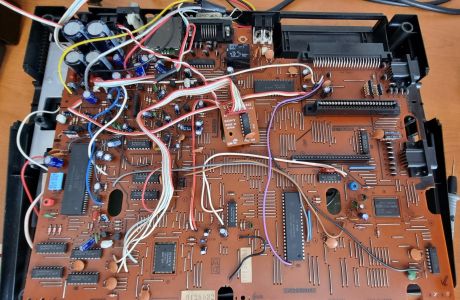 HB-F1 main board in the lower case
-
 Rating label: DC 9 V 1.2 A, AC 18 V 170 mA


Related pages
[edit | edit source]- Sony HB-F1 General Maintenance
- Sony HB-F1 Troubleshooting Guide
- Sony HB-F1 Capacitor Replacement Guide
- Sony HB-F1XDJ
References
[edit | edit source]- ↑ 1.0 1.1 1.2 MSX2, Japanese Wikipedia—link(accessed 2026-10-21) In Japanese. In autumn 1986 Matsushita released the FS-A1 at ¥29,800 and Sony the HB-F1 at ¥32,800, low-priced one-piece MSX2 machines; in 1987 the FS-A1F and HB-F1XD added a built-in drive at ¥54,800. The HB-F1 series has no kanji ROM and has a speed controller that halts the CPU intermittently, Ren-Sha Turbo and a pause key. Early HB-F500 machines had a slot-map problem that stopped some software running; Sony corrected the slot map on machines sent in for repair, and later production used a changed slot map.
- ↑ 2.0 2.1 2.2 File:Sony HB-F1 main board.jpg, photograph of an HB-F1 main board uploaded to the MSX Resource Center wiki by Mars2000you on 13 June 2023. Read from it: "MSX2SYSTEM" printed on the board; four large electrolytic capacitors at the rear left beside an aluminium heat sink, with smaller electrolytics round them; an Omron relay at the rear; a small daughterboard marked EX-1 at the centre; Sharp LH0080A (Z80A) CPU; Yamaha S1985 MSX-Engine with a crystal and a blue trimmer marked TIMER beside it; Fujitsu MB81464-12 DRAMs; the cartridge slot connectors at the right.
- ↑ 3.0 3.1 3.2 Rating label of the HB-F1, photographed for the MSX Resource Center wiki (File:Sony HB-F1 rating label.jpg, uploaded by Mars2000you, 3 January 2023): "MODEL HB-F1 HOME COMPUTER", input "DC9V 1.2A AC18V~170mA", ソニー株式会社, Made in Japan.
- ↑ 4.0 4.1 4.2 4.3 Sony HB-F1, MSX Resource Center wiki—link(accessed 2026-10-21) Community specification page: MSX2, 1986, Japan, ¥32,800; black, or black and red; 64 KB RAM in slot 3-3, 128 KB VRAM, Yamaha V9938, PSG, Yamaha S1985 MSX-Engine; pause button and speed controller slider, no reset button; supplied with the AC-HB3 external power adapter; replaced at the end of 1987 by the HB-F1II; built-in Personal Databank software, bypassed by holding DEL during start-up; two cartridge slots, one on top and one at the back; RF, composite video and audio, RGB (8-pin DIN), cassette, printer and two general-purpose ports. Fixes and repair: the built-in software can be disabled permanently by cutting a bridge near the MB64H444.
- ↑ 5.0 5.1 5.2 5.3 5.4 Trying to repair a Sony HB-F1 (MSX 2), December 2017—link(accessed 2026-10-21) Apocalypse, a console and arcade board repairer, on an HB-F1 with a black screen and the power lamp lit: the main ROM IC14, a Fujitsu MB831124 128K × 8 mask ROM in a 28-pin package, was dead; rails were correct from two +5 V regulators and a 12 V regulator; clock present, reset not stuck, activity on the buses; the EX-1 daughterboard carries only one ceramic capacitor; a Philips diagnostic ROM reported error 711 (RTC); the clock chip is inside the S1985; he fitted sockets and new Z80 and 41464 RAM chips without curing it, and the thread ends unresolved. Replies: the machine has a single mask ROM; gdx suggests a 64 KB EPROM such as a W27C512 holding only the main ROM and sub-ROM; sd_snatcher suggests a RAM cartridge in a slot to boot past faulty internal RAM, and an MSX1 BIOS to test the CPU, RAM and slot selection; with the speed controller slider disconnected the machine boots very slowly, and a jumper across its connector restores normal speed; meits: the machine makes no sound at start-up unless a game cartridge is fitted, and starts without the keyboard but then sits in the built-in software; Jipe first suggested the HIC-1, then corrected himself that the HB-F1 uses a different board; gdx: the AA batteries are not needed to start, but bad values in the clock chip can stop it starting, so replace weak batteries or take them out; gdx: check /ALM on pin 87 of the S1985 and the clock crystal pins.
- ↑ MSX2以降用ハイブリッドIC「EMC-NX0039」の回路図, 19 May 2020—link(accessed 2026-10-21) In Japanese, with the author's redrawn schematic as a PDF. Mitsumi hybrid IC EMC-NX0039 (HIC-1): RGB to NTSC encoder (CXA1145M), sound output amplifier mixing the PSG, the 1-bit sound port and the audio from slots 1 and 2, reset and pause muting, cassette interface amplifiers and relay control. Used in the Sony HB-F1II, HB-F1XD, HB-F1XDmk2, HB-F1XDJ and HB-F1XV and the Panasonic FS-A1mkII and FS-A1F. Sony part number 1-464-877-11. Two 10 µF and one 100 µF electrolytics, all known to leak; the author replaced them with tantalums and advises fused types because tantalums fail short. C26 is a through-hole part on early modules and an SMD part on later ones. R32 and R33 are 220 kΩ on Sony modules and 150 kΩ on Panasonic ones.
- ↑ Sony AC-HB3, MSX Resource Center wiki—link(accessed 2026-10-21) The external power supply supplied with the Japanese HB-F1 and HB-F1II: input AC 100 V, 50/60 Hz, 23 VA; outputs DC 9 V 1.2 A and AC 18 V 170 mA; connector sometimes called Mini-IEC; same specification, connector and pin-out as the Panasonic FS-AA51, so the two are interchangeable; the Sony AC-HB1 series and AC-HB2P use a different connector and voltages and cannot be substituted. The page shows a circuit diagram of the adapter.
- ↑ 8.0 8.1 Vulnerable MSX hardware, MSX Resource Center wiki—link(accessed 2026-10-21) All MSX2 and later machines have a battery for the real-time clock; drained batteries, alkaline ones especially, leak; take removable batteries out before storage; lithium AA cells as an alternative. Lists the Sony HB-75P ("not as serious, as the problem caps are on separate small PCBs"), HB-F1II, HB-F1XD, HB-F1XDJ ("the ELNA caps are risky, the Nichicon ones are ok"), HB-F1XDmk2 and HB-F1XV among models with leaky capacitors. Fractured solder joints on DIN, RCA and DE-9 connectors cause flickering video and crackling sound; reflow them.