
Apple 12" RGB Display
| Macintosh 12" RGB Display | |
|---|---|
 |
|
| Macintosh 12" RGB Display (All About Apple museum, CC BY-SA 3.0) | |
| Manufacturer | Apple Computer, Inc. |
| Type | 12-inch colour CRT monitor |
| Release date | October 1990 |
| Discontinued | March 1993 |
| Interface | Analogue RGB (RS-343), DB-15 video cable |
| Dimensions | 310 × 365 × 253 mm (H × W × D) |
| Weight | 15.9 kg (35 lb) |
| Model | M1296 |
| Power | International: 90-270 V AC; domestic: 100-120 V AC; 90 W maximum |
| Resolution | 512 × 384, 64 dpi |
The Macintosh 12" RGB Display is a 12-inch colour monitor that Apple sold from October 1990 to March 1993. Its model number is M1296.[1] It was introduced with the 12" Monochrome Display as an inexpensive display for the Macintosh LC.[2] It uses a lower resolution than Apple's other colour monitors of the time, 512 × 384 at 60.15 Hz, on a black-matrix dot-screen tube.[3]
Specifications
[edit | edit source]| Item | Value |
|---|---|
| Picture tube | 12 in viewable diagonal; 90° deflection; black-matrix dot screen; aluminised P22 phosphor; spherical antiglare surface |
| Resolution | 512 × 384, 64 dpi; up to 256 colours with the Macintosh Display Card 4•8, 16.7 million with the 8•24 |
| Scan rates | Vertical 60.15 Hz; horizontal 24.48 kHz; rise and fall time 27 ns maximum |
| Active display area | 8.08 × 6.02 in (205 × 153 mm) |
| Input | Analogue red, green and blue, RS-343 |
| Controls | Power switch at the rear; brightness and contrast on the right side |
| Power supply | International version: 90-270 V AC self-configuring, 47-63 Hz, 90 W maximum. Domestic version: 100-120 V AC, 50-60 Hz, 90 W maximum |
| Size and weight | 12.2 in (310 mm) high, 14.4 in (365 mm) wide, 10.0 in (253 mm) deep; 35 lb (15.9 kg) |
| Operating environment | 10-40 °C (derated above 7,000 ft); 95% humidity maximum, non-condensing; up to 10,000 ft |
Apple's online specification page gives a weight of 24 lb, an 11.5-inch viewable image and a 110 V supply; the Service Source figure of 35 lb is used above.[4]
Revisions
[edit | edit source]Apple built two revisions, and their boards and tubes must be kept together.[5][1]
| Part | Rev. A | Rev. B | How to tell |
|---|---|---|---|
| Main deflection board | 661-0616 | 661-0659 | Rev. B has a grey plastic coil, VR504, next to connector J502 |
| CRT assembly | 076-0384 (standard) | 076-0395 (low-ELF) | The low-ELF tube has two field coils, one above and one below the tube |
| CRT/video board | 661-0618 | 661-1618 | Last four digits of the board's serial number: 2801 (Rev. A), 2802 (Rev. B) |
A Rev. A board must be replaced by a Rev. A board and a Rev. B by a Rev. B; a replacement CRT must match the main deflection board.[5] The tube also changed type: Apple's screen-voltage procedure gives different settings for CRT type AT12A9SL and type M29JMN097X13, read from the label on the side of the tube.[6] One collector who keeps a number of these displays reports three variations in practice: early 1990 to early 1991 units with a different CRT assembly and no VR504 coil, later 1991 units, and a 1992 change to a tube with a red, white and blue label in place of the earlier turquoise one, which needs the other screen-voltage setting.[7]
Known faults
[edit | edit source]Apple's symptom charts are module-level: most cures end in replacing the main deflection board, the CRT/video board or the CRT.[8] Owners repairing them at component level report:
- Distortion at the top of the picture caused by failing capacitors, and focus that drifts after about 30 minutes, traced to the flyback transformer, which has the focus control built into it.[7]
- Leaking capacitors in the area of C418 and C419, near the hot resistors R525 and R534 at the edge of the main deflection board, corroding the board and killing transistor Q501. In one repair the 80 V and 12 V test points read 13 V and 1.5 V and the flyback's +12 V supply was missing until Q501 was replaced (with a KSC2383).[9]
Both are covered on the troubleshooting guide.
Documentation
[edit | edit source]- Macintosh 12 RGB Display Service Source: Apple's 113-page Service Source.
- Apple Macintosh Displays and Video Cards Service Guide (1996), chapter 8: board drawings with the Rev. A/B identification and a parts list.[1]
Apple's owner's guide for the display is held on archive.org as item h42_Apple_Macintosh_12_RGB_Display_Owners_Guide.
Maintenance and repair
[edit | edit source]- Apple 12" RGB Display General Maintenance: screen voltage, geometry, white balance and screen luminance.
- Apple 12" RGB Display Troubleshooting Guide: Apple's symptom charts and the community repairs.
Console5 sells a capacitor kit for the M1296, which one repairer fitted to the main deflection board.[9] The CRT keeps a charge after switch-off; follow the CRT Discharge Procedure before working inside.
Gallery
[edit | edit source]-
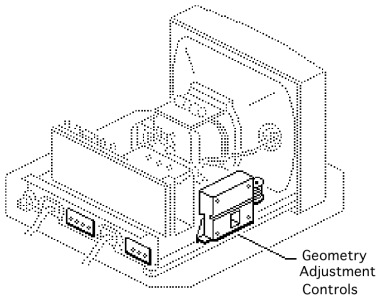 Geometry controls on the main deflection board (Apple Service Source)
-
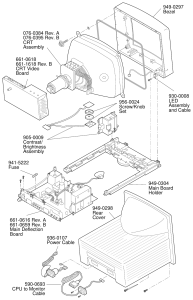 Exploded view with both revisions' part numbers (Apple Service Source)


Related pages
[edit | edit source]References
[edit | edit source]- ↑ 1.0 1.1 1.2 1.3 Apple Computer, Macintosh Displays and Video Cards service guide, September 1996, hosted as File:Apple Macintosh Displays and Video Cards Service Guide (September 1996).pdf. Table 1, model numbers, p. 12 (PDF p. 30); Table 2, dates, p. 13 (PDF p. 31); chapter 8, Macintosh 12" RGB Display: main circuit boards p. 133 and parts list p. 134 (PDF pp. 151-152).
- ↑ Apple displays, Wikipedia—link(accessed 2026-10-02) History only: the two 12-inch displays introduced in 1990 for the Macintosh LC.
- ↑ 3.0 3.1 Apple Computer, Macintosh 12" RGB Display (Service Source), hosted as File:12 rgb display.pdf. Specifications, pp. 1-5 (PDF pp. 3-7).
- ↑ Macintosh 12-inch RGB Display: Technical Specifications, Apple—link(accessed 2026-10-02)
- ↑ 5.0 5.1 5.2 Macintosh 12" RGB Display Service Source, Take Apart: fuse pp. 8-9, CRT/video board pp. 10-17, main deflection board pp. 18-33, CRT assembly pp. 38-42 (PDF pp. 27-61); Exploded View (PDF p. 113).
- ↑ Macintosh 12" RGB Display Service Source, Adjustments: screen voltage pp. 1-15, geometry pp. 16-28, video pp. 29-39 (PDF pp. 67-105).
- ↑ 7.0 7.1 Macintosh 12" RGB Display M1296 - Observations and Questions, TinkerDifferent forum (Scott), 2026-06-29—link(accessed 2026-10-02) Community experience: variations, label colours, distortion and focus faults.
- ↑ Macintosh 12" RGB Display Service Source, Troubleshooting, Symptom Charts, pp. 2-10 (PDF pp. 10-18).
- ↑ 9.0 9.1 Macintosh 12" RGB Display Repair - Need some help, TinkerDifferent forum (jibsaramnim, MacMaster), 2026-03—link(accessed 2026-10-02) Community repair: Console5 cap kit, C418/C419 area, Q501, test-point readings.