

SGI Onyx
 | |
| Onyx deskside workstation (Retro-Computing Society of Rhode Island, CC BY-SA 4.0) | |
| Specifications | |
|---|---|
| Manufacturer | Silicon Graphics |
| Type | Graphics workstation, deskside and rackmount |
| Released | 1993[1] |
| Discontinued | 31 March 1999[1] |
| CPU | IP19 board with one, two or four MIPS R4400; IP21 board with one or two R8000 (POWER Onyx); IP25 board with one, two or four R10000[2] |
| Memory | Up to 2 GB on each MC3 board (32 SIMM sockets, 16 MB or 64 MB SIMMs)[2] |
| Storage | Up to seven half-height SCSI devices in the deskside drive rack[2] |
| Display | 21-inch colour monitor, 1280 × 1024 standard, up to 1600 × 1200[3] |
| Sound | — |
| Graphics | RealityEngine2, VTX, InfiniteReality, i-Station or RealityStation[2] |
| Expansion | Three 9U VME slots (deskside); up to two mezzanine (HIO) boards on the IO4[2] |
| Power | Offline switcher (OLS) making 48 V DC, with DC-DC converters on the boards; deskside 1500 W nominal at 110 V AC, 1900 W (RE2) or 2400 W (InfiniteReality) at 220–240 V AC[4][3] |
| Dimensions | Deskside 65 cm high, 54 cm wide, 74 cm deep (26 × 21 × 29 in)[3] |
| Weight | Deskside 89 kg (195 lb) minimum[3] |
| OS / Firmware | IRIX[5] |
| Successor | SGI Onyx2 |
| Codename | Eveready (deskside), Terminator (rackmount)[1] |
| Model no. | CMN A011 (deskside)[2] |
The SGI Onyx is a graphics workstation made by Silicon Graphics from 1993, in a deskside enclosure code-named Eveready and a rackmount cabinet code-named Terminator.[1] Its system architecture is that of the CHALLENGE servers with graphics boards added. The two lines share the POWERpath-2 board set, the System Controller and the 48 V power system, and SGI wrote one field-service road map and one illustrated parts list for both.[1][6][7] The Onyx graphics boards do not fit a CHALLENGE deskside backplane, which is a different part.[2][8] The SGI Onyx2 replaced the Onyx in 1996, and SGI discontinued the Onyx on 31 March 1999.[1]
Board set
[edit | edit source]The deskside Onyx has a 13-slot cardcage holding the CPU board, an MC3 memory board, an IO4 I/O board with its VME Channel Adapter Module (VCAM), three VME slots and six graphics slots. The drive rack to the right of the cardcage takes seven half-height SCSI devices on sleds.[2] The rackmount Onyx has two cardcages with eleven Ebus slots, four VME slots, six graphics slots and three power board slots, and an optional third cardcage. It takes up to six CPU boards, eight MC3 boards and six IO4 boards, and up to three RealityEngine2 or InfiniteReality pipes or a single VTX pipe.[9]
Three CPU boards were offered. The IP19 carries one, two or four R4400 processors, each with its own support logic. The IP21 carries one or two R8000 processor sets; machines fitted with it were sold as POWER Onyx, and InfiniteReality graphics cannot be used with it. The IP25 carries one, two or four R10000 processors.[2] SGI's parts list gives IP19 boards at 100, 150 and 200 MHz and IP21 boards at 75 and 90 MHz.[10] The sample hardware inventory in the deskside guide shows four 250 MHz IP19 processors.[11]
| Slot | RealityEngine2 and VTX | InfiniteReality and i-Station |
|---|---|---|
| 1 | MC3 memory | MC3 memory |
| 2 | CPU | CPU |
| 3 | IO4 (must be in slot 3) | IO4 (F3-based) |
| 4 | VCAM | VCAM |
| 5–7 | VME | VME |
| 8 | GE10 Geometry Engine | GE12 Geometry Engine |
| 9 | DG2 Display Generator | First RM6 Raster Manager |
| 10 | Third or fourth RM4 | Reserved |
| 11 | Second RM4 | Second RM6 |
| 12 | Third or fourth RM4 | Reserved |
| 13 | First RM4 | DG4 Display Generator |
The IO4 holds the Ethernet controller (10 Mbit/s, AUI connector), two 16-bit SCSI-2 controllers, one RS-422 and three RS-232 serial ports, a parallel port and the flat-cable interfaces to the graphics and VME. Up to two mezzanine boards plug into it; with a VCAM fitted only the short mezzanine boards fit.[2][11] The MC3 takes 16 MB or 64 MB SIMMs in 32 sockets.[2]
Graphics
[edit | edit source]RealityEngine2 uses a GE10 Geometry Engine board with 12 geometry processors, one, two or four RM4 or RM5 Raster Memory boards and a DG2 Display Generator. VTX is a cut-down version with six geometry processors and one RM4.[2] The GE10V board in the gallery below carries twelve Intel i860XP processors.[1]
InfiniteReality uses a GE12 board, one or two RM6 boards in the deskside and up to four per pipe in the rack, and a DG4 board with two display channels; the DG4-8 adds six more.[2][9] InfiniteReality needs the last revision of the VCAM, part 030-0500-206, according to jan-jaap on the IRIXNet forum.[13]
Power and cooling
[edit | edit source]Mains goes through a circuit breaker on the rear panel to the offline switcher (OLS), which converts it to 48 V DC. Power boards on the backplane and DC-DC converters (bricks) on the CPU, memory and VCAM boards convert the 48 V to the voltages each board needs, and smaller regulators on the IO4 make its 1.5 V.[4][6] The deskside has one OLS; the rackmount has two or three, depending on the number of boards and whether the third cardcage is fitted.[14] SGI made the deskside in 110 V and 220–240 V versions and notes that some graphics configurations need the 220–240 V version.[4]
SGI's August 2000 letter to owners states that every Onyx, POWER Onyx, CHALLENGE and POWER CHALLENGE uses a Cherokee International OLS, and that after two to seven years its inductors can overheat because of losses in the magnetic cores, enough for the insulation to smoke and occasionally catch fire. SGI planned to start replacing the supplies in November 2000 with a newly made OLS using improved core material.[15]
The deskside is cooled by a 9.7-inch (24.6 cm) vaned rotor that draws air in near the top, and two 5-inch fans, one for the power supply and one for the drive bays. The System Controller sets the rotor speed from the inlet temperature, and the machine will not boot if the rotor does not turn.[4] The rackmount uses two 11-inch rotors in the top of the cabinet that draw air up from floor level.[14]
System Controller
[edit | edit source]The System Controller is a battery-backed microprocessor board mounted on the backplane, with an LCD panel, a key switch (Off, On, Manager) and four buttons above the drive bays. It sequences the power supplies, monitors temperature, blower speed, backplane voltages and the system clock, shuts the machine down when a limit is passed, and keeps a log of the last ten errors.[2][16][6] The iFixit teardown shows a Motorola 68HC11 microcontroller and a Dallas real-time clock with NVRAM on it.[17] Its messages and the power-on sequence are explained on SGI Onyx Troubleshooting Guide.
Known faults
[edit | edit source]- The OLS. Apart from the overheating covered by SGI's 2000 letter, robespierre on the IRIXNet forum names the power supplies, the VCAM modules and the System Controllers as the parts that fail most often.[15][18] jan-jaap writes that of the several OLS versions only the last revision of the InfiniteReality-capable unit (2400 W, 48 V at 50 A, part 060-0120-001 Rev A) is "safe".[19]
- Power faults at start-up. The System Controller stops the power-on sequence and reports POKA or POKB faults when any converter is out of range. The VCAM is the only source of −5.2 V and −12 V, and jan-jaap has found its inverting regulators more likely to fail than the positive ones.[6][20]
- Dead clock batteries. Two Dallas NVRAM chips with built-in cells hold the configuration: the one on the System Controller holds the system serial number, and the one on the first IO4 holds the PROM environment variables and a backup of the system ID.[19]
- Processors disabled by a failing secondary cache test (SCACHE FAILED on the panel). jan-jaap's advice is to clean and reseat the cache SIMMs beside the processors; processors that the diagnostics have disabled can be re-enabled through the System Controller.[21]
- Memory errors and hangs from MC3 clock jitter or failing SIMMs, both documented by SGI.[5]
- A blown fuse on the IO4 or I/O adapter after plugging the Ethernet cable in with the power on, which stops Ethernet, keyboard, mouse and the powered peripheral ports.[11]
See SGI Onyx Troubleshooting Guide for diagnosis, SGI Onyx General Maintenance for routine care and SGI Onyx Capacitor Replacement Guide for what is known about the electrolytic capacitors.
Documentation
[edit | edit source]- POWER Onyx and Onyx Deskside Owner's Guide, 007-1733-070: File:SGI POWER Onyx and Onyx Deskside Owner's Guide (007-1733-070).pdf
- POWER Onyx and Onyx Rackmount Owner's Guide, 007-1736-060: File:SGI POWER Onyx and Onyx Rackmount Owner's Guide (007-1736-060).pdf
- CHALLENGE/Onyx Diagnostic Road Map, 108-7045-030: File:SGI CHALLENGE and Onyx Diagnostic Road Map (108-7045-030).pdf
- CHALLENGE and Onyx Rack and Deskside Illustrated Parts List, 108-0129-002: File:SGI CHALLENGE and Onyx Rack and Deskside Illustrated Parts List (108-0129-002).pdf
- SGI letter on the OLS power supply hazard, 007-4267-001, August 2000: File:SGI Challenge and Onyx OLS power supply hazard letter (007-4267-001).pdf
Contents and coverage of each are on SGI Onyx Documentation.
Gallery
[edit | edit source]-
 Deskside rear panels: RealityEngine2 video panel above the IO4 panel (RCS/RI, CC BY-SA 3.0)
-
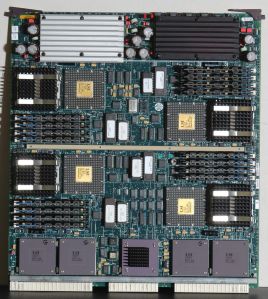 IP19 CPU board with four R4400 processors; the 5 V and 3.3 V converters are under the heat sinks along the top (RCS/RI, CC BY-SA 3.0)
-
 RealityEngine2 GE10V board with twelve i860XP processors (RCS/RI, CC BY-SA 3.0)
-
 Deskside Onyx machines driving the CABIN display at Tokyo University, 1999 (Dave Pape, public domain)


Related pages
[edit | edit source]- SGI Onyx General Maintenance
- SGI Onyx Troubleshooting Guide
- SGI Onyx Capacitor Replacement Guide
- SGI Onyx Documentation
- SGI Onyx2
References
[edit | edit source]- ↑ 1.0 1.1 1.2 1.3 1.4 1.5 1.6 "SGI Onyx", Wikipedia, en.wikipedia.org/wiki/SGI_Onyx (accessed 21 October 2026). Introduction in 1993, code names, relationship to the CHALLENGE, replacement by the Onyx2 in 1996, discontinuation on 31 March 1999, i860XP processors on the GE10.
- ↑ 2.00 2.01 2.02 2.03 2.04 2.05 2.06 2.07 2.08 2.09 2.10 2.11 2.12 2.13 Silicon Graphics, POWER Onyx and Onyx Deskside Owner's Guide, 007-1733-070, 1996, chapter 1, pp. 1–14 (File:SGI POWER Onyx and Onyx Deskside Owner's Guide (007-1733-070).pdf). Model CMN A011, CPU, memory, IO4 and graphics boards, cardcage and drive rack, System Controller, backplane incompatibility with the CHALLENGE.
- ↑ 3.0 3.1 3.2 3.3 SGI, 007-1733-070, appendix A, pp. 136–137, Tables A-1 and A-2. Dimensions, weight, electrical rating, power consumption, 21-inch monitor.
- ↑ 4.0 4.1 4.2 4.3 SGI, 007-1733-070, chapter 2, pp. 29–36. System Controller panel, cooling system, power supplies (OLS to 48 V DC, power boards), 110 V and 220–240 V versions.
- ↑ 5.0 5.1 Silicon Graphics, CHALLENGE/Onyx Diagnostic Road Map, 108-7045-030, 1994, section 2.7, pp. 2-36 to 2-39 (File:SGI CHALLENGE and Onyx Diagnostic Road Map (108-7045-030).pdf). Known problems under IRIX 5.x, MC3 clock jitter, SIMM failures.
- ↑ 6.0 6.1 6.2 6.3 SGI, 108-7045-030, chapter 3, pp. 3-1 to 3-16. Power subsystem: OLSs, power boards and bricks, power-enable and power-OK sequence, VCAM regulators.
- ↑ Silicon Graphics, CHALLENGE and Onyx Rack and Deskside Illustrated Parts List, 108-0129-002, 1995 (File:SGI CHALLENGE and Onyx Rack and Deskside Illustrated Parts List (108-0129-002).pdf). Parts shared between CHALLENGE and Onyx, marked in a column for each.
- ↑ SGI, 108-0129-002, p. 2-11, Table 2-9. Separate deskside backplanes for the server (030-0314) and graphics (030-0310) versions.
- ↑ 9.0 9.1 Silicon Graphics, POWER Onyx and Onyx Rackmount Owner's Guide, 007-1736-060, 1996, chapter 1, pp. 2–3 (File:SGI POWER Onyx and Onyx Rackmount Owner's Guide (007-1736-060).pdf). Rackmount board limits, cardcages and graphics pipes.
- ↑ SGI, 108-0129-002, pp. 4-2 and 4-3. IP19 and IP21 board part numbers and clock speeds.
- ↑ 11.0 11.1 11.2 SGI, 007-1733-070, appendix D, pp. 167–169. Sample hardware inventory, mezzanine boards with the VCAM, IO4 fuse failure after hot-plugging Ethernet.
- ↑ SGI, 007-1733-070, appendix E, pp. 192–195, Tables E-5 and E-6. Deskside slot assignments.
- ↑ jan-jaap, reply of 10 June 2020 in "Onyx IR issues", IRIXNet forum, forums.irixnet.org. VCAM revision 030-0500-206 needed for InfiniteReality.
- ↑ 14.0 14.1 SGI, 007-1736-060, chapter 2, pp. 42–43. Two 11-inch rotors; two or three OLSs and the power boards.
- ↑ 15.0 15.1 SGI, Potential Hazard Regarding Off-Line Switching (OLS) Power Supply, customer letter 007-4267-001, 21 August 2000 (File:SGI Challenge and Onyx OLS power supply hazard letter (007-4267-001).pdf). Cherokee International OLS, inductor overheating, smoke and fire risk, replacement from November 2000.
- ↑ SGI, 007-1733-070, chapter 5, pp. 116–123. System Controller functions, event history log of up to ten messages.
- ↑ Mark, "SiliconGraphics Onyx Teardown", iFixit, January 2013, steps 15–17, ifixit.com. System Controller components, power boards, OLS rating.
- ↑ robespierre, reply of 15 February 2026 in "Onyx Reality Engine2 system restore Feb 2026", IRIXNet forum, forums.irixnet.org. Power supplies, VCAMs and System Controllers as the commonest faults.
- ↑ 19.0 19.1 jan-jaap, reply of 22 March 2019 in "SGI Onyx restoration", IRIXNet forum, forums.irixnet.org. Two Dallas NVRAM chips, OLS recall and the last OLS revision, blower failure messages, differential SCSI channel.
- ↑ jan-jaap, replies of 13 September 2021 in "SGI Challenge L 12VDC Undervoltage", IRIXNet forum, forums.irixnet.org. The VCAM as the only −12 V source; failures of its inverting regulators.
- ↑ capmilk and jan-jaap, "Onyx: boot is incomplete, fault is no master", IRIXNet forum, November 2021, forums.irixnet.org. Secondary cache failures, cleaning cache SIMMs, re-enabling processors from the System Controller.