

SGI Origin 3000
 | |
| Origin 3000 series tall (39U) and short (17U) racks, drawing from SGI's owner's guide (Figure 1-1); no freely licensed photograph of an Origin 3000 was found | |
| Specifications | |
|---|---|
| Manufacturer | Silicon Graphics |
| Type | Modular server |
| Released | July 2000[1][2] |
| Discontinued | Last model discontinued 29 December 2006[1] |
| CPU | Two or four 64-bit MIPS processors per C-brick: R12000 at first, later R14000 and R16000[3][2] |
| Memory | 512 MB to 8 GB per C-brick; up to 1 TB per system[4] |
| Storage | Two Fibre Channel drives in the I-brick; D-brick disk enclosures[4] |
| Display | — |
| Sound | — |
| Expansion | PCI slots in the I-brick (five) and P-brick (twelve); XIO slots in the X-brick (four)[4] |
| Power | Power bay of three to six 950 W supplies at 48 V DC, fed with 200-240 V AC[5] |
| Dimensions | Short rack 916 × 645 × 1032 mm; tall rack 1886 × 762 × 1308 mm (H × W × D)[4] |
| OS / Firmware | IRIX 6.5[6] |
| Predecessor | SGI Origin 2000 |
The SGI Origin 3000 series is a family of modular servers made by Silicon Graphics, built from rack-mounted "bricks" that each do one job: C-bricks hold processors and memory, I-, P- and X-bricks provide I/O, R-bricks route the NUMAlink 3 interconnect between C-bricks, D-bricks hold disks, and a power bay supplies them all.[7] SGI sold it as the Origin 3200, with up to 8 processors in a 17U short rack; the Origin 3400, with up to 32 processors in a 39U tall rack; and the Origin 3800, with 16 to 512 processors in two or more tall racks.[7] It succeeded the SGI Origin 2000, and with graphics bricks added the same system becomes the SGI Onyx 3000.[7][1] The SGI Origin 300 is an entry-level server built on the same architecture.[1]
History
[edit | edit source]SGI introduced the Origin 3000 and Onyx 3000 in July 2000 to succeed the Origin 2000 and Onyx2.[1] The sgistuff.net hardware pages, a community reference, record 500 MHz R14000 processors in May 2001, 600 MHz R14000A in February 2002, the denser Origin 3900 in November 2002, an 800 MHz processor upgrade announced in October 2003 together with the end of production of the Origin 3200 and 3800 on 31 March 2004, and the end of production of the Origin 3900, announced in July 2006, with last shipments in March 2007.[2] Wikipedia gives the Altix 3000 as its successor in 2004 and 29 December 2006 as the discontinuation of the last model.[1]
Hardware
[edit | edit source]| Brick | Function | Height | Maximum power |
|---|---|---|---|
| C-brick | Processors and memory | 3U | 250 W (two processors), 308 W (four) |
| I-brick | Base I/O, five PCI slots, two Fibre Channel drives, CD-ROM | 4U | 190 W |
| P-brick | Twelve PCI slots | 4U | 225 W |
| X-brick | Four XIO slots | 4U | 225 W |
| R-brick | NUMAlink router | 2U | 60 W |
| D-brick | Fibre Channel disk enclosure | 4U | 350 W |
| Power bay | Up to six power supplies | 3U | 950 W output per supply |
C-brick
[edit | edit source]The IP35 motherboard carries the L1 controller logic, the Bedrock ASIC, eight DIMM slots for 512 MB to 8 GB, a serial ID EEPROM and three 2.5 V, 30 A VRMs that make the board's voltages from the 48 V supply. The processors sit in pairs on one or two processor integrated memory modules (PIMMs), each processor with 8 MB of secondary cache.[8] Memory goes in two DIMMs at a time; the standard DIMMs serve systems of up to 128 processors and the "premium" DIMMs, with extra directory memory, larger ones. The DIMMs do not fit the Origin 200, Origin 2000, Onyx2 or Octane.[8] The C-brick's LINK connector joins it to an R-brick (or directly to a second C-brick in an Origin 3200) at 1.6 GB/s each way, and its XIO connector to an I/O brick at 1.2 GB/s each way.[8]
Power
[edit | edit source]The power bay holds three to six hot-swappable supplies, each taking single-phase 200-240 V AC and delivering 950 W at 48 V DC to a common bus; the bay feeds the bricks through eight output connectors and also supplies a 12 V standby voltage that runs each brick's L1 controller. The VRMs and DC-to-DC converters in each brick make the lower voltages from the 48 V.[5] The supplies run N+1, so the loss of one leaves enough power for the system.[5] D-bricks have their own 220 V supplies.[5] SGI reserved the power bay and its supplies for its own engineers.[5]
Cooling
[edit | edit source]Air flows from front to rear. Each brick has three front fans, and the R-brick two smaller single-speed ones. The L1 controller varies the fan speed with temperature; the fans are N+1, and if one fails the others speed up and an error is reported.[7] Each power supply has two fans of its own.[5]
System control
[edit | edit source]Every C-, I-, P-, X- and R-brick has an L1 controller with a display on its front panel. Tall racks with C-bricks have an L2 controller with a touch display on the front door; on the Origin 3200 it is optional.[7] The L1 controllers monitor power and temperature and shut bricks down to prevent overheating.[7]
Known faults
[edit | edit source]- Failed environmental monitoring. jan-jaap, a collector on the IRIX Network forum, recalls that faulty Dallas DS1780 monitoring chips were already a problem in Origin 3000 bricks when the systems were new.[9] The same chips cause false readings in the later SGI Origin 300 and SGI Origin 350.
- Power supply faults are reported through the power supply LEDs and the L1 controllers; see SGI Origin 3000 Troubleshooting Guide and SGI Origin 3000 Capacitor Replacement Guide.[5]
Routine care is on SGI Origin 3000 General Maintenance.
Documentation
[edit | edit source]- SGI Origin 3000 Series Owner's Guide, 007-4240-002: File:SGI Origin 3000 Series Owner's Guide (007-4240-002).pdf
- SGI Origin 3000 Series Technical Configuration Owner's Guide, 007-4311-002: File:SGI Origin 3000 Series Technical Configuration Owner's Guide (007-4311-002).pdf
Contents and coverage are on SGI Origin 3000 Documentation.
Gallery
[edit | edit source]-
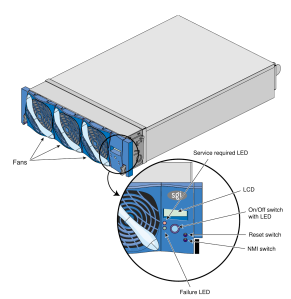 C-brick with its L1 controller panel (SGI owner's guide)
-
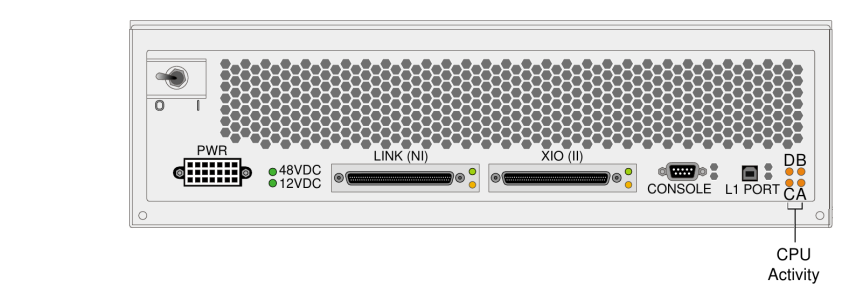 C-brick rear panel (SGI owner's guide)
-
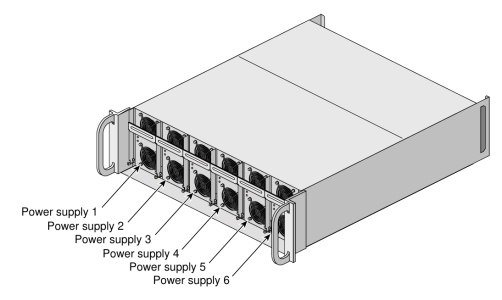 Power bay with six supplies (SGI owner's guide)


Related pages
[edit | edit source]- SGI Origin 3000 General Maintenance
- SGI Origin 3000 Troubleshooting Guide
- SGI Origin 3000 Capacitor Replacement Guide
- SGI Origin 3000 Documentation
- SGI Origin 2000
- SGI Origin 300
- SGI Origin 350
- SGI Onyx 3000
References
[edit | edit source]- ↑ 1.0 1.1 1.2 1.3 1.4 1.5 "SGI Origin 3000 and Onyx 3000", Wikipedia, en.wikipedia.org (retrieved 22 October 2026).
- ↑ 2.0 2.1 2.2 Gerhard Lenerz, "Origin 3000 / Onyx 3000", sgistuff.net, sgistuff.net (retrieved 22 October 2026). Community hardware page: history and processor options.
- ↑ Silicon Graphics, SGI Origin 3000 Series Technical Configuration Owner's Guide, 007-4311-002, January 2001, chapter 2, p. 9. Initial systems with 400 MHz R12000 processors.
- ↑ 4.0 4.1 4.2 4.3 4.4 SGI, 007-4240-002, appendix A, pp. 223-227, Tables A-1 to A-6. System, rack, brick and power specifications.
- ↑ 5.0 5.1 5.2 5.3 5.4 5.5 5.6 SGI, 007-4240-002, chapter 10, pp. 199-210. Power bay, power supplies, LEDs, configuration, 48 V and 12 V standby supply to the bricks.
- ↑ Silicon Graphics, SGI Origin 3000 Series Technical Configuration Owner's Guide, 007-4311-002, January 2001, chapter 9, p. 85 (File:SGI Origin 3000 Series Technical Configuration Owner's Guide (007-4311-002).pdf). IRIX 6.5 Advanced Server Environment.
- ↑ 7.0 7.1 7.2 7.3 7.4 7.5 7.6 Silicon Graphics, SGI Origin 3000 Series Owner's Guide, 007-4240-002, December 2001, chapter 1, pp. 1-24 (File:SGI Origin 3000 Series Owner's Guide (007-4240-002).pdf). Bricks (Table 1-1), cooling and fans, controllers, racks, the Origin 3200, 3400 and 3800 models, RAS features.
- ↑ 8.0 8.1 8.2 SGI, 007-4240-002, chapter 4, pp. 115-125. C-brick: IP35 motherboard, PIMMs, DIMMs and memory kits, L1 controller, rear panel connectors.
- ↑ "Origin 350 - PCI 5V missing", IRIX Network forum, post by jan-jaap, 27 September 2023, forums.irixnet.org/thread-4064.html.