

SGI Origin 2000
 | |
| A rack-mounted Origin 2000 with two modules and the rack system controller display between them (stiefkind, CC0) | |
| Specifications | |
|---|---|
| Manufacturer | Silicon Graphics |
| Type | Server |
| Released | Announced 7 October 1996[1] |
| Discontinued | 30 June 2002[1] |
| CPU | MIPS R10000, later R12000 and R14000; one or two per node board[1][2] |
| Memory | Up to 4 GB per node board[2] |
| Storage | Five SCA 3.5-inch bays and one 5.25-inch bay per deskside module[2] |
| Display | — |
| Sound | — |
| Expansion | Twelve XIO slots per module[2] |
| Power | 850 W typical, 1,850 W maximum per module[3] |
| Dimensions | Deskside 67.3 × 50.8 × 61 cm (H × W × D)[4] |
| Weight | Deskside 54.5 to 77.3 kg[4] |
| OS / Firmware | IRIX 6.4, later IRIX 6.5[1] |
| Successor | SGI Origin 3000 |
| Codename | Lego (SN0) |
| Model no. | Deskside CMN A015[2] |
The SGI Origin 2000 is Silicon Graphics' family of scalable multiprocessor servers, announced on 7 October 1996 to succeed the Challenge and POWER Challenge.[1] It is built from base modules, each holding up to four node boards, two router boards and twelve XIO slots. One module makes a deskside system; racks hold two modules each, and larger systems join several racks.[1][2] The SGI Onyx2 graphics workstation uses the same base module, and the SGI Origin 200 is a smaller server built on the same architecture.[1][3] SGI later sold the deskside versions as the SGI 2100 and 2200 and the rack versions as the SGI 2400 and 2800.[3] The Origin 3000 succeeded it in July 2000, and the Origin 2000 was discontinued on 30 June 2002.[1]
History
[edit | edit source]The project was code-named Lego, and also SN0, for the first of SGI's scalable node architectures.[1] Systems shipped with IRIX 6.4 and later ran IRIX 6.5.[1] The first node boards carried one or two R10000 processors at 180 MHz with 1 MB secondary cache, or two at 195 MHz with 4 MB. A board with two 250 MHz R10000s followed in February 1998, then versions with 300, 350 and 400 MHz R12000s and, near the end, 500 MHz R14000s.[1] The largest systems SGI marketed had 128 processors.[1]
Hardware
[edit | edit source]Node boards
[edit | edit source]Each node board holds one or two processors on daughter cards, a share of main memory, a directory memory that tracks cache coherence, and a Hub ASIC that connects the processors, memory, I/O and the interconnect. It plugs into the midplane through a 300-pin compression connector.[2] SGI's drawing of the node board shows sixteen main memory DIMM slots and eight directory memory slots; extra directory memory is needed only in large rack systems.[2] Each board takes up to 4 GB of memory, and every installed board needs at least 64 MB.[2] At the back of each node board are two red LEDs that light on a voltage problem, and two columns of eight yellow LEDs, one column per processor; the bottom LED of each column flickers as a heartbeat.[4]
Routers, midplane and XIO
[edit | edit source]The midplane takes boards and drives from both sides. A deskside system can run one node board without a router; two node boards need at least one router board, and three or four need the router and star router pair.[4] The twelve XIO slots take PCI carriers, SCSI, Fibre Channel, HIPPI, ATM, Ethernet and graphics boards. The BaseIO board (IO6S or IO6G) must stay in XIO slot 1, and a PCI carrier goes in slot 2.[2][4] The BaseIO panel carries two 9-pin serial ports for RS-232 or RS-422, a 100Base-T Ethernet port and a 68-pin single-ended Ultra SCSI connector.[2]
Module system controller
[edit | edit source]The module system controller (MSC) on the deskside front panel monitors chassis temperature, fan speed, midplane voltages and the system clock, and shuts the system down if any of them goes out of limits.[2] It has a key switch (Standby, On, Diagnostic), reset and NMI buttons, four LEDs, an eight-character display, a 1024 × 8 NVRAM for configuration data, and a 9600-baud diagnostic port on the front, mirrored by a DB-9 connector at the rear.[5] In a rack each module has its own MSC, and the rack carries a multimodule system controller (MMSC) with a display panel.[6]
Power and cooling
[edit | edit source]The supply is autoranging and produces +12 V, +5 V and +3.45 V; separate remote regulators produce the 3.3 V, 2.4 V and 1.6 V termination voltages.[7][5]
| Specification | Value |
|---|---|
| Input | 100-120 V or 200-240 V AC, single phase, 47-63 Hz |
| Power from the wall | 850 W typical, 1,850 W maximum |
| Power factor | 0.98 minimum |
| Inrush current | 140 A peak |
| Heat output | 2,899 Btu/h typical, 6,309 Btu/h maximum |
| Airflow | 350 cubic feet per minute maximum |
A deskside module with one or two node boards runs on 120 V; with three or four it needs 208 V or more. Modules in racks run on 208 V only.[3] Nine fans in a fan tray cool the module. The fans that cool the power supply or a router board are critical, and losing one of them shuts the system down.[8][9] An optional redundant supply of four modules, any one of which an SGI engineer could replace with the system running, was offered for 220 V installations.[9]
Known faults
[edit | edit source]- Power supply failure. Owners on the IRIX Network forum have found the Nichicon electrolytics in the Origin 2000 and Onyx2 supply leaking, with the electrolyte eating through a gate-drive trace and destroying a switching MOSFET and the input fuse. See SGI Origin 2000 Capacitor Replacement Guide.[10]
- Random shutdowns with
PS FAILon the MSC display. In one owner's machine the same fault later showedFAN FAILand the over-temperature LED, and he turned to the fan tray.[11] - Fans running at high speed. The MSC raises the fan speed when the intake air is warm or a fan has failed.[5] See SGI Origin 2000 Troubleshooting Guide.
- Placing the system disk in any bay other than bay 1 stops the system booting; each bay is hard-wired to one SCSI ID.[7]
Routine care is on SGI Origin 2000 General Maintenance.
Documentation
[edit | edit source]- Origin2000 Deskside Owner's Guide, 007-3453-002: File:SGI Origin2000 Deskside Owner's Guide (007-3453-002).pdf
- Origin2000 Rackmount Owner's Guide, 007-3456-003: File:SGI Origin2000 Rackmount Owner's Guide (007-3456-003).pdf
- Origin 2000 Redundant Power Supply Option Owner's Guide, 007-3654-001: File:SGI Origin 2000 Redundant Power Supply Option Owner's Guide (007-3654-001).pdf
- Site Preparation for SGI 2000-Series, Origin Family, Onyx2, Octane and O2, 007-3452-004: File:SGI Site Preparation for SGI 2000-Series, Origin, Onyx2, Octane and O2 (007-3452-004).pdf
Contents and coverage are on SGI Origin 2000 Documentation.
Gallery
[edit | edit source]-
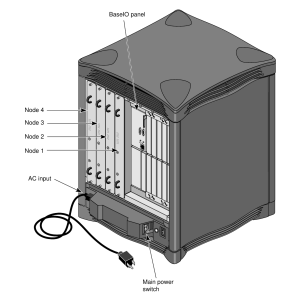 Back of the deskside chassis: node slots, BaseIO panel, AC input and main power switch (SGI owner's guide)
-
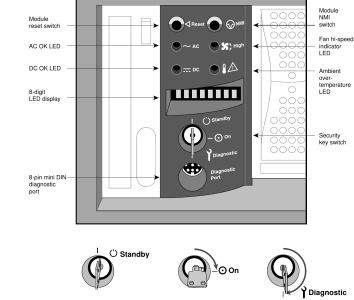 Deskside module system controller panel (SGI owner's guide)
-
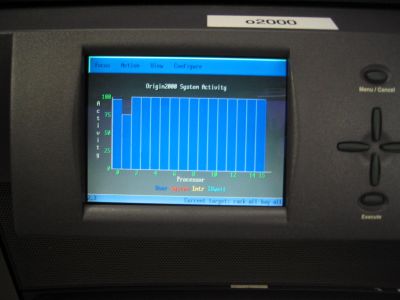 Rack system controller display (Gürkan Sengün, CC BY-SA 3.0)


Related pages
[edit | edit source]- SGI Origin 2000 General Maintenance
- SGI Origin 2000 Troubleshooting Guide
- SGI Origin 2000 Capacitor Replacement Guide
- SGI Origin 2000 Documentation
- SGI Onyx2
- SGI Origin 200
References
[edit | edit source]- ↑ 1.00 1.01 1.02 1.03 1.04 1.05 1.06 1.07 1.08 1.09 1.10 1.11 "SGI Origin 2000", Wikipedia, en.wikipedia.org/wiki/SGI_Origin_2000 (retrieved 21 October 2026). Announcement date, code names, IRIX releases, processor boards, module make-up, largest marketed system, succession and discontinuation.
- ↑ 2.00 2.01 2.02 2.03 2.04 2.05 2.06 2.07 2.08 2.09 2.10 2.11 Silicon Graphics, Origin2000 Deskside Owner's Guide, 007-3453-002, 1997, chapter 1, pp. 1-7 (File:SGI Origin2000 Deskside Owner's Guide (007-3453-002).pdf). Model CMN A015, standard features, node boards and memory, BaseIO, XIO boards, midplane, MSC.
- ↑ 3.0 3.1 3.2 3.3 3.4 Silicon Graphics, Site Preparation for SGI 2000-Series, Origin Family, Onyx2, Octane and O2, 007-3452-004, chapter 6, pp. 55 and 61-64 (File:SGI Site Preparation for SGI 2000-Series, Origin, Onyx2, Octane and O2 (007-3452-004).pdf). SGI 2100/2200/2400/2800 naming, Table 6-4 voltage requirements, Table 6-5 power and cooling.
- ↑ 4.0 4.1 4.2 4.3 4.4 SGI, 007-3453-002, chapter 2, pp. 9-27. Table 2-1 physical specifications, node board LEDs, midplane, router and node combinations, XIO slot rules, BaseIO connectors.
- ↑ 5.0 5.1 5.2 SGI, 007-3453-002, chapter 6, pp. 59-68. MSC front panel, LEDs and switches, features including NVRAM and diagnostic port, Table 6-1 messages.
- ↑ Silicon Graphics, Origin2000 Rackmount Owner's Guide, 007-3456-003, 1997, chapter 2 (File:SGI Origin2000 Rackmount Owner's Guide (007-3456-003).pdf). System controller and rack configuration.
- ↑ 7.0 7.1 SGI, 007-3453-002, chapter 3, pp. 29-41. Operating voltages, safety, drive bays and SCSI IDs, power-on and power-off.
- ↑ SGI, 007-3453-002, chapter 7, pp. 76-77. MSC shutdown and the nine fans.
- ↑ 9.0 9.1 Silicon Graphics, Origin 2000 Redundant Power Supply Option Owner's Guide, 007-3654-001, 1999, pp. xi and 2-8 (File:SGI Origin 2000 Redundant Power Supply Option Owner's Guide (007-3654-001).pdf). Four-module supply, 220 V requirement, fans 1 to 3 under the supply.
- ↑ Pentium, "Onyx2/Origin 2000 Power Supplies and Capacitors - It's time, folks", IRIX Network forum, 27 December 2024, forums.irixnet.org/thread-4427.html. Owner's repair report on a failed supply.
- ↑ "O2000 / onyx2 PSU fail (?)", IRIX Network forum, posts by coldbug and Noguri, 12-13 June 2021, forums.irixnet.org/thread-2958.html. Owner's report of intermittent PS FAIL shutdowns.