

SGI Onyx2
 | |
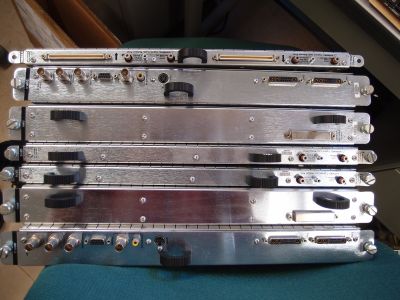
| Onyx2 rack: graphics module at the top, the multimodule System Controller display in the middle and the compute module below (Pedro Lozano, CC BY 2.0) | |
| Specifications | |
|---|---|
| Manufacturer | Silicon Graphics |
| Type | Graphics workstation and visualisation system, deskside and rackmount |
| Released | 1996[1] |
| Discontinued | 27 June 2003[1] |
| CPU | MIPS R10000, later R12000 and R14000, one or two per Node board[1][2] |
| Memory | Up to 4 GB on each Node board (deskside); 32 MB or 64 MB memory modules[2] |
| Storage | Five SCA disk bays and a CD-ROM drive (deskside)[2] |
| Display | — |
| Sound | — |
| Graphics | Onyx2 Reality, InfiniteReality, InfiniteReality2, later InfiniteReality2E and InfiniteReality3[1][2] |
| Expansion | Up to four XIO boards (deskside); optional three-slot PCI module[2] |
| Power | Deskside 110 V (20 A) for limited configurations or 200–240 V (16 A); rack 187–264 V single phase, 5750 W maximum[3][2][4] |
| Dimensions | Deskside 67.3 cm high, 50.8 cm wide, 61 cm deep; rack 185 cm high, 74 cm wide, 99 cm deep[5][4] |
| Weight | Deskside 54.5–77.3 kg; rack 136–340 kg[5][4] |
| OS / Firmware | IRIX 6.4 or 6.5[1] |
| Predecessor | SGI Onyx |
| Successor | SGI Onyx 3000 |
| Codename | Kego[1] |
| Model no. | CMN A015 (deskside)[2] |
The SGI Onyx2 is Silicon Graphics' visualisation system of 1996, code-named Kego, built on the architecture of the SGI Origin 2000 server with graphics hardware added. It replaced the SGI Onyx, was succeeded by the SGI Onyx 3000 in 2000 and was discontinued on 27 June 2003.[1] It was sold as a deskside workstation and in racks of graphics and compute modules. SGI's field-service booklet covers the Origin 2000 and Onyx2 together, and owners treat the module power supplies as common to both.[2][6][7][8][9] The Onyx2 graphics boards fit only Onyx2 midplanes.[2]
Deskside
[edit | edit source]The deskside Onyx2 (model CMN A015) takes one or two Node boards, each with one or two 64-bit processors and up to 4 GB of memory, so a full machine has four processors. Each Node board has a Hub ASIC that controls its share of the distributed memory, and the two boards are joined through a null router board at the front of the chassis. A single graphics pipe of Onyx2 Reality or InfiniteReality2 boards, a graphics BaseIO (IO6G) board and up to four optional XIO boards fit at the rear; there are no VME slots. At the front are five drive bays for SCA disks, a CD-ROM drive and the module System Controller (MSC).[2][10]
Unlike earlier SGI desksides, the Onyx2 uses a midplane, with boards and drives plugging into both sides.[10] The first Node board goes in the right-hand of the two Node slots, and the system disk must be in the bay next to the MSC with SCSI ID 1.[10]
| Item | Value |
|---|---|
| Height × width × depth | 67.3 × 50.8 × 61 cm (26.5 × 20 × 24 in) |
| Weight | 54.5 kg minimum, 77.3 kg maximum |
| Operating temperature | 5 to 35 °C below 5000 ft; 5 to 30 °C above |
| Operating humidity | 10% to 90%, non-condensing |
| Noise | 50 dBA typical |
Rack systems
[edit | edit source]A single Onyx2 rack holds a graphics module, normally at the top, and a compute module below it, with a multimodule System Controller (MMSC) display between them. Each graphics module holds up to two pipes: the right-hand pipe (seen from the back) takes one, two or four RM/TM assemblies and the left-hand pipe one or two, and each pipe can drive up to eight monitors. Multirack systems join several compute and graphics modules; the three-rack configuration SGI called RealityMonster holds up to six modules, and SGI quotes one to sixteen pipes for the rack range.[6][11] SGI warns that chassis joined by CrayLink or Crosstown cables must not differ in ground potential by more than 0.5 V.[12]
Graphics
[edit | edit source]Each pipe has a Geometry Engine (GE) board, one or two RM/TM raster boards in the deskside, and a DG5 display generator. The DG5-2 has two high-resolution outputs; the DG5-8 adds a VIO5H daughterboard for eight; an optional GVO board adds two serial digital video outputs. The DG5 also has S-Video, composite, StereoView, genlock and swap-ready connectors. SGI gives 1920 × 1200 at 66 Hz as the default resolution of InfiniteReality2 with its SuperWide monitor, and about 300 Mpixel/s as the total output bandwidth.[13] The connector at the top of the RM board is for calligraphic lights support and is not SCSI; SGI warns against plugging drives into it.[2]
Power and cooling
[edit | edit source]The deskside has one autoranging power supply behind the front cover, with a circuit breaker and mains inlet at the rear. North American machines can be set up for 110 V, but SGI limits them to a few configurations; anything larger needs 200–240 V at 16 A.[10][3] The supply produces +12 V, +5 V and +3.45 V, and remote regulators make 3.3 V, 2.4 V and 1.6 V.[14] SGI does not treat the supply as user-replaceable.[15] The MSC sets the fan speed from the intake temperature, runs the remaining fans at full speed if a non-critical fan fails, and shuts the system down if a critical fan fails or the intake air is too hot.[14] The power cord takes an IEC C19 connector at the machine end.[16]
In a rack, each graphics module has its own supply and breaker and plugs straight into a 200–240 V outlet, while the compute module, drive enclosure and MMSC take power from the rack's power distribution unit.[12][9]
Known faults
[edit | edit source]- The module power supply, shared with the Origin 2000. Pentium on the IRIXNet forum found leaking Nichicon capacitors had eaten through a gate-drive trace and destroyed a MOSFET and the input fuse in his Origin 2000 supply; his repair is described on SGI Origin 2000 Capacitor Replacement Guide.[8] Graphics module supplies in Onyx2 racks have also failed, and are scarcer than the standard supplies.[9]
- Random shutdowns with PS FAIL, FAN FAIL or over-temperature on the MSC. coldbug's investigation of this on his Origin 2000 moved from the supply to the fan tray, and Noguri points to dust trapped between the supply and the midplane stiffeners.[17] jan-jaap names the fan tray's SCA connector as its weak point.[18]
- Failed GE board EEPROMs. The PROM reports a bad KONA EEPROM and installs no graphics console; Irinikus has had the EEPROM fail on two GE16-4 boards.[19]
- "Widget present, but link not alive" at power-on, which jan-jaap has traced to dirty or damaged compression connectors between the boards and the midplane.[20][21]
- An exploded tantalum capacitor on the deskside midplane, found by CB_HK; jan-jaap read the value from a spare midplane as 33 µF 25 V.[18]
See SGI Onyx2 Troubleshooting Guide, SGI Onyx2 General Maintenance and SGI Onyx2 Capacitor Replacement Guide.
Documentation
[edit | edit source]- Silicon Graphics Onyx2 Deskside Workstation Owner's Guide, 007-3454-005: File:SGI Onyx2 Deskside Workstation Owner's Guide (007-3454-005).pdf
- Silicon Graphics Onyx2 Rackmount Owner's Guide, 007-3457-005: File:SGI Onyx2 Rackmount Owner's Guide (007-3457-005).pdf
- Origin and Onyx2 Theory of Operations Manual, 007-3439-002: File:SGI Origin and Onyx2 Theory of Operations Manual (007-3439-002).pdf
- Onyx2 Reality, Onyx2 InfiniteReality and Onyx2 InfiniteReality2 Technical Report, August 1998: File:SGI Onyx2 Reality and InfiniteReality2 Technical Report (August 1998).pdf
- Site Preparation for SGI 2000-Series, Origin Family, Onyx2, Octane, and O2, 007-3452-004: File:SGI Site Preparation for SGI 2000-Series, Origin, Onyx2, Octane and O2 (007-3452-004).pdf
- SGI's Hardware Quick-reference Booklet (Origin and Onyx2 Series), HMQ-380-C, a field-service booklet, is on the Internet Archive.[7]
Contents and coverage are on SGI Onyx2 Documentation.
Gallery
[edit | edit source]-
 Deskside Onyx2 from the rear and front (SGI Owner's Guide, Figure 1-1)
-
 Deskside midplane with the Node, graphics, BaseIO and XIO boards drawn out (SGI Owner's Guide, Figure 2-2)
-
 Rack graphics module with InfiniteReality3 boards (JC Penalva, CC BY-SA 2.0 fr)
-
 InfiniteReality2E boards: DG5-2, RM9 and GE16 (htomari, CC BY-SA 2.0)
-
 Two Onyx2 racks beside an Origin 2000 (Wolfgang Stief, CC0)


Related pages
[edit | edit source]- SGI Onyx2 General Maintenance
- SGI Onyx2 Troubleshooting Guide
- SGI Onyx2 Capacitor Replacement Guide
- SGI Onyx2 Documentation
- SGI Origin 2000
- SGI Onyx
- SGI Onyx 3000
References
[edit | edit source]- ↑ 1.0 1.1 1.2 1.3 1.4 1.5 1.6 "SGI Onyx2", Wikipedia, en.wikipedia.org/wiki/SGI_Onyx2 (accessed 22 October 2026). Introduction in 1996, code name, Origin 2000 basis, succession by the Onyx 3000 in 2000, discontinuation on 27 June 2003, processors, graphics generations, IRIX versions.
- ↑ 2.00 2.01 2.02 2.03 2.04 2.05 2.06 2.07 2.08 2.09 2.10 Silicon Graphics, Silicon Graphics Onyx2 Deskside Workstation Owner's Guide, 007-3454-005, 1999, chapter 1, pp. 1–9 (File:SGI Onyx2 Deskside Workstation Owner's Guide (007-3454-005).pdf). Model CMN A015, Node boards, memory, BaseIO, graphics, XIO, drives, MSC, midplane compatibility, the RM board's lights connector, 110 V availability.
- ↑ 3.0 3.1 SGI, 007-3454-005, p. 32, Table 3-1. Operating voltages and the 110 V North American configurations.
- ↑ 4.0 4.1 4.2 SGI, 007-3457-005, appendix A, pp. 145–146, Tables A-1 and A-2. Rack dimensions, weight, electrical rating.
- ↑ 5.0 5.1 5.2 SGI, 007-3454-005, p. 11, Table 1-2. Deskside physical and environmental specifications.
- ↑ 6.0 6.1 Silicon Graphics, Silicon Graphics Onyx2 Rackmount Owner's Guide, 007-3457-005, 2000, chapter 1, pp. 1–6 (File:SGI Onyx2 Rackmount Owner's Guide (007-3457-005).pdf). Graphics and compute modules, pipe counts, multirack and RealityMonster configurations.
- ↑ 7.0 7.1 Silicon Graphics, Hardware Quick-reference Booklet (Origin and Onyx2 Series), HMQ-380-C, November 1999, Internet Archive item Origin2k_Hardware_Guide.
- ↑ 8.0 8.1 Pentium, "Onyx2/Origin 2000 Power Supplies and Capacitors - It's time, folks", IRIXNet forum, 27 December 2024, forums.irixnet.org.
- ↑ 9.0 9.1 9.2 bjornl, "Repair Onyx2 graphics module power supply", IRIXNet forum, 7 October 2018, forums.irixnet.org; jdanna and Raion, "WANTED: Onyx2 rack graphics power supply", 14 July 2021, forums.irixnet.org.
- ↑ 10.0 10.1 10.2 10.3 SGI, 007-3454-005, chapter 2, pp. 13–22. Midplane, front components, null router, Node board slots, power connector and breaker.
- ↑ SGI, 007-3457-005, chapter 2, p. 31. Graphics module pipes and RM/TM assemblies.
- ↑ 12.0 12.1 SGI, 007-3457-005, chapter 4, pp. 95–99. Rack power-on procedure, power distribution unit, ground potential caution.
- ↑ SGI, 007-3454-005, chapter 4, pp. 45–49. DG5 configurations, connectors, default resolution and output bandwidth.
- ↑ 14.0 14.1 SGI, 007-3454-005, chapter 6, pp. 90–92. MSC LEDs, fan control, DC OK voltages.
- ↑ SGI, 007-3454-005, chapter 7, p. 97. Power supply not an end-user replaceable part.
- ↑ indigofan, kaigan and jwhat, "Onyx 2 Power Cable type", IRIXNet forum, 13–16 September 2021, forums.irixnet.org. IEC C19 power cord.
- ↑ coldbug and Noguri, "O2000 / onyx2 PSU fail (?)", IRIXNet forum, 12–13 June 2021, forums.irixnet.org.
- ↑ 18.0 18.1 jan-jaap and CB_HK, "Onyx2 Restoration (WIP)", IRIXNet forum, 19 March 2019, forums.irixnet.org. Fan tray connector, exploded midplane tantalum and its value.
- ↑ gandtimo and Irinikus, "EEPROM-Error on Onyx2", IRIXNet forum, 15–18 March 2025, forums.irixnet.org.
- ↑ jan-jaap, reply of 26 September 2021 in "SGI Onyx 2 Deskside no screen", IRIXNet forum, forums.irixnet.org.
- ↑ jan-jaap, reply of 2 October 2025 in "ONYX 2 issue", IRIXNet forum, forums.irixnet.org.