

SGI Visual Workstation 230
 | |
| Front of the Silicon Graphics 230, from SGI's User's Guide (Figure 1-1) | |
| Specifications | |
|---|---|
| Manufacturer | Silicon Graphics, Inc. (SGI) |
| Type | Workstation |
| Released | 2000[1] |
| CPU | One Intel Pentium III, FC-PGA socket[2] |
| Memory | Up to 1.5 GB ECC registered SDRAM in three DIMM sockets[2] |
| Storage | Two IDE channels and a floppy interface[2] |
| Display | From the AGP graphics card[2] |
| Sound | On-board: speaker out, audio in, microphone in[2] |
| Graphics | AGP graphics card[2][3] |
| Expansion | One AGP slot, five 32-bit PCI slots[2] |
| Dimensions | 48.9 × 20.95 × 49.16 cm (H × W × D, with bezel)[4] |
| OS / Firmware | Windows NT 4.0 or Windows 2000; Red Hat Linux on the 230L[3] |
The SGI Visual Workstation 230 (sold as the Silicon Graphics 230 visual workstation) is a single-processor Pentium III workstation that SGI introduced in 2000; its User's Guide was first published in March 2000.[1] Unlike the SGI Visual Workstation 320 and 540, which use SGI's Cobalt chipset and ARC firmware, the 230 is a conventional PC: an M23D system board with a VIA Apollo Pro 133A chipset, an AGP graphics card and a standard BIOS.[2][3] SGI's User's Guide credits the chapters on the system board and the BIOS Setup utility to Acer Incorporated.[1] The dual-processor SGI Visual Workstation 330 uses the same chassis with a different board.[5]
Hardware
[edit | edit source]The M23D is an extended ATX board with one FC-PGA socket (U3) for a Pentium III. The VIA Apollo Pro 133A chipset is made up of the VT82C694X north bridge (U4) and the VT82C686A south bridge (U25), and the board also carries an Intel 82559 10/100 Ethernet controller (U9).[2] There are three DIMM sockets for up to 1.5 GB of 3.3 V, 133 MHz ECC registered SDRAM, one AGP slot and five 32-bit, 33 MHz PCI slots.[2] Jumper block JPX1 sets the ratio between the front side bus and the processor clock; SGI's guide says the frequency is set automatically and that the table is for service technicians only.[2]
Ports
[edit | edit source]| Connector | Function |
|---|---|
| CN1 | PS/2 mouse (upper) and keyboard (lower) |
| CN2 | Two USB ports |
| CN4 | Parallel port, serial ports 1 and 2 |
| CN6 | Ethernet (RJ-45) |
| UK1, PH1 | Audio in, speaker out, microphone in |
| CN7, CN8 | IDE channels 1 and 2 |
| CN5 | Floppy drive |
| PWR1 | ATX power supply |
| BT1 | Battery |
Chassis and cooling
[edit | edit source]The tower has three 5.25-inch bays (the top one holding the CD-ROM drive) and four 3.5-inch bays, two of them at the front. It is cooled by three fans: one at the front drawing air in, one on the rear panel, and the one in the power supply. The supply is switch-selectable for 110 V or 220 V and sits above the system board at the rear, and the board is held by a single screw.[6] SGI gives the system's power requirements only on the label at the back.[4]
Known faults
[edit | edit source]SGI's guide lists the BIOS error messages and what to do about each. "CMOS Battery Bad" calls for a new lithium battery, and repeated "Run Setup" messages mean the battery may be bad and the CMOS settings are not being kept.[7] See SGI Visual Workstation 230 Troubleshooting Guide and SGI Visual Workstation 230 General Maintenance.
Documentation
[edit | edit source]- Silicon Graphics 230 Visual Workstation User's Guide, 007-4263-001, March 2000: File:SGI Visual Workstation 230 User's Guide (007-4263-001).pdf
- Installing an AGP Card in the Silicon Graphics 230, 330, and 550 Visual Workstations, 007-4299-001: File:SGI Visual Workstation 230, 330 and 550 AGP Card Installation (007-4299-001).pdf
Gallery
[edit | edit source]-
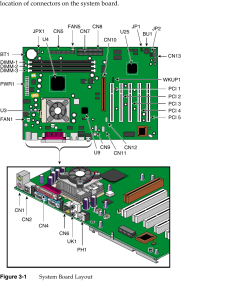 M23D system board layout (SGI User's Guide, Figure 3-1)

Related pages
[edit | edit source]- SGI Visual Workstation 230 General Maintenance
- SGI Visual Workstation 230 Troubleshooting Guide
- SGI Visual Workstation 230 Capacitor Replacement Guide
- SGI Visual Workstation 330
- SGI Visual Workstation 320
References
[edit | edit source]- ↑ 1.0 1.1 1.2 Silicon Graphics, Inc., Silicon Graphics 230 Visual Workstation User's Guide, 007-4263-001, front matter (File:SGI Visual Workstation 230 User's Guide (007-4263-001).pdf). Revision 001, March 2000; chapters 3 and 4 provided by Acer Incorporated.
- ↑ 2.00 2.01 2.02 2.03 2.04 2.05 2.06 2.07 2.08 2.09 2.10 2.11 SGI, 007-4263-001, pp. 57-71, Tables 3-1 and 3-3. M23D board overview, chipset, memory, AGP and PCI, connectors, JPX1, processor and DIMM installation.
- ↑ 3.0 3.1 3.2 "SGI Visual Workstation", Wikipedia, en.wikipedia.org. The 230, 330 and 550 as standard PCs with NVIDIA Quadro2-based AGP cards; Windows NT and 2000; the "L" models preloaded with Red Hat Linux 6.2.
- ↑ 4.0 4.1 SGI, 007-4263-001, p. 121, Table B-1. Dimensions; power requirements on the rear label.
- ↑ Silicon Graphics, Inc., Silicon Graphics 330 Visual Workstation User's Guide, 007-4278-001, June 2000, pp. 1-8 and 55-61 (File:SGI Visual Workstation 330 User's Guide (007-4278-001).pdf). Same chassis and dimensions; M25D dual-processor board.
- ↑ SGI, 007-4263-001, pp. 1-8. External and internal structure, drive bays, fans, power supply and its voltage switch.
- ↑ SGI, 007-4263-001, pp. 72-75, Table 3-4. System error messages and corrective measures.