

SGI Origin 350
 | |
| Origin 350 compute module, drawing from SGI's user's guide (Figure 3-1); no freely licensed photograph of an Origin 350 was found | |
| Specifications | |
|---|---|
| Manufacturer | Silicon Graphics |
| Type | Server |
| Released | Announced April 2003[1] |
| Discontinued | End of sales announced July 2006; last systems shipped March 2007[1] |
| CPU | Two or four 64-bit MIPS R16000 processors per compute module[2] |
| Memory | 1 to 8 GB per compute module in eight DIMM slots[2] |
| Storage | One or two Ultra3 SCSI drives; optional slim-line DVD-ROM[2] |
| Display | — |
| Sound | — |
| Expansion | Four 64-bit PCI/PCI-X slots on two buses, the lowest holding the IO9 card[2] |
| Power | One or two hot-swappable 500 W supplies, 110/220 V[2] |
| Dimensions | 8.74 × 43.33 × 68.58 cm (H × W × D, with bezel)[2] |
| Weight | 17.18 to 20.23 kg[2] |
| OS / Firmware | IRIX[3] |
| Predecessor | SGI Origin 300 |
The SGI Origin 350 is a server made by Silicon Graphics from 2U compute modules, each holding two or four 64-bit MIPS R16000 processors.[2] One base compute module is a complete server. Joined by NUMAlink 3 cables, and through a NUMAlink module for the larger configurations, up to eight compute modules form a single system of up to 32 processors and 64 GB of memory; memory and PCI expansion modules add memory or slots without processors.[4] It succeeded the SGI Origin 300.[1] The same hardware with VPro graphics is the SGI Onyx 350, and the SGI Tezro workstation is built on it too.[1]
History
[edit | edit source]The sgistuff.net hardware pages, a community reference, record the Origin 350's announcement in April 2003, the end-of-sales announcement in July 2006, and the last shipments at the end of March 2007.[1] Wikipedia gives its discontinuation as December 2006.[5] SGI's user's guide of June 2003 lists 600 and 700 MHz R16000 processors; sgistuff.net also lists 800 MHz and 1 GHz compute modules, the 1 GHz version with 16 MB of secondary cache per processor.[4][1]
Hardware
[edit | edit source]| Feature | Origin 300 | Origin 350 |
|---|---|---|
| Processors | 2 or 4 | 2 or 4 |
| Memory | 512 MB to 4 GB | 1 GB to 8 GB |
| Free expansion slots | Two 64-bit PCI, 33 or 66 MHz | Three: one PCI, two PCI-X at 66 or 100 MHz |
| Serial ports | 2 | 4 |
| DVD-ROM | None | 1 |
| Keyboard and mouse | 2 USB | 2 PS/2 |
| Power supplies | 1 | 2 (one redundant) |
| Ethernet | 10/100 | 10/100/1000 |
Compute module
[edit | edit source]The IP53 node board carries the processors, each with its secondary cache (4 MB in SGI's guide), eight DIMM slots, the Bedrock hub ASIC that links processors, memory, network and I/O, a serial ID EEPROM, and three voltage regulator modules (VRMs) for the processor core, 1.5 V I/O and 2.5 V memory supplies. The processors are soldered to the board.[2] The interface board carries the L1 controller logic, the power supply interface, switching regulators, and the NUMAlink and XIO connectors; the PCI riser card carries the PIC ASIC and the four slots.[2] The IO9 card in the lowest slot provides Gigabit Ethernet, external SCSI, real-time interrupt ports, the IDE channel for the DVD-ROM, four serial ports, the PS/2 ports, NVRAM and the time-of-day clock; three of the serial ports and the PS/2 ports are on a daughtercard. Only SGI engineers were to fit or remove processors and the IO9 card.[2]
Memory and storage
[edit | edit source]Memory is added two DIMMs at a time, the first pair in slots 0 and 1, and each pair must be the same size. SGI's 2003 guide lists 512 MB and 1 GB DIMMs, and the DIMMs do not fit the Origin 200, Origin 2000, Onyx2 or Octane.[2][6] The base module takes one or two sled-mounted Ultra3 SCSI drives (18 GB at 15,000 rpm or 73 GB at 10,000 rpm) on a backplane wired to the IO9 card, with the master drive at the bottom.[2]
Power and cooling
[edit | edit source]Each supply takes 110 or 220 V AC and delivers up to 500 W at 12 V, 5 V and −12 V. Both are hot-swappable and sit behind the bezel door at the front right; the left one is the primary.[2] jan-jaap, a collector on the IRIX Network forum, identifies the supply as a rebadged Delta DPS-500EB, with a 15 V bias output at 50 mA, −12 V at 0.5 A, 5 V at 2 A and 12 V at 40 A, so that almost everything in the module is made from the 12 V rail.[7] The L1 controller reports fans for the two exhaust positions, the supply and the PCI area.[7]
L1 controller
[edit | edit source]The L1 controller monitors the module and shows status and errors on the front display; a console on the rear DB-9 console port reaches its command prompt. Larger systems add an L2 controller connected to each module's L1 USB port.[3][2]
Known faults
[edit | edit source]- Power supply failure. The Delta supplies have a known manufacturing fault, the subject of Intel Technical Advisory TA-0674-5, in which the primary power factor correction diode fails; it happened to jan-jaap's Origin 350.[7]
- Regulated rails out of limits. One owner's module shut itself down on a 1.8 V low fault after a FireWire card was added, and another owner traced a missing PCI 5V rail to a failed switching regulator on the interface board. See SGI Origin 350 Troubleshooting Guide and SGI Origin 350 Capacitor Replacement Guide.[8][9]
- False readings from the Dallas DS1780 monitoring chips on the interface board, which can show impossible voltages and temperatures; one collector has replaced three of them.[7]
- Flat SNAPHAT battery and crystal modules for the clock on the IO9 card: one owner found three of the five in his machines dead and the other two low.[8]
Routine care is on SGI Origin 350 General Maintenance.
Documentation
[edit | edit source]- SGI Origin 350 Server System User's Guide, 007-4566-001: File:SGI Origin 350 Server System User's Guide (007-4566-001).pdf
Contents and coverage are on SGI Origin 350 Documentation.
Gallery
[edit | edit source]-
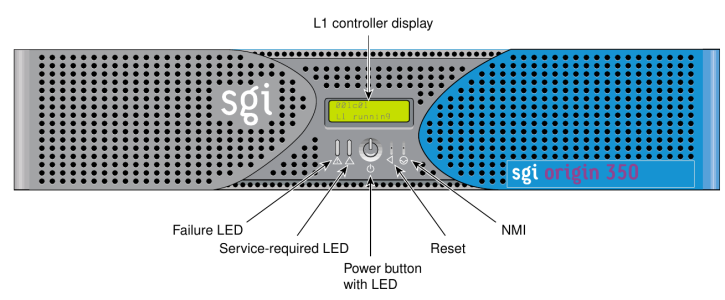 Front panel controls (SGI user's guide)
-
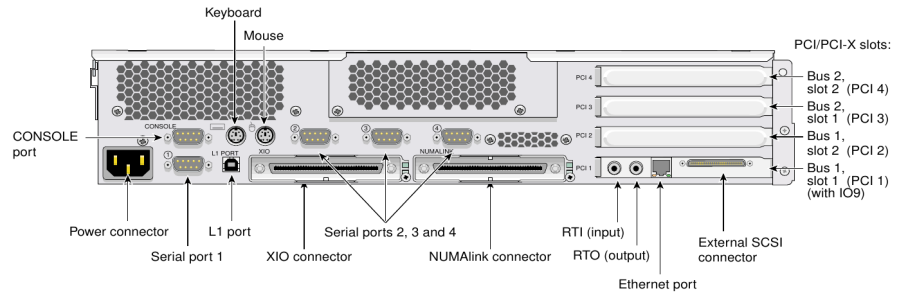 Rear panel (SGI user's guide)
-
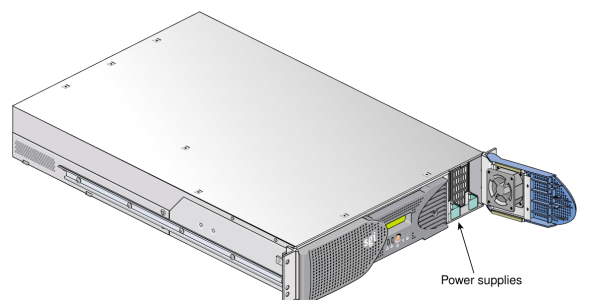 Power supplies behind the bezel door (SGI user's guide)


Related pages
[edit | edit source]- SGI Origin 350 General Maintenance
- SGI Origin 350 Troubleshooting Guide
- SGI Origin 350 Capacitor Replacement Guide
- SGI Origin 350 Documentation
- SGI Origin 300
- SGI Origin 3000
- SGI Onyx 350
- SGI Tezro
References
[edit | edit source]- ↑ 1.0 1.1 1.2 1.3 1.4 1.5 Gerhard Lenerz, "Origin 350 / Onyx 350", sgistuff.net, sgistuff.net (retrieved 22 October 2026). Community hardware page: dates, processor boards, relationship to the Onyx 350 and Tezro.
- ↑ 2.00 2.01 2.02 2.03 2.04 2.05 2.06 2.07 2.08 2.09 2.10 2.11 2.12 2.13 2.14 2.15 SGI, 007-4566-001, chapter 3, pp. 107-131. Compute module features, Table 3-1 comparison with the Origin 300, IP53 node board, DIMMs, IO9 card, interface board, PCI riser, drives, power supplies, front and rear panels, Table 3-6 specifications.
- ↑ 3.0 3.1 Silicon Graphics, SGI Origin 350 Server System User's Guide, 007-4566-001, June 2003, chapter 1, pp. 51-63 (File:SGI Origin 350 Server System User's Guide (007-4566-001).pdf). System console, powering on and off with the L1 and L2 controllers, IRIX shutdown, front panel.
- ↑ 4.0 4.1 SGI, 007-4566-001, chapter 2, p. 75, Table 2-1. Configuration ranges, R16000 at 600 and 700 MHz.
- ↑ "SGI Origin 350", Wikipedia, en.wikipedia.org (retrieved 22 October 2026).
- ↑ SGI, 007-4566-001, chapter 6, pp. 186-187. Memory rules and DIMM compatibility.
- ↑ 7.0 7.1 7.2 7.3 "o350 env chip locations", IRIX Network forum, posts by vvuk, jan-jaap, jwhat, fleedwood and weblacky, 28 February to 3 March 2022, forums.irixnet.org/thread-3424.html. Power supply identity and outputs, TA-0674-5, DS1780 locations, example
envoutput. - ↑ 8.0 8.1 "O350 Voltage Fault:ATTN: 1.8V low fault limit reached @ 1.396V.", IRIX Network forum, posts by jwhat and weblacky, November 2020 to March 2022, forums.irixnet.org/thread-2563.html. 1.8 V fault, IO9 clock batteries, regulator output capacitors.
- ↑ "Origin 350 - PCI 5V missing", IRIX Network forum, posts by aSpartan111 and weblacky, September to December 2023, forums.irixnet.org/thread-4064.html. Interface board regulator repair.