

SGI Tezro
 | |
| Silicon Graphics Tezro tower (Andy Diller, CC BY-SA 2.0) | |
| Specifications | |
|---|---|
| Manufacturer | Silicon Graphics, Inc. (SGI) |
| Type | Workstation (tower or rackmount) |
| Released | July 2003[1] |
| Discontinued | End of line announced July 2006[1] |
| CPU | 1, 2 or 4 MIPS R16000 on an IP53 node board[2] |
| Memory | 512 MB to 8 GB DDR SDRAM in eight DIMM slots (tower)[2] |
| Storage | One or two internal SCSI disks on sleds; optional DVD-ROM[2] |
| Display | DVI-I (analogue and digital) from the VPro board[2] |
| Sound | Analogue audio on the I/O daughtercard (tower)[2] |
| Graphics | VPro graphics board with 128 MB SDRAM; optional Dual Channel Display daughterboard[2] |
| Expansion | Eight 64-bit 3.3 V PCI-X slots on four buses (2- and 4-processor towers), two XIO slots[2] |
| Power | 550 W supply (tower)[2] |
| Dimensions | 17 × 13.75 × 20.75 in (H × W × D, tower)[3] |
| Weight | 60.6 lb (27.5 kg, tower)[3] |
| OS / Firmware | IRIX 6.5[1] |
| Predecessor | SGI Octane2[4] |
The SGI Tezro (Silicon Graphics Tezro visual workstation) is SGI's last MIPS workstation line with in-house graphics, announced in July 2003. SGI sold it as a deskside tower and as a rack-mounted system, with one, two or four R16000 processors, VPro graphics and IRIX 6.5.[1][2][4] It is built on the same Origin 3000-generation architecture as the SGI Origin 350 and SGI Onyx 350, and like them it is managed by an L1 system controller with a small display on the front.[1][5][6] SGI announced the end of the series in July 2006, with the last systems shipping by the end of March 2007.[1]
Hardware
[edit | edit source]Node board and memory
[edit | edit source]The processors and memory sit on an IP53 system node board, which plugs into the interface board through two connectors on its underside. Each R16000 has 64 KB of on-chip cache and 4 MB of external cache in SGI's 2003 tower guide. Processor upgrades are made by replacing the whole node board, and a one-processor tower cannot take a two- or four-processor board.[2] sgistuff.net lists IP53 boards at 600, 700 and 800 MHz, and two- and four-processor boards at 1 GHz with 16 MB of secondary cache.[1]
The eight DIMM slots form four pairs (slots 0-1, 2-3, 4-5 and 6-7). Pair 1 must be fitted, DIMMs go in pairs of the same size, and the minimum is 512 MB for a one-processor system and 1 GB for two or four processors, up to 8 GB. The DDR DIMMs are the same as those of the Origin 300, Origin 3000 and Onyx 3000, and do not fit the Octane, O2, Origin 200, Origin 2000 or Onyx2.[2]
I/O and graphics
[edit | edit source]The interface board carries the PCI-X and XIO slots and distributes power. The two- and four-processor towers have eight 64-bit, 3.3 V PCI-X slots on four buses, each bus running at up to 100 MHz; the one-processor tower has four slots on two buses and one XIO slot.[2] The IO9 board always occupies bus 1, slot 1. It provides the IDE connector for the DVD-ROM drive, internal and external SCSI, real-time interrupt input and output, Ethernet, and the system's non-volatile RAM and time-of-day clock. An I/O daughtercard at the rear carries the PS/2, audio, two serial ports, the console port and the L1 diagnostic USB port.[2]
The graphics module near the bottom of the tower holds a VPro board with 128 MB of SDRAM and a single DVI-I port, plus the optional Dual Channel Display daughterboard with two more DVI-I ports.[2] The DMediaPro DM3 board uses the second XIO slot.[2]
Power and cooling
[edit | edit source]The tower's power supply sits in the top rear quadrant. SGI's overview gives it as up to 550 W, while the specification table limits the combined 3.3 V, 5 V and 12 V output to 500 W and gives the system input as 100-240 V, 7.0-3.0 A, 430 W.[2][3] Eight fans cool the tower: a fan wall of two 60 mm and two 80 mm fans for the interface board, PCI boards and graphics, an 80 mm fan behind the disks, a rear assembly of three 80 mm fans for the node board and memory, and the power supply's own fan.[2]
| Output | Rating |
|---|---|
| 3.3 V | 24 A |
| 5 V | 24 A |
| +12 V1 / +12 V2 / +12 V3 | 8 A / 12 A / 18 A |
| −12 V | 0.5 A |
| +5 V standby | 2 A |
| Combined 3.3 V, 5 V and 12 V | 500 W |
Rackmount Tezro
[edit | edit source]The rack-mounted Tezro has its own hardware guide. Its supply accepts 110/220 V and provides up to 500 W, and its enclosure can be linked to a second enclosure for more PCI slots and memory.[7][1] sgistuff.net describes it as the same hardware as the Onyx 350 with less room for expansion.[1]
Known faults
[edit | edit source]- The L1 controller's clock module (a Dallas DS1742W) and the IO9 board's SNAPHAT clock each keep data on a battery. IRIXNet members have traced an L1 that would not start to a dead L1 module, and "NVRAM checksum is incorrect" after every power cut to a dead IO9 battery. Replacing the L1 module can leave the system reporting an invalid serial number until it is set again from the L1 prompt.[8][9][10]
- Original power supplies fail with age; one owner's supply had lost its 5 V output. IRIXNet members have recapped them and have run Tezros from rewired ATX supplies.[8][11][12]
- The system powers itself off if a fan runs below 80% of its rated speed, a sensor reaches 70 °C, or a voltage drifts 20% from nominal.[5]
- SGI's tower guide asks owners to leave the soldered lithium batteries to qualified service staff.[13]
See SGI Tezro Troubleshooting Guide, SGI Tezro General Maintenance and SGI Tezro Capacitor Replacement Guide.
Documentation
[edit | edit source]- Silicon Graphics Tezro Visual Workstation Hardware User's Guide: Tower Configuration, 007-4564-001: File:SGI Tezro Hardware User's Guide, Tower Configuration (007-4564-001).pdf
- Hardware User's Guide: Rackmount Configuration, 007-4643-003: File:SGI Tezro Hardware User's Guide, Rackmount Configuration (007-4643-003).pdf
- SGI L1 and L2 Controller Software User's Guide, 007-3938-006: File:SGI L1 and L2 Controller Software User's Guide (007-3938-006).pdf
Details are on SGI Tezro Documentation.
Gallery
[edit | edit source]-
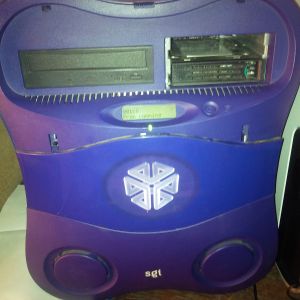 Front with the drive shroud off and the L1 display reading "Prom Running" (Telecineguy, CC BY-SA 3.0)
-
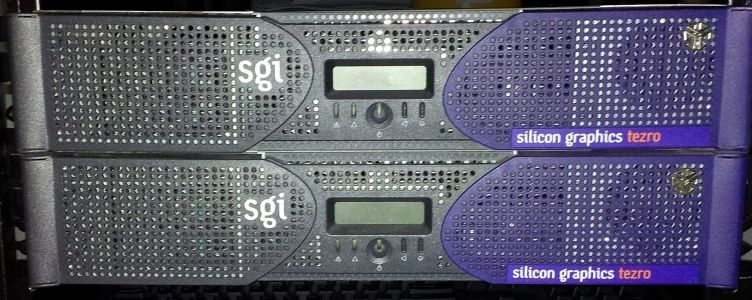 Two rackmount Tezro enclosures (Telecineguy, CC BY-SA 4.0)
-
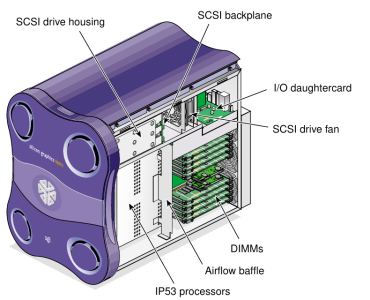 Tower interior from the right (SGI Hardware User's Guide, Figure 2-1)


Related pages
[edit | edit source]- SGI Tezro General Maintenance
- SGI Tezro Troubleshooting Guide
- SGI Tezro Capacitor Replacement Guide
- SGI Tezro Documentation
- SGI Fuel
- SGI Onyx 350
References
[edit | edit source]- ↑ 1.0 1.1 1.2 1.3 1.4 1.5 1.6 1.7 1.8 Gerhard Lenerz, "Tezro", sgistuff.net, sgistuff.net. History (announced July 2003, 800 MHz February 2004, end announced July 2006), processor boards, rackmount version, IRIX 6.5.30 recommended.
- ↑ 2.00 2.01 2.02 2.03 2.04 2.05 2.06 2.07 2.08 2.09 2.10 2.11 2.12 2.13 2.14 2.15 2.16 Silicon Graphics, Inc., Silicon Graphics Tezro Visual Workstation Hardware User's Guide: Tower Configuration, 007-4564-001, July 2003, pp. 23-44 (File:SGI Tezro Hardware User's Guide, Tower Configuration (007-4564-001).pdf). System overview: node board, processors, DIMMs, interface board, IO9 and I/O daughtercard, drives, graphics module, PCI buses, power supply, cooling, upgrades.
- ↑ 3.0 3.1 3.2 3.3 SGI, 007-4564-001, pp. 127-128, Tables A-1 and A-2. Dimensions, weight, power requirements, power supply outputs.
- ↑ 4.0 4.1 "Tezro", TechPubs wiki (IRIXNet), tech-pubs.net. Introduced to replace the Octane; the last SGI machine with in-house graphics.
- ↑ 5.0 5.1 SGI, 007-4564-001, p. 114. Environmental fault monitoring and bezel LEDs.
- ↑ Silicon Graphics, Inc., SGI L1 and L2 Controller Software User's Guide, 007-3938-006, October 2006, pp. 47-49 (File:SGI L1 and L2 Controller Software User's Guide (007-3938-006).pdf). L1 controller tasks and messages.
- ↑ Silicon Graphics, Inc., Silicon Graphics Tezro Visual Workstation Hardware User's Guide: Rackmount Configuration, 007-4643-003, March 2004, p. 33 (File:SGI Tezro Hardware User's Guide, Rackmount Configuration (007-4643-003).pdf). Rackmount power supply.
- ↑ 8.0 8.1 "Tezro L1 not starting even though LCD backlight is on", IRIXNet forum, February to October 2024, posts by K-Town Computeum, weblacky and chulofiasco, forums.irixnet.org. Dead L1 clock module and a supply with low 5 V.
- ↑ "Tezro won't boot into PROM", IRIXNet forum, March to September 2024, posts by PTSGI, weblacky and jwhat, forums.irixnet.org. NVRAM checksum errors cured by a new IO9 SNAPHAT battery.
- ↑ "SGI Tezro problem on boot after remove Dallas DS1742W-120", IRIXNet forum, March 2024, posts by pauloarruda, lohmos and weblacky, forums.irixnet.org.
- ↑ "Tezro PSU rebuild process", IRIXNet forum, posts by weblacky, August 2021 to February 2023, forums.irixnet.org.
- ↑ "Tezro: PSU replacement with standard PC ATX hardware", IRIXNet forum, March 2024, posts by MrWeedster and weblacky, forums.irixnet.org.
- ↑ SGI, 007-4564-001, pp. 47-49. Safety instructions, soldered lithium batteries, required tools.