

SGI Crimson
 | |
| The IRIS Crimson badge on the red side skin of a Crimson VGXT (WayTru, CC BY 2.0) | |
| Specifications | |
|---|---|
| Manufacturer | Silicon Graphics, Inc. |
| Type | Deskside workstation and server |
| Released | January 1992[1] |
| Discontinued | December 1997 (end of production)[1] |
| Intro price | About US$27,900 (server), US$42,900 (Crimson/Elan), US$69,900 (Crimson/VGX), basic configurations[1] |
| CPU | MIPS R4000SC, 50 MHz external and 100 MHz internal, 1 MB secondary cache, on the IP17 board[2]; R4400 at 150 MHz in later systems[1] |
| Memory | 16 to 256 MB on the IP17 board, in 2 MB or 8 MB SIMMs[2][3] |
| Storage | Four front-loading 5.25-inch bays (two half-height, two full-height) for SCSI disk and tape drives[1] |
| Display | — |
| Sound | — |
| Graphics | None (server), Entry, XS, XS24, Elan, Extreme, PowerVision VGX or VGXT, or RealityEngine[4][5] |
| Expansion | Four VME slots[2] |
| Power | 1050 W DC power supply; 104 to 132 V or 200 to 240 V input, 1400 W RMS maximum[6] |
| Dimensions | 65 × 54 × 74 cm (26 × 21 × 29 in)[6] |
| Weight | 82 kg (180 lb)[6] |
| OS / Firmware | IRIX 4D1-4.0.3 or later[6]; IRIX 6.2 is the last release that runs on it[1] |
| Predecessor | SGI Power Series |
| Codename | Diehard2[7] |
| Model no. | 4D/510[7]; marketing codes W6-4DCRIMS (server), W6-4DCRIMBLG, W6-4DCRIMXS, W6-4DCRIMXS24, W6-4DCRIMEG, W6-4DCRIMVGX, W6-4DCRIMVGXT, W6-4DCRIMRE[4] |
The SGI IRIS Crimson is a deskside workstation and server that Silicon Graphics introduced in January 1992.[1] It was SGI's first 64-bit product, built around the MIPS R4000 processor.[7][2] The Crimson uses the single-tower deskside chassis of the SGI Power Series, with a new IP17 processor board that carries all of the main memory, and the IO3B I/O board.[2][1] It takes a single processor only and has four VME slots.[2] SGI sold it as a server with no graphics and with graphics options ranging from Entry to RealityEngine.[4]
The Crimson appears in the 1993 film Jurassic Park. SGI later sold a limited-edition R4400 Crimson called the Jurassic Classic, with a special logo and James H. Clark's signature on the drive door.[7][1]
History
[edit | edit source]SGI's US prices for basic configurations at launch were about $27,900 for the server, $42,900 for a Crimson/Elan and $69,900 for a Crimson/VGX. RealityEngine graphics followed later in 1992. Production ended in December 1997 and SGI ended service in June 2004.[1]
Gerhard Lenerz of sgistuff.net describes the Crimson as the last of the 4D Power Series: a Power Series system with a different processor and memory subsystem for the R4000. A Power Series machine could be upgraded to a 4D/510 by replacing its processor and memory boards with the IP17 and fitting an IO3B; such upgrades keep the dark Power Series skins and carry an "R4000-50" label.[1] SGI also sold an upgrade that replaced the older twin-tower Professional Series chassis, processor and I/O boards with a Crimson chassis and Elan graphics, keeping the customer's monitor, keyboard and peripherals.[8]
Siemens Nixdorf sold a relabelled Crimson as the RW460.[1]
Specifications
[edit | edit source]| Parameter | Value |
|---|---|
| Processor | R4000SC, 50 MHz external, 100 MHz internal; 32/64-bit integer, 64-bit floating point |
| Memory | 16 to 256 MB, in 16 MB or 64 MB steps |
| Input voltage | 104 to 132 V, or 200 to 240 V; 47 to 63 Hz |
| Input power | 1400 W RMS maximum, 2112 VA maximum; 16 A |
| Power consumption | 1050 W DC continuous |
| Mains connector | NEMA 5-20 (US and Canada); NEMA 6-15R (220 V countries) |
| Heat dissipation | 4777 BTU/hour (chassis), 512 BTU/hour (monitor) |
| Operating environment | 10 to 35 °C at sea level; 20 to 80% relative humidity, non-condensing |
| Dimensions | 26 × 21 × 29 in (65 × 54 × 74 cm) |
| Weight | 180 lb (82 kg) |
| SCSI disk options | 780 MB, 1.2 GB, 1.6 GB; IPI-2 1.1 GB |
| Tape options | 1/4-inch QIC-150, 8 mm, 4 mm DAT, 1/2-inch reel |
| Ports | Two SCSI; four RS-232 serial (24 more optional) |
Hardware
[edit | edit source]IP17 processor board
[edit | edit source]The IP17 carries the R4000SC with 1 MB of secondary cache and all of the system memory. SGI's custom ASICs on the board link the processor to local I/O and the Crimson bus (RCB), to main memory (RMI), and the Crimson bus to memory for DMA (CBMI); DCC ASICs control the DRAM.[2] Memory is fitted in 32 SIMM sockets arranged as four blocks of eight. SIMMs go in eight at a time, either 2 MB parts (16 MB per group) or 8 MB parts (64 MB per group), and SGI lists fourteen allowed combinations from 16 MB to 256 MB.[3] The SIMMs are the same type as Power Series memory, and MC2 memory boards from the Power Series are not recognised in a Crimson.[2][1]
Fitting an R4400 at 150 MHz to an IP17 is not a simple chip swap. IRIXNet contributor jan-jaap notes that the 50 MHz oscillator must be changed for a 75 MHz part and a PAL replaced as well.[9]
IO3B board and connectors
[edit | edit source]The IO3B (POWER Channel) board in slot 5 provides two SCSI channels, Ethernet and the bridge from the Crimson bus to the VME slots.[2][10] Its SCSI controllers are Western Digital WD33C93A parts.[1] The non-volatile environment settings are held in a battery-backed SRAM sitting in a Dallas DS1216 socket on the IO3B, not in a combined clock chip as on later SGI systems.[11]
The PP2 serial board on the I/O door carries four 9-pin D-sub serial ports, three 8-pin DIN ports that share wiring with three of the D-subs, and the 15-pin keyboard connector.[10] Graphics connectors depend on the option fitted: 13W3 for Entry, XS, XS24 and Elan, RGB BNC connectors for VGX and VGXT, and a larger panel of video connectors for RealityEngine.[10]
Backplane and slots
[edit | edit source]The chassis has a 14-slot backplane. Slots 1 to 4 are VME, slot 5 holds the IO3B, slot 6 the IP17, and slots 9 to 14 the graphics boards. Slots 7 and 8 are unused in a Crimson.[10] VME boards must be fitted from slot 1 upwards without gaps, because the backplane passes the bus grant signals from slot to slot; a slot can only be skipped if jumpers are placed behind it.[3]
Graphics options
[edit | edit source]SGI listed one server and eight graphics configurations, each also available with 64 MB of memory.[4]
- Crimson/Entry: 8 bitplanes, 1024 × 768, software z-buffer in main memory.
- Crimson/XS: 1280 × 1024, one Geometry Engine, optional hardware z-buffer.
- Crimson/XS24: XS with 24-bit colour.
- Crimson/Elan: XS24 with a standard z-buffer and four Geometry Engines.
- Crimson/VGX and VGXT: the four-board PowerVision set (GM3, GE6, DG1, RM2); VGXT has faster texture mapping from a newer image engine on the RM2.
- Crimson/RealityEngine, with 16 MB or 64 MB of system memory.
[4] The Entry, XS, XS24 and Elan boards sit beside an MG1 interface board in slot 9, which converts their GIO bus signals to the Crimson bus.[3][2] SGI's upgrade instructions add Extreme graphics to the list.[5]
Power supply and cooling
[edit | edit source]SGI rates the supply at 1050 W DC and notes that this limit is why a four-RM board RealityEngine configuration is not supported.[6][10] Two makes were used: a Power-One SPM5 modular supply ("silver brick") in older systems and a Cherokee unit ("black brick") in newer ones.[12] sgistuff.net states that Crimsons loaded with RealityEngine had 1500 W supplies; jan-jaap, who has rebuilt several of these units, says both types have the same 1050 W total output and that the 1500 W figure is the maximum the SPM5 chassis can hold, not the rating of the modules SGI fitted.[1][13]
The fan tray under the card cage has four blowers in older systems and six in newer ones; the six-fan tray is required for RealityEngine, which also needs the fans set to run at full speed.[1][14]
Known faults
[edit | edit source]- Power supply failure. Leaking electrolytic capacitors in the Power-One supply's output modules and backplane, and failures of its auxiliary bias supply, are the faults most often reported by owners.[12][15][13] See SGI Crimson Capacitor Replacement Guide.
- Lost environment settings and "Non-volatile RAM checksum is incorrect" at power-on, caused by the exhausted battery in the DS1216 socket on the IO3B.[11]
- Wrong date after a reboot. The Crimson is not year-2000 ready, and the clock has to be set again or taken from a time server.[1]
- A dirty front power switch that stops the system turning on even though the supply is good.[12]
See SGI Crimson Troubleshooting Guide for diagnosis and SGI Crimson General Maintenance for routine work.
Documentation
[edit | edit source]- IRIS Crimson Installation and Configuration Guide, 108-7034-020, 1992: File:SGI IRIS Crimson Installation and Configuration Guide (108-7034-020).pdf
- IRIS Crimson Graphics Upgrade Installation Instructions, 108-7035-020: File:SGI IRIS Crimson Graphics Upgrade Installation Instructions (108-7035-020).pdf
Contents and coverage of both are on SGI Crimson Documentation. SGI also published an IRIS Crimson Owner's Guide, part number 007-1560-xxx.[3]
Gallery
[edit | edit source]-
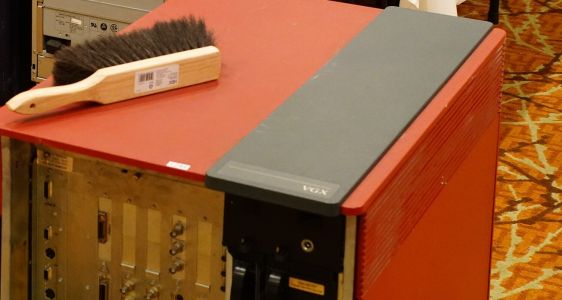 A Crimson with VGX graphics at VCF Midwest 2017, identified from its red skins and grey VGX top hat (Patrick Finnegan, CC BY 2.0)
-
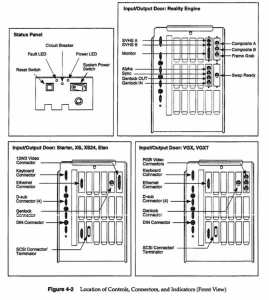 Status panel and I/O door layouts (SGI, Figure 4-2)
-
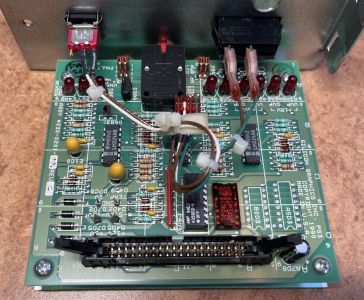 PS3 status panel board (jan-jaap)


Related pages
[edit | edit source]- SGI Crimson General Maintenance
- SGI Crimson Troubleshooting Guide
- SGI Crimson Capacitor Replacement Guide
- SGI Crimson Documentation
- SGI Power Series
References
[edit | edit source]- ↑ 1.00 1.01 1.02 1.03 1.04 1.05 1.06 1.07 1.08 1.09 1.10 1.11 1.12 1.13 1.14 1.15 1.16 Gerhard Lenerz, "Crimson", sgistuff.net, sgistuff.net/hardware/systems/crimson.html (last modified 30 June 2025, retrieved 2026-10-21). History and prices, IP17 and R4400, memory, IO3B and WD33C93A, VME rules, chassis, fans, power supply ratings, Siemens Nixdorf RW460, Jurassic Classic, IRIX versions, Y2K.
- ↑ 2.00 2.01 2.02 2.03 2.04 2.05 2.06 2.07 2.08 2.09 Silicon Graphics, IRIS Crimson Installation and Configuration Guide, 108-7034-020, 1992, chapter 1, pp. 1-1 to 1-13 (File:SGI IRIS Crimson Installation and Configuration Guide (108-7034-020).pdf). Product description, IP17 and its ASICs, memory, MG1 board, graphics subsystems.
- ↑ 3.0 3.1 3.2 3.3 3.4 SGI, 108-7034-020, chapter 5, pp. 5-1 to 5-23. SIMM rules (Table 5-1), jumpers, VME slot order, owner's guide reference.
- ↑ 4.0 4.1 4.2 4.3 4.4 SGI, 108-7034-020, chapter 2, pp. 2-1 to 2-8. Server and graphics configurations and their marketing codes.
- ↑ 5.0 5.1 Silicon Graphics, IRIS Crimson Graphics Upgrade Installation Instructions, 108-7035-020, chapter 1 (File:SGI IRIS Crimson Graphics Upgrade Installation Instructions (108-7035-020).pdf). Graphics systems including Extreme.
- ↑ 6.0 6.1 6.2 6.3 6.4 6.5 SGI, 108-7034-020, chapter 3, pp. 3-1 to 3-4, Table 3-1. Site requirements and system specifications.
- ↑ 7.0 7.1 7.2 7.3 "SGI Crimson", Wikipedia, en.wikipedia.org/wiki/SGI_Crimson (retrieved 2026-10-21). Code name, 4D/510, first 64-bit SGI product, Jurassic Park and the Jurassic Classic.
- ↑ SGI, 108-7035-020, section 3.3.3, p. 3-4. Professional Series to Crimson upgrade.
- ↑ Geoman, jan-jaap and others, "Red Fever Trouble", IRIXNet forums, 2021 to 2022, forums.irixnet.org/thread-2828.html. R4400 upgrade requirements, Cherokee supply repair, PS3 board.
- ↑ 10.0 10.1 10.2 10.3 10.4 SGI, 108-7034-020, chapter 4, pp. 4-1 to 4-16. Controls and indicators, PP2 serial board, backplane, slot assignments, RealityEngine power limit.
- ↑ 11.0 11.1 CB_HK, jan-jaap and GanjaTron, "NVRAM Checksum Issue (Solved)", IRIXNet forums, October 2018 and March 2022, forums.irixnet.org/thread-555.html. DS1216 on the IO3B, external battery modification.
- ↑ 12.0 12.1 12.2 CB_HK, jan-jaap and others, "Crimson Help - PSU (SOLVED)", IRIXNet forums, September 2018, forums.irixnet.org/thread-427.html. Power-One and Cherokee supplies, Power-One module codes, leaking capacitors, dirty power switch.
- ↑ 13.0 13.1 jan-jaap and others, "Rebuilding a PowerOne PSU for a 4D PowerSeries/Crimson", IRIXNet forums, April to May 2022, forums.irixnet.org/thread-3477.html. SPM5 output ratings, 1050 W versus 1500 W, bias supply failures.
- ↑ SGI, 108-7035-020, sections 3.9.1 and 3.9.2, pp. 3-19 to 3-24. Six-fan tray and fan-speed jumper for RealityEngine.
- ↑ dexter1, CB_HK, jan-jaap and others, "My Crimson PSU Troubles", IRIXNet forums, February to July 2020, forums.irixnet.org/thread-1896.html. Electrolyte-soaked 5 V module, recapping 34 capacitors.