

SGI Origin 300
 | |
| Origin 300 server, drawing from SGI's user's guide (Figure 1-1); no freely licensed photograph of an Origin 300 was found | |
| Specifications | |
|---|---|
| Manufacturer | Silicon Graphics |
| Type | Server |
| Released | Announced October 2001[1] |
| Discontinued | 31 December 2003 (end of production)[1] |
| CPU | Two or four 64-bit MIPS processors per server[2] |
| Memory | 512 MB to 4 GB in four DIMM slots[2] |
| Storage | Two sled-mounted Ultra3 SCSI drives[2] |
| Display | — |
| Sound | — |
| Expansion | Two 64-bit PCI 2.2 slots, 33 or 66 MHz[2] |
| Power | 460 W modified WTX supply, 110/220 V autosensing; 275 W maximum draw[3] |
| Dimensions | 8.8 × 48.3 × 68.0 cm (H × W × D, with bezel)[2] |
| Weight | 16.4 kg[2] |
| OS / Firmware | IRIX 6.5[1] |
| Predecessor | SGI Origin 200 |
| Successor | SGI Origin 350 |
The SGI Origin 300 is a 2U rack-mountable server made by Silicon Graphics, with two or four 64-bit MIPS processors.[2] It is the entry-level member of the SGI Origin 3000 family, built on the same architecture in a different package.[4] Two Origin 300 servers joined by a NUMAlink 3 cable run as one system with up to eight processors and 8 GB of memory, and larger systems join several servers through a NUMAlink router module.[2][5] Its XIO (Crosstown2) connector links it to an InfiniteReality graphics pipe.[2] It is managed through an L1 system controller with a display on the front panel.[2]
History
[edit | edit source]The sgistuff.net hardware pages, a community reference, record the Origin 300's announcement in October 2001, the end-of-production notice in August 2003 for 31 December 2003, and the end of service in December 2008. They list R14000 processors at 500 or 600 MHz and support from IRIX 6.5.14 onwards.[1] The SGI Origin 350, announced in April 2003, succeeded it.[6]
Hardware
[edit | edit source]| Feature | One server | Two servers |
|---|---|---|
| Processors | 2 or 4 | 4, 6 or 8 |
| Memory | 512 MB to 4 GB | 1 GB to 8 GB |
| PCI slots | Two, 32- or 64-bit, 33 or 66 MHz | Four |
| Serial ports | Two DB-9, RS-232 or RS-422 | Four |
| Ethernet | One 10/100Base-T | Two |
| Internal SCSI | One Ultra3, 160 MB/s | Two |
| 3.5-inch drive bays | Two | Four |
Main board and I/O
[edit | edit source]The IP45 motherboard carries the processors with their secondary caches, four DIMM slots, the Bedrock hub ASIC that links processors, memory and I/O, the Xbridge ASIC for the PCI slots, a serial ID EEPROM, the L1 controller logic, and five voltage regulator modules (VRMs) that make the low voltages the components need.[2] The I/O-8 board assembly, with its daughtercard and PCI riser, carries the external SCSI, Ethernet, serial, USB and real-time interrupt connectors and the L1 controller functions.[2] SGI's safety notes place a lithium battery on the system I/O board.[7]
Memory
[edit | edit source]The four DIMM slots form two pairs, and memory is added two DIMMs at a time; both DIMMs of a pair must be the same size. Memory includes the directory memory for cache coherence, and SGI offered 512 MB, 1 GB and 2 GB kits.[2] The DIMMs do not fit the Origin 200, Origin 2000, Onyx2 or Octane.[7]
Storage and expansion
[edit | edit source]Two sled-mounted 3.5-inch Ultra3 LVD SCSI drives plug into a SCSI backplane; 10,000 and 15,000 rpm drives are supported. The PCI slots take 3.3 V or universal cards only.[2][7] For more storage the server connects to a TP900 disk enclosure, and for more slots to a PCI expansion module on the NUMAlink port.[2]
Power and cooling
[edit | edit source]The power supply is a non-redundant modified WTX unit with autosensing 110/220 V input and up to 460 W at 3.3, 5 and 12 V, delivered through a cable harness. Three fans cool the chassis in an N+1 arrangement, and two more fans in the supply cool it the same way. Air flows from front to back.[2] SGI gives the server's maximum draw as 275 W and its heat output as 938 Btu per hour.[2][3]
L1 controller
[edit | edit source]The L1 controller monitors fan speeds, temperatures and voltages and drives the status LEDs. Its front display shows status and error messages, and its console port at the rear accepts commands.[2][8] The NUMAlink module user's guide lists the full L1 command set.[8]
Known faults
[edit | edit source]- Failed fans. The L1 log records a fan dropping to 0 rpm and the loss of environmental redundancy; one owner found the left chassis fan rattling and then stopping.[9]
- False voltage readings. One owner's Origin 300 would not start, and its L1 reported auxiliary voltages far too low to be real even after the power supply, VRMs and I/O-8 assembly had been swapped. Collectors on the IRIX Network forum suspected the Dallas DS1780 monitoring chips, a known failure on the related Fuel and Origin 350. See SGI Origin 300 Troubleshooting Guide.[10][11]
- Power supply failure; see SGI Origin 300 Capacitor Replacement Guide.
Routine care is on SGI Origin 300 General Maintenance.
Documentation
[edit | edit source]- SGI Origin 300 User's Guide, 007-4365-002: File:SGI Origin 300 User's Guide (007-4365-002).pdf
- SGI Origin 300 System with NUMAlink Module User's Guide, 007-4498-002: File:SGI Origin 300 System with NUMAlink Module User's Guide (007-4498-002).pdf
Contents and coverage are on SGI Origin 300 Documentation.
Gallery
[edit | edit source]-
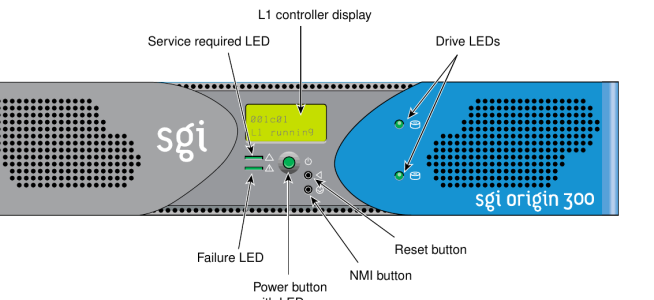 Front panel controls (SGI user's guide)
-
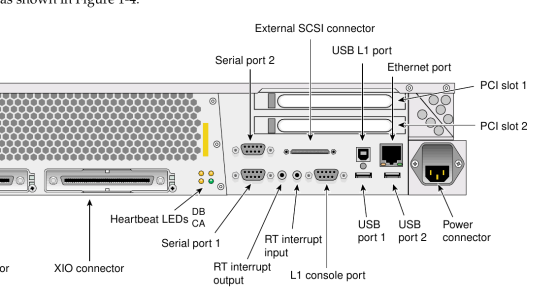 Rear panel (SGI user's guide)
-
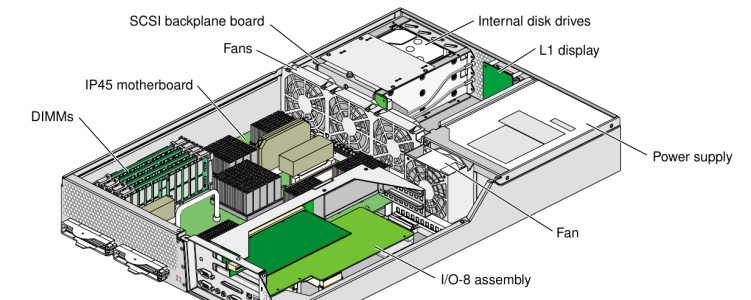 Internal components (SGI NUMAlink module user's guide)


Related pages
[edit | edit source]- SGI Origin 300 General Maintenance
- SGI Origin 300 Troubleshooting Guide
- SGI Origin 300 Capacitor Replacement Guide
- SGI Origin 300 Documentation
- SGI Origin 3000
- SGI Origin 350
References
[edit | edit source]- ↑ 1.0 1.1 1.2 1.3 Gerhard Lenerz, "Origin 300 / Onyx 300", sgistuff.net, sgistuff.net (retrieved 22 October 2026). Community hardware page: announcement, production and service dates, processor options, IRIX support.
- ↑ 2.00 2.01 2.02 2.03 2.04 2.05 2.06 2.07 2.08 2.09 2.10 2.11 2.12 2.13 2.14 2.15 2.16 2.17 2.18 Silicon Graphics, SGI Origin 300 User's Guide, 007-4365-002, April 2002, chapter 1, pp. 1-14 (File:SGI Origin 300 User's Guide (007-4365-002).pdf). Overview, Table 1-1 specifications, front and rear panels, IP45 motherboard, DIMMs, I/O-8, SCSI backplane, power supply, cooling, Table 1-2 features.
- ↑ 3.0 3.1 SGI, 007-4365-002, appendix A, p. 65, Table A-2. Power requirements.
- ↑ "SGI Origin 3000 and Onyx 3000", Wikipedia, en.wikipedia.org (retrieved 22 October 2026). Origin 300 as the entry-level variant of the Origin 3000 architecture.
- ↑ Silicon Graphics, SGI Origin 300 System with NUMAlink Module User's Guide, 007-4498-002, 2002, chapter 1 (File:SGI Origin 300 System with NUMAlink Module User's Guide (007-4498-002).pdf). Multi-module systems with a NUMAlink module.
- ↑ Gerhard Lenerz, "Origin 350 / Onyx 350", sgistuff.net, sgistuff.net (retrieved 22 October 2026). Origin 350 as successor, April 2003 announcement.
- ↑ 7.0 7.1 7.2 SGI, 007-4365-002, chapter 4, pp. 44-56. Lithium battery on the system I/O board, PCI card voltages, DIMM compatibility.
- ↑ 8.0 8.1 SGI, 007-4498-002, appendix C, pp. 177-220. L1 and L2 controller command sets.
- ↑ "How to Incorporate an Origin 300 In Homelab?", IRIX Network forum, posts by jander31, 6 May 2025, forums.irixnet.org/thread-4523.html. Owner's report of a failed fan.
- ↑ "Origin 300 is not starting", IRIX Network forum, posts by blacksmith, jan-jaap and weblacky, 31 March to 11 April 2022, forums.irixnet.org/thread-3466.html. Owner's report and community diagnosis.
- ↑ weblacky, "Dallas DS1780 IC Replacement Services", IRIX Network forum, 2 November 2021 and later posts, forums.irixnet.org/thread-3207.html. Replacement of failed DS1780 monitoring chips on Fuel boards.