

SGI Power Indigo²
 | |
| The POWER and Extreme badges on the teal front grille of a POWER Indigo² (Drinebold, CC BY-SA 4.0) | |
| Specifications | |
|---|---|
| Manufacturer | Silicon Graphics, Inc. (SGI) |
| Type | Desktop workstation |
| Released | 1994[1][2] |
| CPU | MIPS R8000 chipset at 75 MHz (integer unit and separate floating-point unit) on an R8000 CPU module, IP26 system board[3][4] |
| Memory | Twelve 72-pin SIMM sockets; SGI maximum 640 MB[5][6] |
| Storage | Two 3.5-inch bays and one 5.25-inch half-height bay, two Fast SCSI-2 channels[7] |
| Display | — |
| Sound | Integrated audio: stereo analogue line and serial digital (IEC958) in and out, 16-bit, up to 48 kHz[7] |
| Graphics | XL, XZ, Elan or Extreme; IMPACT not supported[8][9] |
| Expansion | Four slots: EISA, two of which can be GIO-64[7] |
| Power | Indigo² power supply, revision S or later; 100–120 V or 200–240 V AC[10][7] |
| Dimensions | 127 × 470 × 470 mm (5 × 18.5 × 18.5 in)[7] |
| Weight | 18 kg (40 lb)[7] |
| OS / Firmware | IRIX 6.0.1 or later (64-bit); IRIX 6.5 up to 6.5.22[11][8] |
The SGI Power Indigo² (written POWER Indigo2 by SGI) is the R8000 version of the teal SGI Indigo² desktop workstation. It keeps the Indigo² chassis, drive bays, power supply and pre-IMPACT graphics boards, but replaces the IP22 system board and R4000-series CPU module with the IP26 system board and an R8000 CPU module.[3][12][13] SGI aimed it at floating-point work: its 1994 product guide quotes 300 MFLOPS for the CPU and calls the POWER Indigo² Extreme the most powerful desktop workstation then available.[1] The same hardware without graphics was sold as the POWER CHALLENGE M server; see SGI Challenge M.[3][8]
Machines were built as POWER models or converted from an R4000-series Indigo² with SGI's upgrade kit, which replaced the system board, CPU module and power supply.[14] The case, drive tray, power supply, environment limits and most service procedures are those of the teal Indigo², and are covered on the SGI Indigo² pages; the POWER Indigo² guides deal with the parts the R8000 changes.
Identifying a POWER Indigo²
[edit | edit source]- A "POWER" badge on the front grille. SGI's upgrade kit included one to snap into the grille, and a label with the new model number to stick over part of the old label at the rear.[15] Badges and skins can be swapped between machines, so sgistuff.net treats colour and labels as a first indication only.[8]
- A teal case. SGI shipped R8000 machines with Newport or Express graphics in teal skins.[8][13]
- The hardware inventory. SGI's check after an upgrade is
hinv -vat the Command Monitor, which should report System: IP26, a 75 MHz R8000, 16 KB primary instruction and data caches and a 2 MB secondary cache.[16] One owner's machine reports a MIPS R8000 processor chip revision 2.2 and an R8010 floating-point chip revision 0.1.[4]
Hardware
[edit | edit source]
R8000 CPU module
[edit | edit source]The module carries the two-chip R8000 chipset: an integer unit (IU) and a separate floating-point unit (FPU), both under one heat sink and EMI shield. Around them are the cache controller (TCC), two tag RAMs, the data bus chips (TDB), the RAM and address buffers of the 2 MB global cache, and the clock buffers.[17] The primary caches are 16 KB for instructions and 16 KB for data, and the global cache is 2 MB and four-way set-associative.[3] An 80-bit, 75 MHz internal bus, the Tbus, links the integer unit, the floating-point unit and the cache controller.[18]
The module connects to the system board through a flex cable and sits on five standoffs. SGI's drawing shows the +3.3 V and +5 V supplies reaching the module through two of the standoffs.[12][17] SGI also warns that several capacitors on the back of the module help control its internal clocks, and that if any one of them is damaged the module will not work.[19]
IP26 system board
[edit | edit source]SGI describes the IP26 layout as largely unchanged from the IP22. The main change is a new memory controller that uses error-correcting code (ECC) and takes more memory.[12] Four of the module standoffs are 40 mm long and one is 18 mm; they are M3 standoffs held from underneath by hex nuts.[12] In an Indigo², the audio board moves across from the old IP22 board when the machine is converted.[14]
SGI's figures for the R8000 against the 200 MHz R4400 Indigo²:[7][5]
| Item | R4400 (IP22) | R8000 (IP26) |
|---|---|---|
| Clock | 200 MHz | 75 MHz |
| Primary cache (instruction/data) | 16 KB / 16 KB | 16 KB / 16 KB |
| Secondary cache | 1 MB | 2 MB, four-way set-associative |
| Maximum memory | 384 MB | 640 MB |
| Peak floating point | About 40 MFLOPS | 300 MFLOPS |
| Data path to memory | 64 bits at 50 MHz | 128 bits at 75 MHz |
| SPECint92 (preliminary) | 119 | 108 |
| SPECfp92 (preliminary) | 131 | 270 |
| LINPACK 1000×1000 DP (preliminary) | 57 | 230 |
The product guide marks its benchmark figures as preliminary. sgistuff.net gives 107 SPECint92 and 265 SPECfp92 for the R8000/75.[7][8]
Memory
[edit | edit source]The twelve SIMM sockets are in banks A, B and C, and every SIMM in a bank must be the same size.[6] The sockets take 72-pin fast-page-mode SIMMs with parity, 36 bits wide, at 60 or 70 ns.[9] With 4, 8, 16 and 32 MB SIMMs the maximum is 48, 96, 192 and 384 MB. SGI allows 64 MB SIMMs in only two of the three banks, with 32 MB or smaller in the third, which gives its maximum of 640 MB.[6]
The R8000 module sits over bank C and the last socket of bank B, so SIMMs there must be no taller than about 32 mm. SGI's 1994 upgrade instructions give 1.27 in and sockets S7 to S12; its 1995 note on 64 MB SIMMs gives 1.260 in and sockets S8 to S12.[6][20] The TechPubs Wiki says the IP26 can take 128 MB SIMMs if lower-profile SIMMs are used where the CPU carrier needs clearance, and that owners have reported working configurations of up to 896 MB; sgistuff.net gives 768 MB, with twelve 64 MB SIMMs. Both are above SGI's own limit.[9][8]
Graphics and options
[edit | edit source]sgistuff.net lists XL, XZ and Extreme graphics as supported on the R8000 models; one owner's machine has Elan graphics.[8][4] IMPACT graphics is not supported on the POWER Indigo². sgistuff.net adds that SGI had planned a driver and did not release one, and that there have since been reports of R8000 machines running IMPACT boards.[9][8] The 1994 product guide says the video and compression options were supported only on R4400 and R4600 systems, and SGI's upgrade instructions warned that some option boards might not yet be supported on the R8000.[7][11]
Power supply
[edit | edit source]The POWER Indigo² uses the Indigo² supply, revision S or later. Revision S supplies are mechanically the same as earlier ones but give a nominal 3.45 V on the 3.3 V rail, which SGI says the R8000 needs. The revision is marked on the side of the supply.[10][21] SGI says the POWER models use almost exactly the same power and give off almost exactly the same heat as the R4000-series Indigo², so their site requirements are unchanged.[22]
Software
[edit | edit source]The R8000 needs the 64-bit IRIX 6.0.1 or later, and the kernel runs in 64-bit mode.[11][5] sgistuff.net recommends IRIX 6.2 for R8000 machines, whatever the memory size, and says IRIX 6.5.22 was the last release to support any Indigo².[8] One owner runs IRIX 6.2 on a POWER Indigo² with a BlueSCSI device holding the installation CD images.[4]
Known faults
[edit | edit source]- Power supply. An owner whose POWER Indigo² would spin its fans and light the disk LED, but gave no chime or picture and ignored the power button, was told by weblacky that Indigo² supplies do not regulate without a load, so a supply that runs on the bench proves little, and that recapping it was the place to start.[23] See SGI Power Indigo² Troubleshooting Guide.
- A shorted tantalum capacitor, C57, on the audio board. The Indigo² owner who found his own C57 short also found a report of the same capacitor failing on an R8000 Indigo² that had not been used for months.[24]
- Handling damage to the R8000 module: SGI warns about static, about setting the module down roughly or scraping its underside, and about using an ohmmeter on it.[19] See SGI Power Indigo² General Maintenance.
The other faults reported on the teal Indigo², including the clock chip, the PROM password and supplies that trip after running for a while, are on SGI Indigo² Troubleshooting Guide. SGI's IP26 block diagram shows a real-time clock on the board without naming the part, so check the chip on your own board against the Indigo² pages before ordering a replacement.[25]
Documentation
[edit | edit source]- POWER Indigo2 and POWER CHALLENGE M Upgrade Instructions, 108-0130-001, 1994: File:SGI POWER Indigo2 and POWER CHALLENGE M Upgrade Instructions (108-0130-001).pdf
- 64 MB SIMM Upgrade for R8000 Indigo2 and POWER CHALLENGE M Systems, 108-0139-001, 1995: File:SGI 64 MB SIMM Upgrade for R8000 Indigo2 and POWER CHALLENGE M Systems (108-0139-001).pdf
- Indigo2 Product Guide, INDIGO2-TM-GD (09/94): File:SGI Indigo2 Product Guide (INDIGO2-TM-GD-09-94).pdf
- Indigo2 Workstation Owner's Guide, 007-9096-050, 1996, for the chassis and the parts shared with the teal Indigo². Its CPU module procedures cover the R4000, R4400 and R4600 modules only: File:SGI Indigo2 Workstation Owner's Guide (007-9096-050).pdf
More on the Indigo² manuals is on SGI Indigo² Documentation.
Gallery
[edit | edit source]-
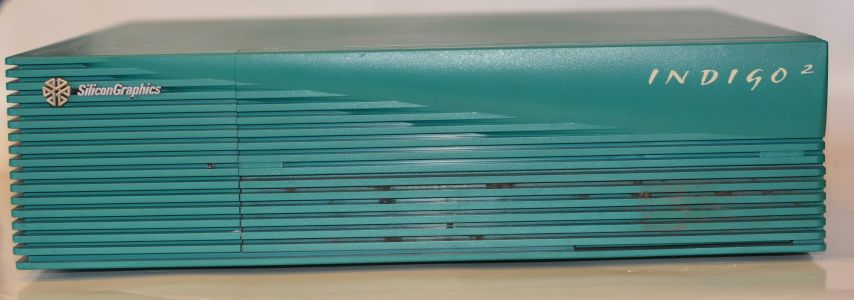 A teal Indigo². The POWER Indigo² uses the same case (Rules666, CC BY-SA 4.0)
-
 Removing the R8000 CPU module (SGI, 108-0139-001 Figure 1-8)


Related pages
[edit | edit source]- SGI Power Indigo² General Maintenance
- SGI Power Indigo² Troubleshooting Guide
- SGI Power Indigo² Capacitor Replacement Guide
- SGI Indigo²
- SGI Indigo² General Maintenance
- SGI Indigo² Troubleshooting Guide
- SGI Indigo² Capacitor Replacement Guide
- SGI Challenge M
References
[edit | edit source]- ↑ 1.0 1.1 Silicon Graphics, Indigo2 Product Guide, INDIGO2-TM-GD (09/94), 1994, PDF page 3 (File:SGI Indigo2 Product Guide (INDIGO2-TM-GD-09-94).pdf). POWER Indigo2 on the 75 MHz R8000; 300 MFLOPS CPU and 256 MFLOPS graphics for the POWER Indigo2 Extreme.
- ↑ "R8000", Wikipedia, revision of 28 December 2025, en.wikipedia.org/wiki/R8000. First 75 MHz R8000 introduced on 7 June 1994; used in the Power Indigo2.
- ↑ 3.0 3.1 3.2 3.3 Silicon Graphics, POWER Indigo2 and POWER CHALLENGE M Upgrade Instructions, 108-0130-001, 1994, section 1.1, p. 1-1 (File:SGI POWER Indigo2 and POWER CHALLENGE M Upgrade Instructions (108-0130-001).pdf). R8000 CPU module and IP26 board; 300 MFLOPS and 300 MIPS peak; 16 KB primary caches; 2 MB four-way global cache.
- ↑ 4.0 4.1 4.2 4.3 "New R8000 owner ... what next?", IRIX Network forums, thejpster, 20 November 2024, forums.irixnet.org.
hinvof a POWER Indigo²: R8000 revision 2.2, R8010 revision 0.1, GR3-Elan graphics; IRIX 6.2. - ↑ 5.0 5.1 5.2 SGI, 108-0130-001, Table 1-1, p. 1-6. Differences between IP22 and IP26 systems.
- ↑ 6.0 6.1 6.2 6.3 SGI, 108-0130-001, section 1.6 and Table 1-2, p. 1-7, and section 2.1.2, pp. 2-2 to 2-3. Maximum memory by SIMM size; SIMM height limit.
- ↑ 7.0 7.1 7.2 7.3 7.4 7.5 7.6 7.7 7.8 SGI, Indigo2 Product Guide, INDIGO2-TM-GD (09/94), PDF page 8, Technical Specifications. Caches, bays, slots, SCSI, preliminary SPEC92 and LINPACK figures, video and compression on R4400/R4600 only, dimensions, weight, power.
- ↑ 8.00 8.01 8.02 8.03 8.04 8.05 8.06 8.07 8.08 8.09 Gerhard Lenerz, "Silicon Graphics Indigo 2", sgistuff.net, sgistuff.net/hardware/systems/indigo2.html (retrieved 21 October 2026). IP26 board, graphics support, IMPACT on R8000, memory, skin colours, Power Challenge M, recommended IRIX releases, SPEC92 figures.
- ↑ 9.0 9.1 9.2 9.3 "Indigo 2", TechPubs Wiki, tech-pubs.net (retrieved 21 October 2026). IP26 as the POWER Indigo 2; SIMM type; SGI's 640 MB limit and owners' 896 MB; IMPACT not supported.
- ↑ 10.0 10.1 SGI, 108-0130-001, section 1.3, p. 1-2. Revision S power supply, nominal 3.45 V on the 3.3 V rail, required for the R8000.
- ↑ 11.0 11.1 11.2 SGI, 108-0130-001, sections 1.2 and 1.2.1, p. 1-2. 64-bit IRIX 6.0.1 or later; some option boards may not yet be supported.
- ↑ 12.0 12.1 12.2 12.3 SGI, 108-0130-001, section 1.4 and Figure 1-1, pp. 1-2 to 1-3. IP26 layout, ECC memory controller, five standoffs.
- ↑ 13.0 13.1 "SGI Indigo2", Wikipedia, en.wikipedia.org/wiki/SGI_Indigo2 (retrieved 21 October 2026). Power Indigo2 as a version of the teal Indigo2 with the R8000 chipset on the IP26 board.
- ↑ 14.0 14.1 SGI, 108-0130-001, section 2.1, p. 2-1. Upgrade steps, including moving the audio board to the IP26.
- ↑ SGI, 108-0130-001, section 2.7, p. 2-21. POWER badge and upgrade label.
- ↑ SGI, 108-0130-001, section 2.5, p. 2-19.
hinv -voutput after the upgrade. - ↑ 17.0 17.1 SGI, 108-0130-001, section 1.5 and Figure 1-2, pp. 1-3 to 1-4. R8000 CPU board component layout.
- ↑ SGI, 108-0130-001, section 1.5.2, pp. 1-4 to 1-6. Separate integer and floating-point units; the Tbus.
- ↑ 19.0 19.1 SGI, 108-0130-001, section 2.1.1, p. 2-2. Static precautions; no ohmmeter on the R8000 module; capacitors on the back of the module.
- ↑ Silicon Graphics, 64 MB SIMM Upgrade for R8000 Indigo2 and POWER CHALLENGE M Systems, 108-0139-001, 1995, pp. 4–5 (File:SGI 64 MB SIMM Upgrade for R8000 Indigo2 and POWER CHALLENGE M Systems (108-0139-001).pdf). 1.260 in height limit for sockets S8 to S12; 64 MB SIMMs in two banks only.
- ↑ SGI, 108-0130-001, section 2.2, pp. 2-3 to 2-4. Kit contents; power supply revision marked on its side.
- ↑ SGI, 108-0130-001, section 1.1.1, pp. 1-1 to 1-2. Power and heat almost exactly as the Indigo²; no new site requirements.
- ↑ "Indigo2 MIPS R8000 power issues", IRIX Network forums, Xav101 and weblacky, 21 February 2022, forums.irixnet.org.
- ↑ "My SGI Indigo2 audio board give off magic smoke", IRIX Network forums, khral, 8 October 2021, forums.irixnet.org. C57 short on the audio board; a report of the same failure on an R8000 Indigo².
- ↑ SGI, 108-0130-001, Figure 1-3, p. 1-5. POWER Indigo2 and POWER CHALLENGE M block diagram.